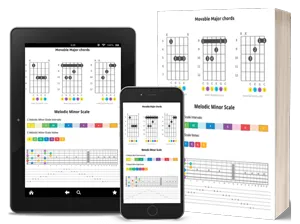
Guitar Chord Progressions
Master guitar chord progressions with audio examples, chord diagrams, and an interactive jam tracks tool
This guide covers everything you need to know about guitar chord progressions: what they are, how the Nashville Number System works, and a collection of the most common progressions across rock, pop, blues, jazz, folk, and more, each with audio examples and chord diagrams.
You'll also find an interactive chord progression generator to build and hear your own sequences, plus tips on borrowed chords, modulation, and secondary dominants to make your songs stand out.
Chord Progression Generator - Interactive Tool
The Chord Progression Generator With Guitar Fretboard is a free, browser-based tool that lets you build custom chord progressions of up to 24 chords, hear them played back with realistic strumming, and see every chord tone on the fretboard in real time. It works on any device (Windows, Mac, Linux or mobile) with no installation or sign-up required.
Key features:
- Time signatures and tempo: choose from 3/4, 4/4, 5/4, and 7/8, each with its own strum pattern and drum groove. Adjust BPM from 30 to 300.
- Wide chord library: from basic major, minor, diminished, and suspended voicings to extended 7th, 9th, 11th, and 13th chords.
- Preset progressions: start from classics like I-V-vi-IV (pop), ii-V-I (jazz), or I7-IV7-V7 (blues) and customize from there.
- Visual fretboard: during playback, the current chord tones are highlighted with filled markers while the next chord is previewed with half-transparent outlines, helping you practice improvisation and voice leading.
- Note names or scale degrees: switch display modes to suit your learning style.
- Built-in microphone: real-time note detection so you can play along and check your pitch.
- Multiple tunings: standard, Drop D, Open G, and more, plus bass guitar layouts and a left-handed fretboard option.
- Save and load: store your complete progressions (chords, BPM, time signature, tuning, and drum settings) directly in the browser.
What Is A Chord Progression
Quick answer: A guitar chord progression is a sequence of chords played in a chosen key that creates the harmonic foundation of a song. Most popular music is built on a small set of recurring patterns: I-IV-V (rock and pop), I-V-vi-IV (the Axis of Awesome pop progression), ii-V-I (jazz turnaround) and the 12-bar blues. Learn just these four and you can play thousands of songs.
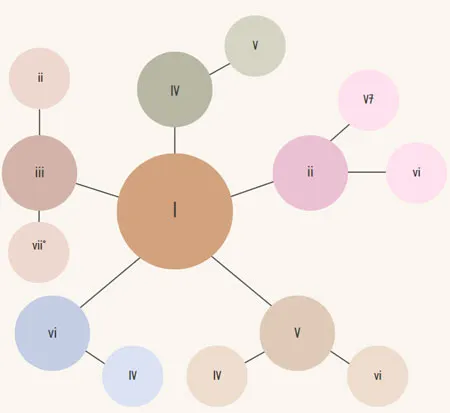 On your music journey so far you have moved from pitches to scales, to
intervals, to
making chords, and now we come to the next step in your
guitar practice routine:
chord progressions.
On your music journey so far you have moved from pitches to scales, to
intervals, to
making chords, and now we come to the next step in your
guitar practice routine:
chord progressions.
There are certain sequences of chords that just happen to sound very pleasing to our ears.
Most popular music across many genres relies on specific chord progressions to set the mood of a song.
Chord progressions are like drum beats and bass lines: they cannot be copyrighted and are used by everyone. It is the melody, the specific note and rhythmic choices, that belongs to a particular musician.
The better you get to know the popular progressions, the easier it will be to recognize them in every song you listen to.
Drill Down: this tutorial covers some of the progressions listed in the ebook: 52 Chord Progressions - Learn How To Connect Chords and Create Great Songs.
Some progressions are used so often that by learning just one pattern you can play hundreds of songs.
We will list quite a few below, and you should aim to memorize each one.
Many guitarists focus on learning scales, which is great, but you shouldn't neglect chord progressions. First, let's learn how to read chord progression charts.
So let's begin!
Some Words About Strumming Chords
When starting out with chord progressions on guitar, don't stress too much about perfecting your strumming patterns right away.
Your strumming style will naturally evolve as you practice. For now, focus on maintaining a steady rhythm.
It's okay to strum open strings between chord changes, this can even add a unique touch to your playing.
Your primary goal should be mastering the chord fingerings and achieving smooth transitions between chords.
Let's try playing a simple song with just one chord: A major. You should already know the fingering for this chord, as shown above on this page.
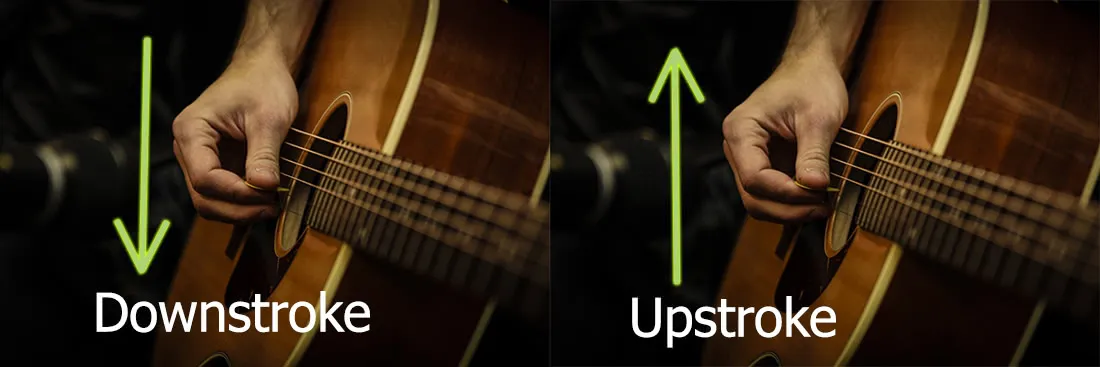
The song is in 4/4 time, which means the count is 1-2-3-4, 1-2-3-4, and so on.
To develop proper strumming technique from the start, try this:
- On 1, hit the open A string and let it ring.
- On 2, strum down from the A string.
- On 3, hit the E string and let it ring.
- On 4, strum down from the A string.
- Repeat for every measure.
This technique creates a nice bass line and will significantly improve your sound while helping you develop a solid rhythmic strumming style from the beginning.
Learning to sing along with the song is all about timing. Listen to the song a few times, and you'll get the hang of it.
It's easier than trying to explain time signatures and timing. You'll know when you've got it right. Just keep listening.
Drill Down: Learn 10 strumming patterns to practice daily for great improvement.
A Useful Tool for Chord Sequences: the Nashville Number System
There are many charts available for quick reference on each major and minor key. Some charts don't use Roman numerals at all, relying instead on the Nashville Number System.
This system was invented in the late 1950s and was frequently used by Elvis Presley's backup singers, The Jordanaires.
The idea is simple: you replace the Roman numerals with standard Arabic numbers. The symbols also change to indicate whether a chord is major, minor, or diminished.
The Nashville number system is widely used in real-life musical situations.
For example, when a musician tells the band it's a 1-4-5 song in the key of C, everyone knows the chords are C-F-G.
| Key | 1 | 2 | 3 | 4 | 5 | 6 | 7 |
|---|---|---|---|---|---|---|---|
| C | C | Dm | Em | F | G | Am | Bdim |
If the band leader says it's a 1-5-6-4 in the key of G, we know to play G-D-Em-C.
| Key | 1 | 2 | 3 | 4 | 5 | 6 | 7 |
|---|---|---|---|---|---|---|---|
| G | G | Am | Bm | C | D | Em | F#dim |
Now, certain chords happen to sound great when played in specific orders. Just as the note C and its fifth G sound good played one after another, so do the chords C major and G major.
Many folk and simple pop tunes use nothing more than the first and fifth chords of the key. And just as the root, fourth, and fifth are common intervals, we get the very popular chord progression I-IV-V.
In the key of C that gives us C-F-G.
Playing those three simple chords opens up thousands of songs in pop, rock, punk, and gospel , a huge amount of music is built on the 1-4-5!
The blues then extends the 1-4-5 to 1-4-1-5-1 or something similar, often adding sevenths.
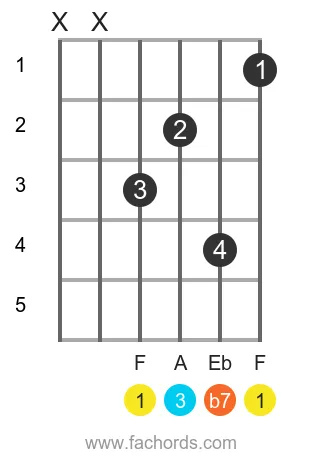
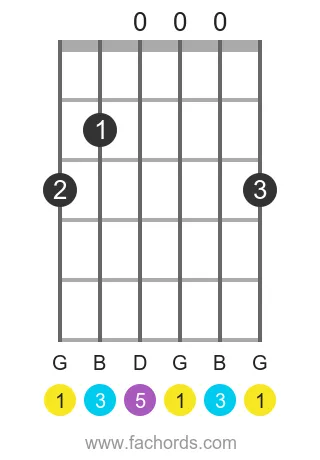
Pick up your guitar and play C F7 G C:
C Major
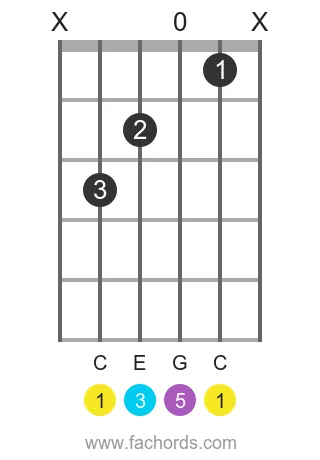
F7
G Major
C Major
Repeat the C and F7 a few times back and forth, then end with a G7 resolving to C.
If we reverse the 1-4-5 to 5-4-1, we get many popular classic rock tunes. Typically, the progression finishes on the tonic, unless you are modulating or moving to another key.
Just as three-chord progressions follow the rules of scales and intervals, so do four-chord progressions.
After the I-IV-V progression, which chord would also sound pleasant to add? The answer is the vi, the natural minor.
In the key of C, that would be Am. Once we add Am to the other three chords, we unlock a variety of popular chord progressions.
With I-V-vi-IV we get the chord progression behind countless hit songs.
Change it to I-vi-IV-V and you can play nearly every 50's doo wop tune. Start with the minor, vi-IV-I-V, and you have the backbone of nearly every sensitive or sad tune ever written.
Pick any key you like and try each of these four chord progressions. You may already recognize some songs as you play through them.
Common Chord Progressions
Below is a list of the most widely used chord progressions in popular music. There are more out there, but in reality, our ears keep coming back to the same harmonic patterns over and over.
One of the best bands to study chord progressions with is The Beatles. They mastered the basic progressions, then used their creativity to modulate, borrow, and substitute chords, crafting truly incredible songs.
They are a great example of how you can take the basics that everyone loves, tweak them with solid music theory, and create something extraordinary.
While there is certainly experimental music that tries to break all the rules, in general you want to work with what audiences respond to.
The 1-5-6-4 is arguably the best-sounding progression in modern Western music, so you can't go wrong using it as the backbone of your song.
Below is a list of the most popular chord progressions, give each one a try in various keys! (Use this chart to make sure you have the right chords.)
| Progression | Numerals | In key of C | Genre / mood |
|---|---|---|---|
| Basic Rock n' Roll / Pop | I IV V | C F G | Rock, pop, blues, gospel |
| Classic Rock | V IV I | G F C | Classic rock, surf, rockabilly |
| Axis of Awesome | I V vi IV | C G Am F | Pop hits, uplifting |
| Doo Wop | I vi IV V | C Am F G | 50s doo wop, ballads |
| Folk Songs | I V | C G | Folk, simple sing-alongs |
| 12-Bar Blues | I IV I V I | C F C G C | Blues, rock 'n' roll |
| Rock Ballad | I iii IV V | C Em F G | Epic rock, power ballads |
| La Folia (v1) | i V7 i VII | Am E7 Am G | Medieval, fantasy |
| La Folia (v2) | III VII i V7 i | C G Am E7 Am | Medieval, baroque |
| Flamenco / Andalusian | i VII VI V | Am G F E | Spanish, classical guitar |
| Pop Rock Lydian | I II IV I | C D F C | Pop rock, Beatles-style |
| Sensitive Progression | vi IV I V | Am F C G | Pop rock, indie, sad |
| Jazz Standard | I vi ii V | C Am Dm G | Jazz standards, Christmas |
| Jazz Stomp | I VI7 ii IV VII I VI7 ii7 V7 ii V | C A7 Dm F B C A7 Dm7 G7 Dm G | Swing era jazz |
| Jazz and Pop Rock 2-5-1 | ii V I | Dm G C | Jazz turnaround, soft rock |
| Ascending Augmented | I I+ I6 I7 | C Caug C6 C7 | Showtunes, soul ballads |
| Ragtime | I VI7 II7 V7 | C A7 D7 G7 | Ragtime, early jazz |
Remember, these are only the standard foundations. Chords are often tweaked with sevenths (especially in blues and jazz), extended chords, or suspended chords to make a song more distinctive.
Don't be afraid to experiment and build on these basics.
You can find more chord progressions in the ebook 52 Chord Progressions | Learn How To Connect Chords and Create Great Songs.
Basic Rock n' Roll or Pop
I IV V (1 4 5 chord progression) (C F G)
The 1-4-5 is the most common progression of all. Knowing this simple chord sequence lets you jam with any band, as long as you know the key.
Even though it seems simple, there are countless ways to tweak it.
Many rock and blues songs add a seventh to the fifth chord, giving us the classic rock 'n' roll progression E-A-B7. You can even add sevenths across the board. For example, Prince's "Kiss" uses this 1-4-5 in the key of A: A-D-E.
He makes it funky by playing A7-D7-Esus4.
The sus4 chord replaces the third with the fourth degree, and the Esus4 contains the note A, which ties it neatly back to the key and gives it that funky sound.
There are a ton of substitutions that can make a three-chord progression sound unique to each genre.
Classic Rock
V IV I (G F C)
Just as 1-4-5 dominates rock, the reverse, 5-4-1, was especially common in many classic pop songs.
This progression has too many examples to list. Surf songs, sock hops, rockabilly, 60's rock , anything you want to play with a driving groove.
You can use variations like E-D, D-A-E, or even E-A-D-A.
Axis of Awesome
I V vi IV (C G Am F)
This progression is named after the comedy band that famously performed dozens of hit songs all built on this same sequence. Virtually every artist has used this 4-chord sequence , do a quick search and you'll be amazed at how many songs follow this pattern!
Doo Wop
I vi IV V (C Am F G)
Nearly every 50's doo wop tune uses this exact sequence. Once you can play one song from that era, you can play them all, from "Monster Mash" to "Earth Angel" and, of course, "Beauty School Dropout" from Grease.
Folk Songs
I V (C G)
Folk tunes are very simple, often nothing more than the root and fifth repeated over and over.
These songs can sometimes be more fun to listen to than to play, as the repetition can get tedious. A seventh is often added to the V chord for extra color.
12-Bar Blues
I IV I V I (C F C G C)
In the key of E, a blues tune would go E-A-E-B-E.
Most blues songs use seventh chords, so you'll want to mix those in.
Blues progressions can vary, but they always revolve around the first, fourth, and fifth chords.
As shown above, you can repeat the first and fourth for a few measures before building tension with a V7, then resolving back to I.
The number 7 beside a chord denotes a dominant chord , a major chord with a minor seventh interval added.
Rock Ballad
I iii IV V (C Em F G)
Virtually any epic or powerful rock ballad you've ever heard follows this progression. David Bowie was a big fan of it.
Without even looking up the chords to Ziggy Stardust, we already know how the verse goes: in the key of C it's C-Em-F-G.
La Folia
This is a minor progression with two common versions:
i-V7-i-VII (Am E7 Am G)
III-VII-i-V7-i (C G Am E7 Am)
La Folia is one of the oldest progressions in Western music. Try it in the key of A minor.
You'll notice it has a distinctly medieval, almost fantasy-like quality. If you were playing music in a castle for royalty, this would be the progression to reach for.
Even after hundreds of years, our ears still love this sound.
Flamenco or Andalusian
i-VII-VI-V (Am G F E)
If you want a Spanish flamenco flavor on classical guitar, give this one a try. In the key of A minor the chords are Am-G-F-E. The Ventures' "Walk Don't Run" follows this progression.
Pop Rock Lydian
I II IV I (C D F C)
You'll recognize this from songs like "Eight Days a Week." Note that the second chord here is major, not minor. In the key of C, that gives us C-D-F-C.
For a long time, the II major chord was traditionally followed by the V and then the tonic. The Beatles popularized moving to the IV instead of the V, creating a completely different resolution.
Sensitive Progression
vi IV I V (Am F C G)
This progression is often called the sensitive female progression, as many pop-rock and indie women artists have built songs around it.
Of course, it's not limited to any one style. Jewel, Avril Lavigne, Joan Osborne, and many more use it. It also powers Boston's "More Than a Feeling" and Iggy Pop's "The Passenger."
Jazz Standard Progressions
I vi ii V (C Am Dm G)
This progression and its variations are perfect for tunes like "Heart and Soul," "Have Yourself a Merry Little Christmas," and Nilsson's "Without You."
In those songs, of course, sevenths are added to each chord.
Jazz Stomp
I VI7 ii IV VII I VI7 ii7 V7 ii V (C A7 Dm F B C A7 Dm7 G7 Dm G)
This longer progression was a staple of the swing era.
Jazz and Pop Rock 2-5-1
ii V I (Dm G C)
You'll hear this in songs like "I'd Really Love to See You Tonight" and "It Never Rains in Southern California."
Also known as the 2-5-1 turnaround, it is a staple of both jazz and rock, another progression with countless examples.
You might find this ii-V-I play-along backing track useful for practice.
Ascending Augmented
I I+ I6 I7 (C Caug C6 C7)
An example of this progression is C-Caug-C6-C7. You'll recognize it in songs like "You've Got to Accentuate the Positive" and Whitney Houston's "Greatest Love of All."
The "+" symbol indicates that the fifth is raised by a half step, creating an augmented chord.
C6 refers to a C Sixth chord, a major chord with an added major sixth.
Ragtime Progression
I VI7 II7 V7 (C A7 D7 G7)
If you're looking for something truly distinctive, try some ragtime chord patterns, you never know what inspiration they might spark.
Read Also: Uncommon Chord Progressions
We've also interviewed 11 guitar experts and asked them about their favorite unusual chord progressions.
The result is a great list of unconventional chord progressions you can use in your songs. Check it out!
Key takeaways
- 1-4-5 and 1-5-6-4 are the two most-used progressions in Western popular music.
- The Nashville Number System lets you transpose any progression to any key on the fly.
- This page covers 17 popular patterns (rock, pop, blues, jazz, folk, doo wop, flamenco) each with audio and chord diagrams.
- The embedded Chord Progression Generator plays your progressions on a visual fretboard with strumming, drums and multiple tunings.
- Expand your songs with borrowed chords, modulation and secondary dominants.
- Works in standard tuning, Drop D, Open G, bass guitar and a left-handed fretboard.
How To Expand Chord Progressions
Of course, not every song follows a progression exactly as written. Chords can be substituted with 7ths, 9ths, 13ths, min7, maj7, sus2, and sus4 voicings, among many others (see this list of different chord structures for reference).
When playing a common chord progression, it's the small changes that can make your song sound unique and stand out.
Along with substituting chords, you can change keys , subtly or dramatically, depending on the sound you're after.
Use Borrowed Chords
A borrowed chord is a chord taken from a parallel key without changing the tonic or overall key of the song.
Borrowed chords often involve a flattened 3rd and flattened 7th (b3 and b7).
In the key of C, for example, the most common borrowed chords are Eb and Bb, which stay close to the natural 3rd and 7th degrees. This technique is especially popular in rock.
Alternatively, you can skip borrowing altogether and simply change the key of your song at some point, this is known as modulation.
Modulate to Other Keys
There are several ways to modulate. You can move chromatically, such as shifting from the key of C to C#.
There's also common-tone modulation: both the key of C and G contain the note D, so you can use that shared note as a pivot when moving from C to G.
Parallel modulation means moving from C major to C minor, keeping the same tonal center but changing the mode.
Finally, there's phrase (or abrupt) modulation, where you simply change the key after a phrase ends. Generally, it's best to keep to a somewhat related key when doing this.
You can even combine different types of modulation in what's called a chain modulation.
Add Secondary Dominants
Another way to enrich your chord progressions is by adding secondary dominants.
The first chord of the key is the tonic, and the fifth is called the dominant. To find the secondary dominant, count up a fifth from the dominant or use the Circle of Fifths.
- G is the dominant of the key of C
- D is the dominant of the key of G
Therefore, D is the secondary dominant of the key of C. Secondary dominants are often played as seventh chords or higher extensions (9ths, 11ths, 13ths).
The reason they're typically sevenths is that the purpose of the secondary dominant is to create tension that resolves into the next chord.
For example, instead of going straight from C to G, we can insert the secondary dominant: C-D7-G. Secondary dominants open up many new possibilities for your progressions.
You Can Even Use Extended Dominants
An extended dominant takes this concept further by resolving down a fifth to another dominant seventh chord. In notation, it's written as V/V/V.
The extended dominant of C is A7.
There's even a quaternary dominant (V/V/V/V), in the key of C, that would be E7.
You probably won't use borrowed chords that far removed from the key very often, but it's a great exercise for testing your music theory knowledge.
Another interesting approach is modal chord progression, which builds progressions from the chords of each mode.
Guitar Chord Progressions FAQ
Quick answers to the most common questions about guitar chord progressions, the patterns they follow and how to write your own.
What is a guitar chord progression?
A guitar chord progression is a sequence of chords played in a chosen key that creates the harmonic backbone of a song. Most popular music is built on a handful of recurring patterns such as I-IV-V, I-V-vi-IV and ii-V-I. Progressions cannot be copyrighted, so the same sequence can power thousands of different songs.
What are the most common guitar chord progressions?
The most common guitar chord progressions are 1-4-5 (rock and pop), 1-5-6-4 (the Axis of Awesome pop progression), 1-6-4-5 (doo wop), 6-4-1-5 (sensitive or sad progression), ii-V-I (jazz turnaround) and the 12-bar blues. Together these patterns appear in thousands of well-known songs.
What does I-V-vi-IV mean on guitar?
I-V-vi-IV is the Roman numeral name for a four-chord progression built on the 1st, 5th, 6th and 4th degrees of a major key. In the key of C major it becomes C-G-Am-F. In the key of G it becomes G-D-Em-C. It is sometimes called the Axis of Awesome progression because so many pop hits use it.
What is the Nashville Number System?
The Nashville Number System replaces Roman numerals with Arabic numbers so chord progressions can be transposed to any key on the fly. A 1-4-5 in C means C-F-G; the same 1-4-5 in G means G-C-D. Symbols next to the numbers indicate whether each chord is major, minor or diminished.
How do I write my own chord progression on guitar?
Pick a key, list its seven diatonic chords, then start from a proven pattern like I-V-vi-IV or ii-V-I. Swap chord qualities with 7ths, 9ths, sus2 or sus4 voicings, borrow chords from the parallel key, and insert secondary dominants to add tension. The interactive Chord Progression Generator on this page lets you build and hear progressions instantly.
What is the difference between I-V-vi-IV and vi-IV-I-V?
Both progressions contain the same four chords but start in different places. I-V-vi-IV starts on the tonic and feels bright and uplifting. vi-IV-I-V starts on the relative minor and gives a sadder, more reflective mood. It is often called the sensitive female progression for that reason.
Can I use the chord progression generator on mobile?
Yes. The Chord Progression Generator is browser-based and runs on Windows, Mac, Linux, iOS and Android without installation or sign-up. It supports standard tuning, Drop D, Open G, bass guitar layouts and a left-handed fretboard option.
Do I need to know music theory to use chord progressions?
No. You can start by copying a popular pattern like 1-4-5 or 1-5-6-4 and playing it in any key. Music theory only becomes useful once you want to substitute chords, modulate to other keys, borrow chords from a parallel mode or add secondary dominants for extra color.
Chord Progressions - More Resources and Conclusions
Practice each of these progressions and use your ears to identify which songs they remind you of.
When writing your own music, don't be afraid to substitute chords and experiment.
Once you start modulating, altering chord qualities, and changing keys, you'll be amazed at the music you can create.
Now that you understand the fundamentals of chord progressions on guitar, you have the foundation to learn and write countless songs.
There are of course more progressions beyond the ones listed here, but most are simply variations or slight modifications of the examples above.
To stay updated on new tutorials, subscribe to the free newsletter (you'll also get access to the download area with lots of free printable resources).
Below you'll find more resources to help you deepen your chord progression knowledge:

Created by
Giancarlo is a musician (teaching guitar since 2000), software engineer, AI consultant and published researcher