Sing Every Note You Play: A Guitarist's Complete Guide to the Syllable-Per-Interval Method
Introduction
Every guitarist eventually hits the same wall: your fingers know more shapes than your ear can hear. You can run scales and arpeggios cleanly, yet your solos come out sounding like memorized patterns rather than music, because you're playing what your hands remember, not what you actually hear.
The core idea: if you can sing it, you can hear it, and if you can hear it, you can play it.
The syllable-per-interval method closes that gap. By giving every note a single singable name tied to its function within the key, and singing that syllable every time you play it, you train your ear to recognize, and eventually pre-hear, every degree of the scale. This is the foundation skill behind ear training, improvisation, and playing guitar by ear.
In short
Assign one singable syllable to each of the 12 chromatic scale degrees (movable-do solfège: Do, Ra/Di, Re, Me/Ri, Mi, Fa, Fi/Se, Sol, Le/Si, La, Te/Li, Ti) and sing that syllable every time you play its note.
This links each interval's function to its sound, which is the fastest documented route to being able to audiate (hear internally) before you play, because it trains relative pitch against a key center rather than isolated intervals.
Movable-do chromatic solfège is the best primary system for a guitarist; scale-degree numbers and Indian sargam are viable alternatives, but solfège wins because every degree, including chromatic ones, is a single, flowing, open-vowel syllable that you can sing at speed.
What you'll gain from this method
- Audiate before you play, hear a line in your head and find it on the fretboard on the first try, instead of hunting for it.
- Improvise melodically, build solos that "sound like the song" from chord tones you can actually hear, not scale shapes you memorized.
- Recognize any interval in context, train functional relative pitch against a key center, which is far more useful for real playing than naming isolated intervals.
- Transcribe faster, learn licks and melodies by ear because you can sing them before you ever touch the guitar.
- Tighten your rhythm and phrasing, singing while you play naturally locks your timing to the pulse.
- See measurable progress, diatonic fluency in a few weeks and chromatic fluency in roughly 3–6 months of short daily practice.
What you'll find in this guide
- Why it works, the science of audiation, functional hearing, and the fingers-ear loop, with the research that backs it.
- The three syllable systems compared, movable-do solfège, scale-degree numbers, and Indian sargam, and why solfège wins for guitarists.
- The complete chromatic syllable chart, all 12 degrees ascending and descending, with pronunciations and enharmonic pairs.
- Worked examples for scales, major, Dorian, natural minor, and both pentatonics, each shown as an interval ladder and a one-string fretboard map.
- Worked examples for arpeggios, major, minor, m7, dominant 7, maj7, m7♭5, dim7, and the 9-11-13 extensions, all sung in syllables.
- Guitar-specific fretboard tactics, single-string practice, drones, and handling a limited vocal range with octave displacement.
- A progressive four-phase practice plan, from finding the tonic to full improvisation, with clear benchmarks that tell you when to advance.
- Common pitfalls, recommendations, and honest caveats, so you spend your practice time on the things that actually transfer to the fretboard.
Key Findings
The concept is "audiation," and it is teachable. Edwin Gordon coined the term for hearing and comprehending music in the mind when no sound is physically present.
Gordon's Music Learning Theory explicitly instructs teachers to "have students sing everything before they play" and to "remind students to audiate what they are going to perform before they perform it." Your guitar is only an amplifier for the music you can already hear.
Singing what you play exposes and closes the gap between your fingers and your ear. Jazz educators are near-unanimous: if you can't sing your line, you're not really hearing it, you're relying on muscle memory and patterns.
Hal Galper's masterclass "The Illusion of an Instrument" makes the point that "the real instrument is the one between your ears. That piece of brass, wood, or ivory at the tips of your fingers is simply its amplifier." Multiple jazz-guitar forum veterans report that singing while playing "almost instantly improves your rhythm and phrasing."
A key-center (functional) approach beats interval-only training for improvisers. Bruce Arnold's widely used "Ear Training: One Note" method, the required text at both New York University and Princeton University, where Arnold heads the guitar departments, is built on hearing each of the 12 notes in relation to a tonic, not as isolated interval distances, because interval-counting is too slow to use in real time.
The system is universal. Movable-do solfège (Kodály, Berklee), scale-degree numbers (common among jazz players), and Indian sargam (Sa Re Ga Ma Pa Dha Ni) are all movable, tonic-anchored systems doing the same job.
Sargam is traditionally practiced against a drone, emphasizing intervals over scale, a powerful technique you should borrow regardless of which syllable system you choose.
Guitar-specific tactics make this practical. Single-string work turns the fretboard into a linear "piano" so pitch maps to distance; octave displacement solves the limited-vocal-range problem; drones and call-and-response build the reflex; and singing scales and arpeggios in syllables cements the fretboard-to-ear link.
Details
Why It Works: Audiation, Function, and the Fingers-Ear Loop
The whole method rests on one idea: you can only reliably play what you can hear internally. Edwin E. Gordon named this internal hearing audiation, defined in his Roots of Music Learning Theory and Audiation (p. 10) as "the ability to hear and give meaning to music when sound is not physically present or may never have been physically present."
Audiation is to music what thinking is to language. Gordon's Music Learning Theory lays out a sequence, listening, then performance, then audiation/improvisation, then reading, then writing, in which singing precedes and prepares instrumental performance.
Attaching a syllable to each note is the accelerator. Gordon's "verbal association" stage gives contextual meaning to what you're audiating through tonal syllables (solfège), so that "Me" is not just a pitch but the sound and feeling of a lowered third over the tonic.
As Bruce Arnold argues, the traditional interval method teaches you to hear the distance between two notes "with no regard to a key center," which is too slow to use "in the moment." His "One Note" method instead trains you to instantly recognize the sound of all 12 notes within a key center, and solfège syllables are the vocabulary for exactly that.
There is research support. In a frequently cited study, Christopher Azzara (1993, Journal of Research in Music Education 41(4), pp. 328–342) took 66 fifth-grade instrumental students, randomly assigned them to two groups both using a "sound-before-sight" curriculum, and gave the treatment group 27 weeks of additional audiation-based improvisation work.
His finding, verbatim: "Students who received instruction that included emphasis on improvisation were found to perform at significantly higher achievement levels than students who received instruction without such emphasis."
Azzara concluded (in his 1999 Music Educators Journal article "An Aural Approach to Improvisation," p. 339) that "improvisation ability appears to transfer to a student's clearer comprehension of the tonal, rhythmic, and expressive elements of music in an instrumental performance from notation." Freely available sources confirm a significant treatment advantage on composite performance scores plus a significant music-aptitude effect, but do not publish the exact p-values or effect sizes, which sit behind the journal paywall.
Everyday Musicality
The practical payoff, reported over and over by jazz educators, is a solo that "sounds like the song" rather than like scales dropped onto chord changes.
When you're forced to sing an improvised line instead of fingering it, "pushing down a key or valve will not automatically guarantee a correct note", you have to actually hear it. That is the entire point.
The Syllable Systems Compared
- Movable-do chromatic solfège (recommended primary). Do is always the tonic, wherever that is. Chromatic notes follow a consistent vowel rule: raised syllables take an "ee" vowel ending (Di, Ri, Fi, Si, Li), lowered syllables take an "ay/eh" vowel (Ra, Me, Se, Le, Te). Every syllable is one flowing, open-mouthed sound, which is exactly why it beats numbers for singing at speed. As one Berklee-trained forum contributor put it, singing "Smoke on the Water" as numbers forces multisyllabic mouthfuls ("one, flat-three, four…") that "limit your speed, distort the rhythm and kill the flow," whereas "do, me, fa, do, me, se, fa" simply flows.
- Scale-degree numbers (strong alternative, common in jazz). Many jazz and pop players sing 1‑2‑3‑4‑5‑6‑7 with "flat/sharp" for chromatics. The advantage: numbers directly encode chord/interval relationships and connect instantly to chord symbols and the Nashville Number System. The drawback, noted in the sight-singing literature: numbers aren't all singable, "seven" has two syllables, and chromatic alterations force clumsy prefixes. Good compromise: think numbers for theory, sing solfège for sound.
- Indian sargam (Sa Re Ga Ma Pa Dha Ni). A movable system where Sa is the immutable tonic (like Do) and Pa (the fifth) is the other fixed anchor ("achal swaras"); the other five swaras have komal (flat) and one tivra (sharp) variants, giving the full 12. Sargam's greatest lesson for Western players is how it's practiced: against a drone, with emphasis on intervals rather than running scales. W. A. Mathieu's "Harmonic Experience" is a Western ear-training book built entirely on singing sargam-style over a just-intonation drone.
Fixed-do vs. movable-do: Fixed-do (Do always = C) is standard in many European/Latin conservatories and is essentially absolute-pitch note-naming; it is poor for the "hear-the-function" goal because a lowered third in one key and a natural third in another can share a syllable. For a guitarist learning to audiate function and improvise, movable-do is unambiguously the right choice.
Which one is which? This is the single most common mix-up in ear training, and the trick is hidden in the names. In movable-do the do moves to sit on the tonic of whatever key you are in, so a melody keeps the exact same syllables in every key. In fixed-do the do is fixed on C forever, so C is always do, D is always re, and the syllables are effectively just the Italian note names (do = C, re = D, mi = E, and so on).
A concrete example makes the difference obvious. Take the opening of Ode to Joy in D major (F♯ F♯ G A A G F♯ E D D E F♯ F♯ E E). In movable-do you sing mi mi fa sol sol fa mi re do do re mi mi re re, here do = D, the tonic, and you would sing those very same syllables if you transposed the tune to any other key. In fixed-do you would sing fi fi sol la la sol fi mi re re mi fi fi mi mi, because do stays glued to C. Note that the 12 chromatic syllables themselves are identical in both systems; the only thing that changes is what do is anchored to. That is exactly why movable-do is the better tool here: it trains you to hear each note by its function within the key, do–sol and fa–do are both perfect fifths, yet they feel completely different in real music, and movable-do captures that difference where fixed-do erases it.
The Chromatic Syllable Chart (Ascending and Descending)
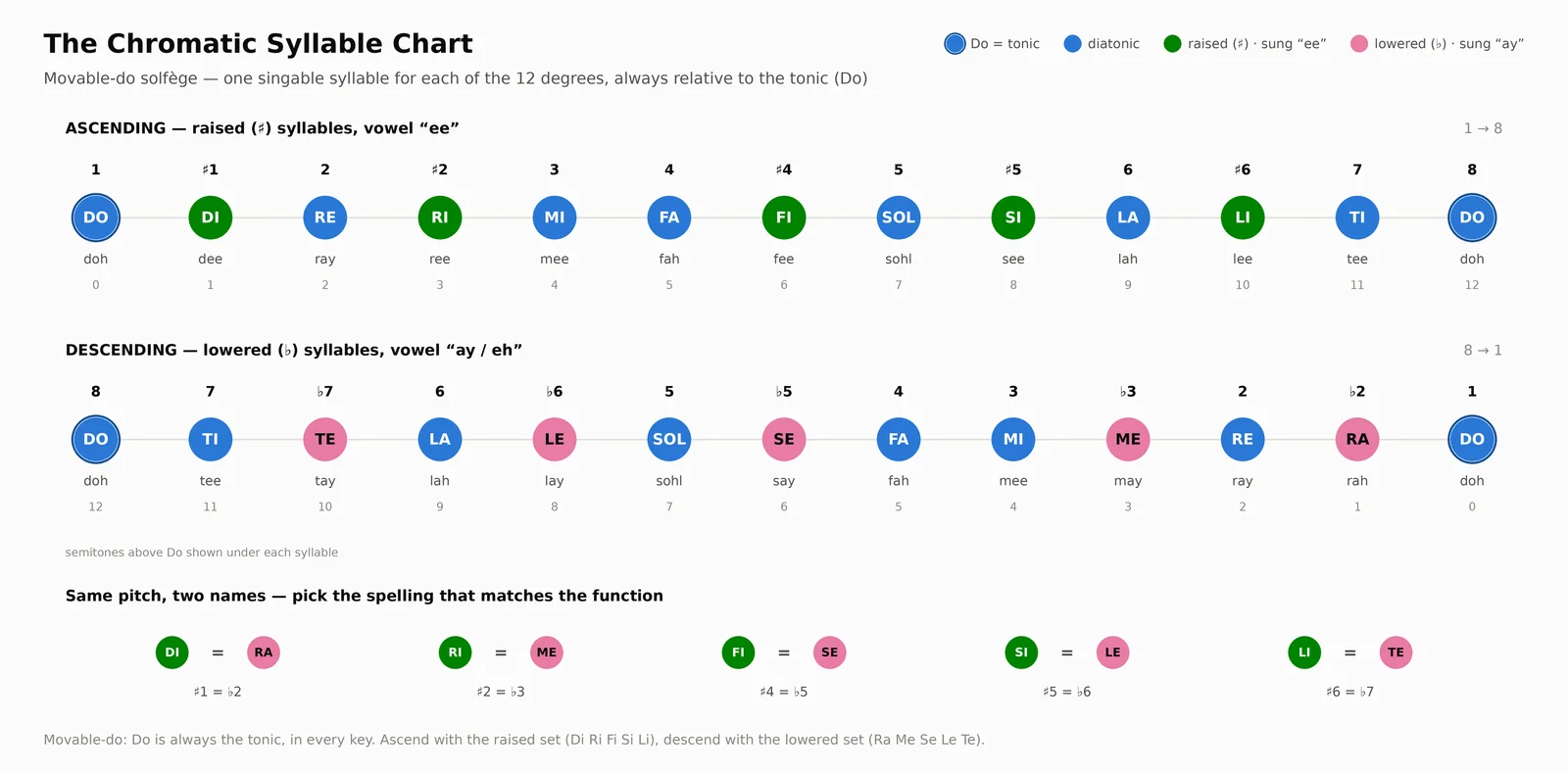
The Chromatic Syllable Chart, Ascending and Descending
← swipe the diagrams sideways to read them full-size →
The full 13-note chromatic ladder you should be able to sing both directions:
DO – RA/DI – RE – ME/RI – MI – FA – FI/SE – SOL – LE/SI – LA – TE/LI – TI – DO
▶ Hear it — the full ladder up (with the "ee" syllables) then back down (with the "ay" syllables); each note plays as a tone, then sung on that pitch.
Note the enharmonic pairs: the same pitch is "Ri" going up but "Me" coming down, "Fi" up but "Se" down, "Si" up but "Le" down. In practice, choose the spelling that matches the note's function in the moment (a raised 4th resolving up = Fi; a lowered 5th of a half-diminished chord = Se).
Worked Examples: Scales in Syllables
Below, each scale is shown as an interval ladder (read bottom-to-top = ascending) and as a one-string fretboard map so you can see the pitch-to-distance relationship directly. For every scale in all positions plus an interactive fretboard, see our complete guide to guitar scales.
Fret numbers assume you place Do on the open string or a chosen fret; the shape (fret gaps) is transposable to any string and any key.
Major Scale (Ionian), Do Re Mi Fa Sol La Ti Do
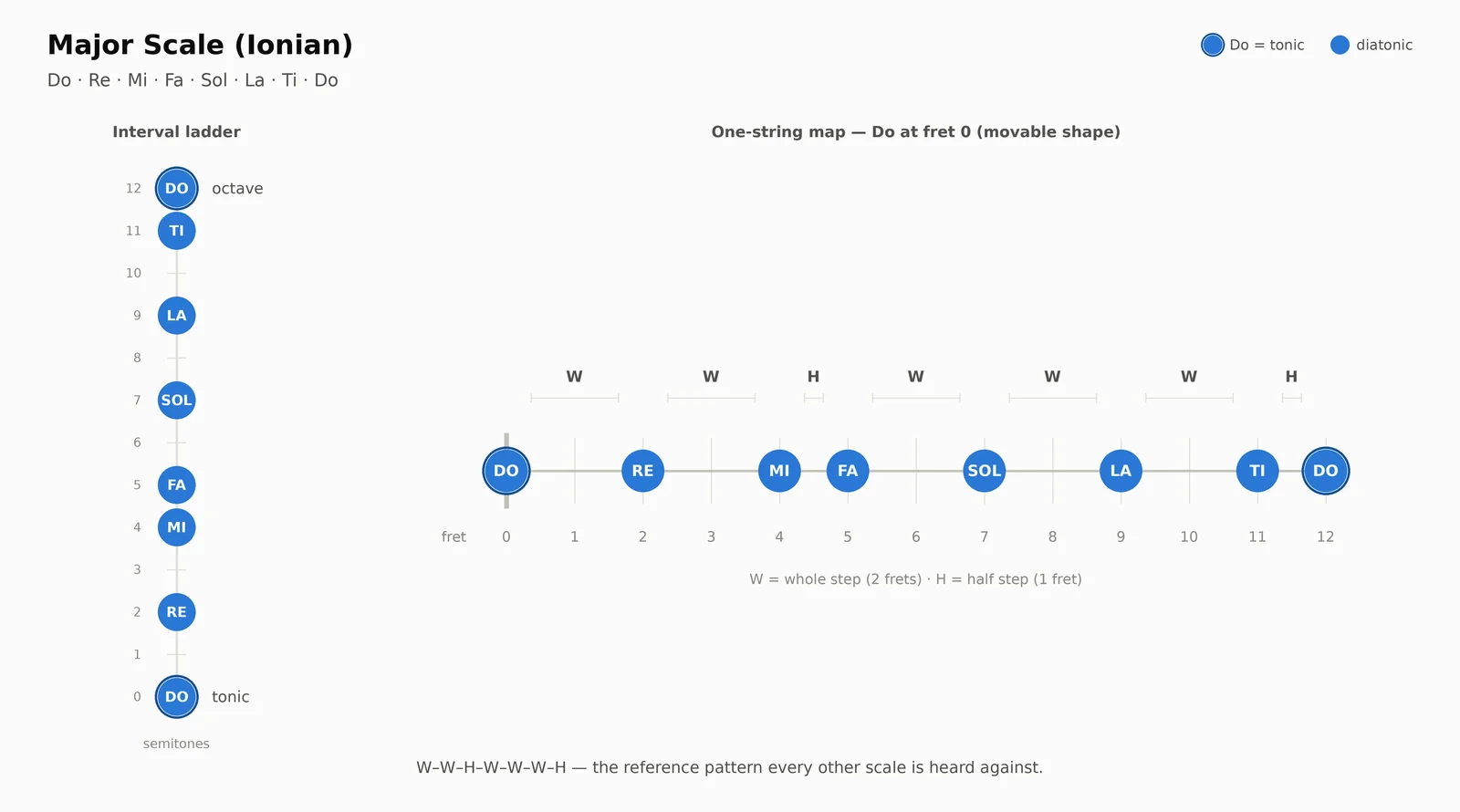
▶ Hear it — Do Re Mi Fa Sol La Ti Do, each note played, then sung on that pitch.
Dorian (minor with natural 6), Do Re Me Fa Sol La Te Do
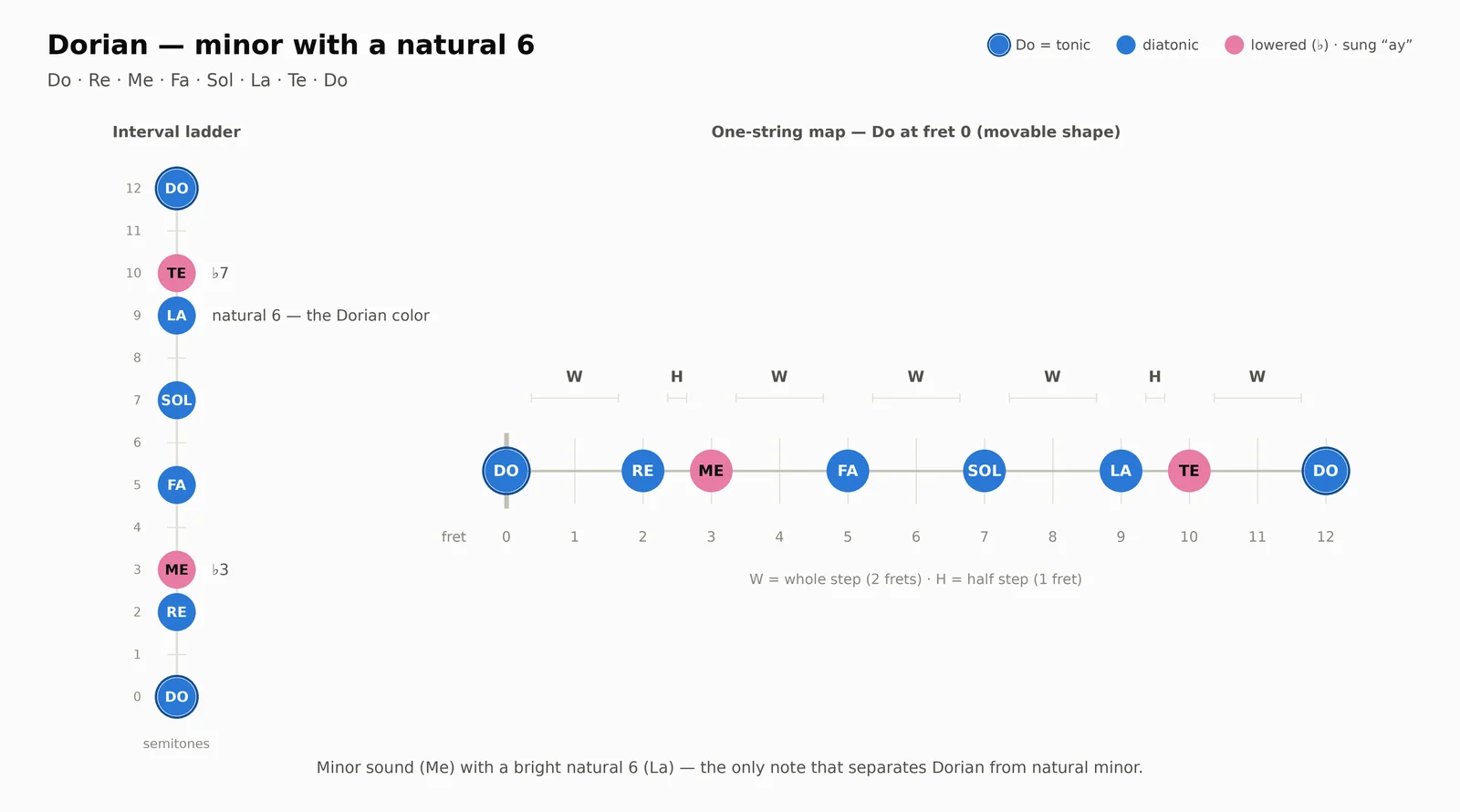
▶ Hear it — Do Re Me Fa Sol La Te Do; listen for the natural 6th (La) that gives Dorian its color.
Natural Minor (Aeolian), Do Re Me Fa Sol Le Te Do
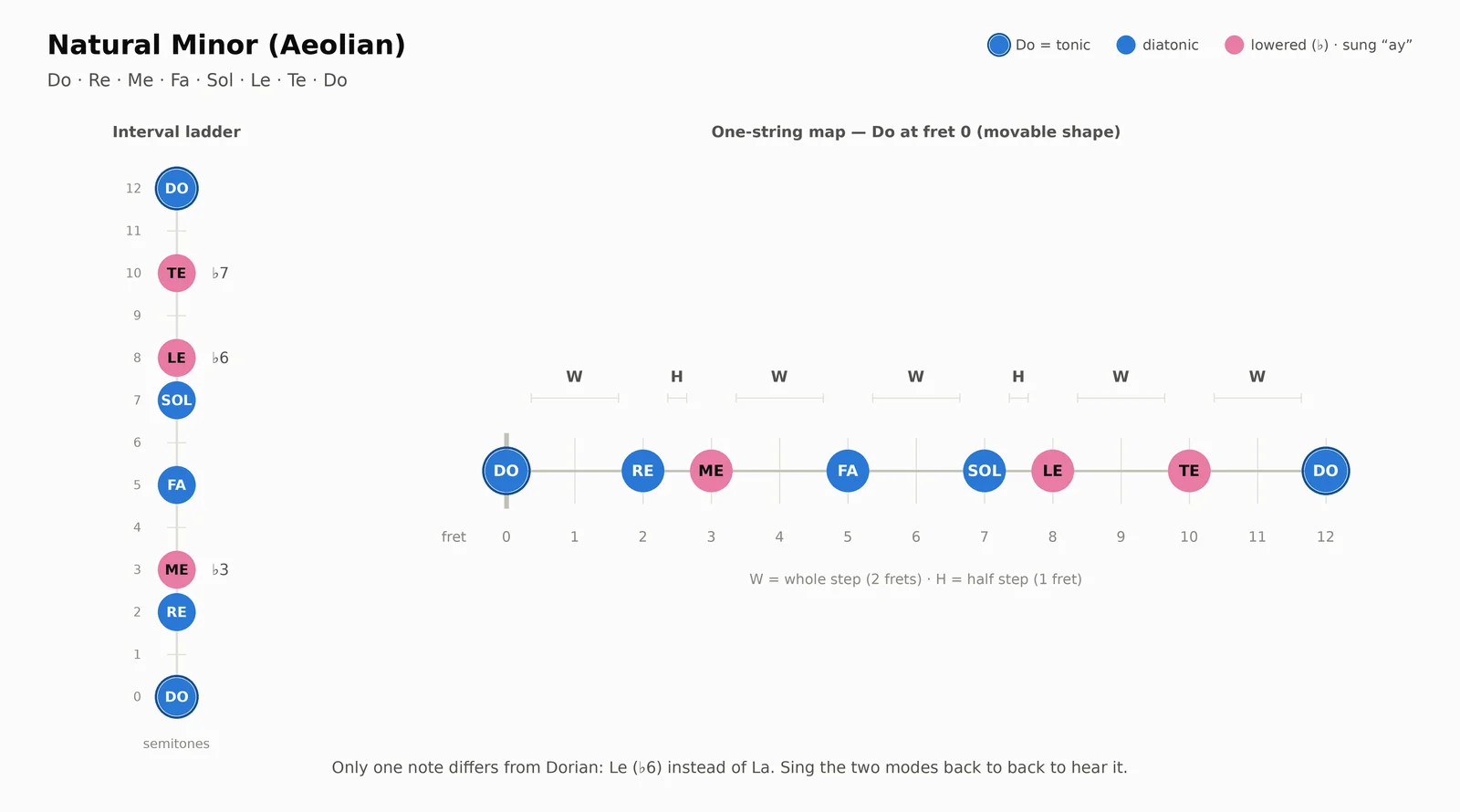
▶ Hear it — Do Re Me Fa Sol Le Te Do; the lowered 6th (Le) is the only note that differs from Dorian above.
Compare Dorian vs. natural minor: the only difference is La vs. Le, the natural vs. lowered 6th. Singing them back to back is the single best way to hear the difference between the two minor modes.
Minor Pentatonic, Do Me Fa Sol Te Do
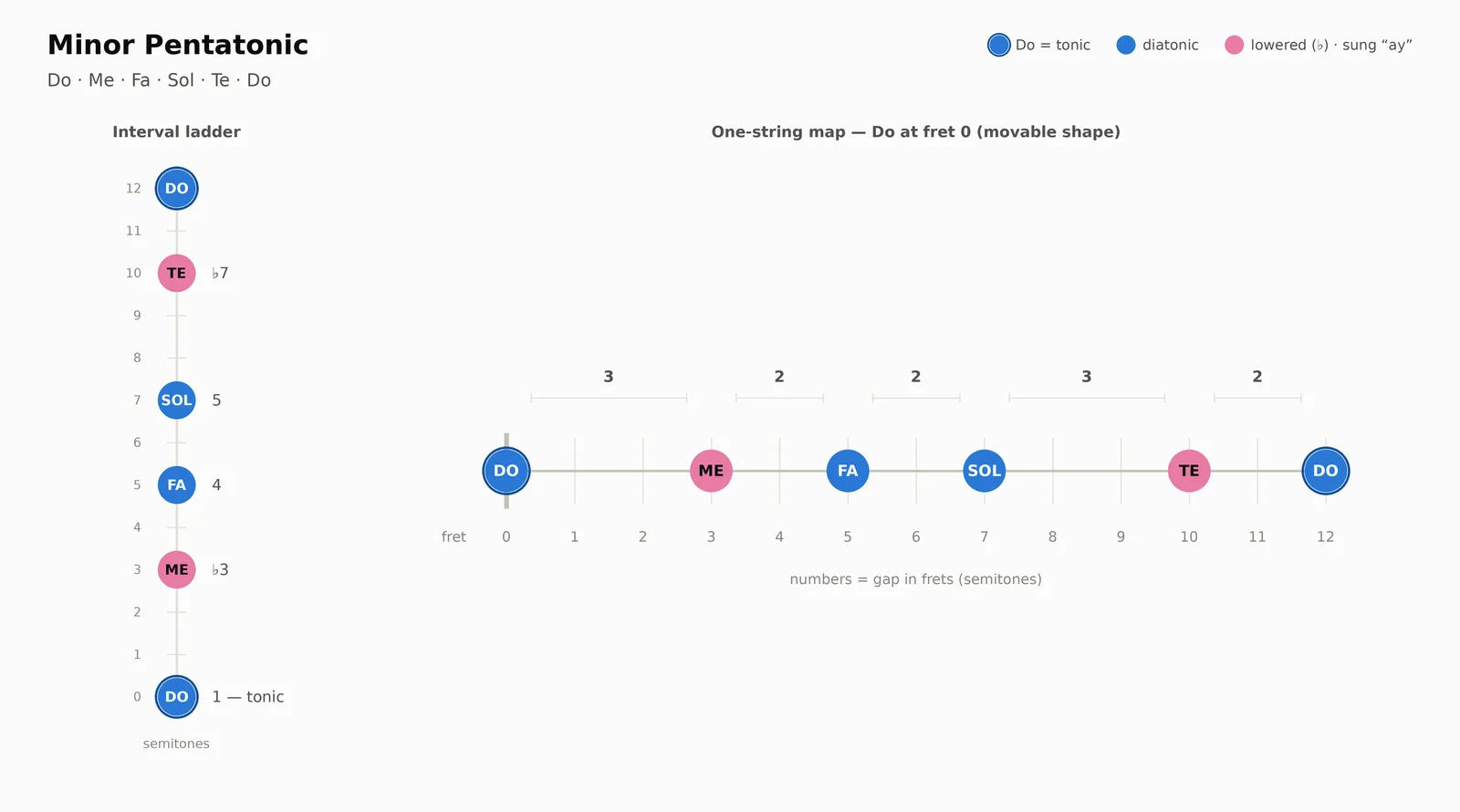
▶ Hear it — Do Me Fa Sol Te Do, each note played, then sung on that pitch.
Major Pentatonic, Do Re Mi Sol La Do
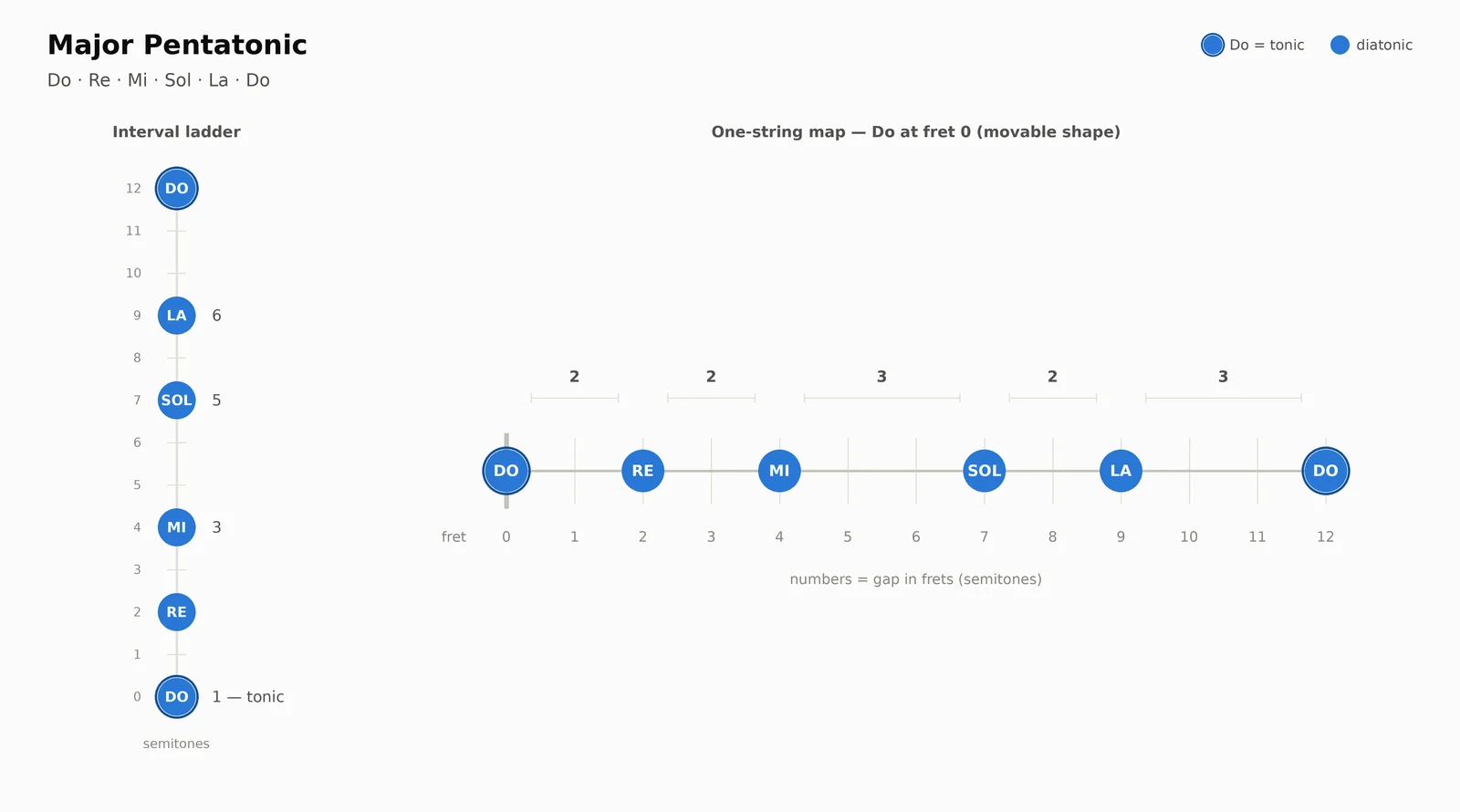
▶ Hear it — Do Re Mi Sol La Do, each note played, then sung on that pitch.
Chromatic scale, sing the full ladder above. Practice tip: ascend using Di/Ri/Fi/Si/Li and descend using Te/Le/Se/Me/Ra so the "up = ee, down = ay" vowel logic becomes automatic.
Harmonic minor, Do Re Me Fa Sol Le Ti Do (raised 7th vs. natural minor's Te → Ti). Melodic minor (ascending), Do Re Me Fa Sol La Ti Do (natural 6 and 7 over a minor 3rd).
Worked Examples: Arpeggios in Syllables
Guitar arpeggios are where this method pays off most for a jazz/fusion player, because you're singing chord tones, the notes you most want to target.
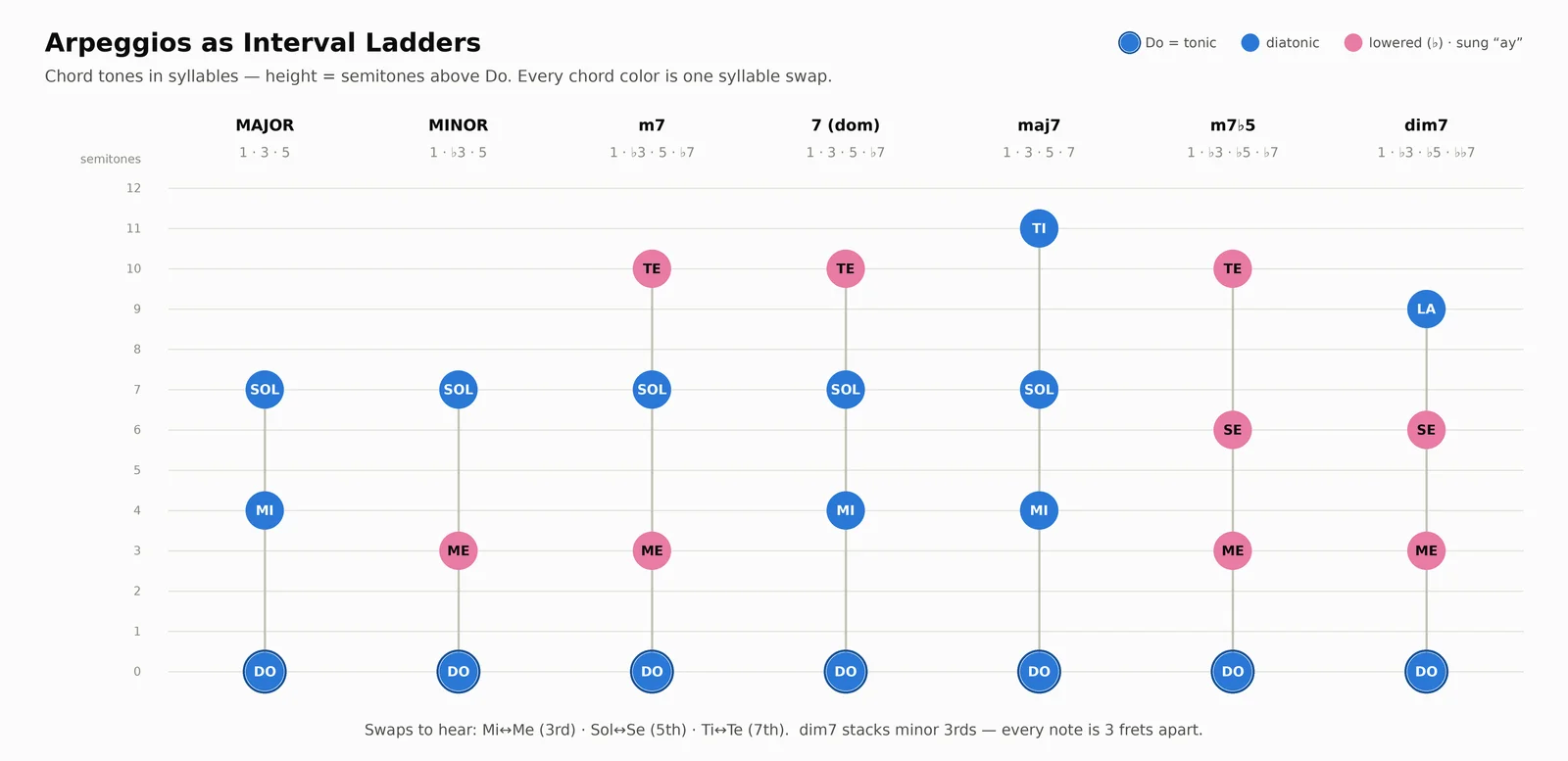
Here are the core shapes on two adjacent strings (a compact, transposable box). "R" = root = Do. Each shape simply spells out the intervals that define the chord, so it helps to know how chords are built from intervals.
Major Triad, Do Mi Sol
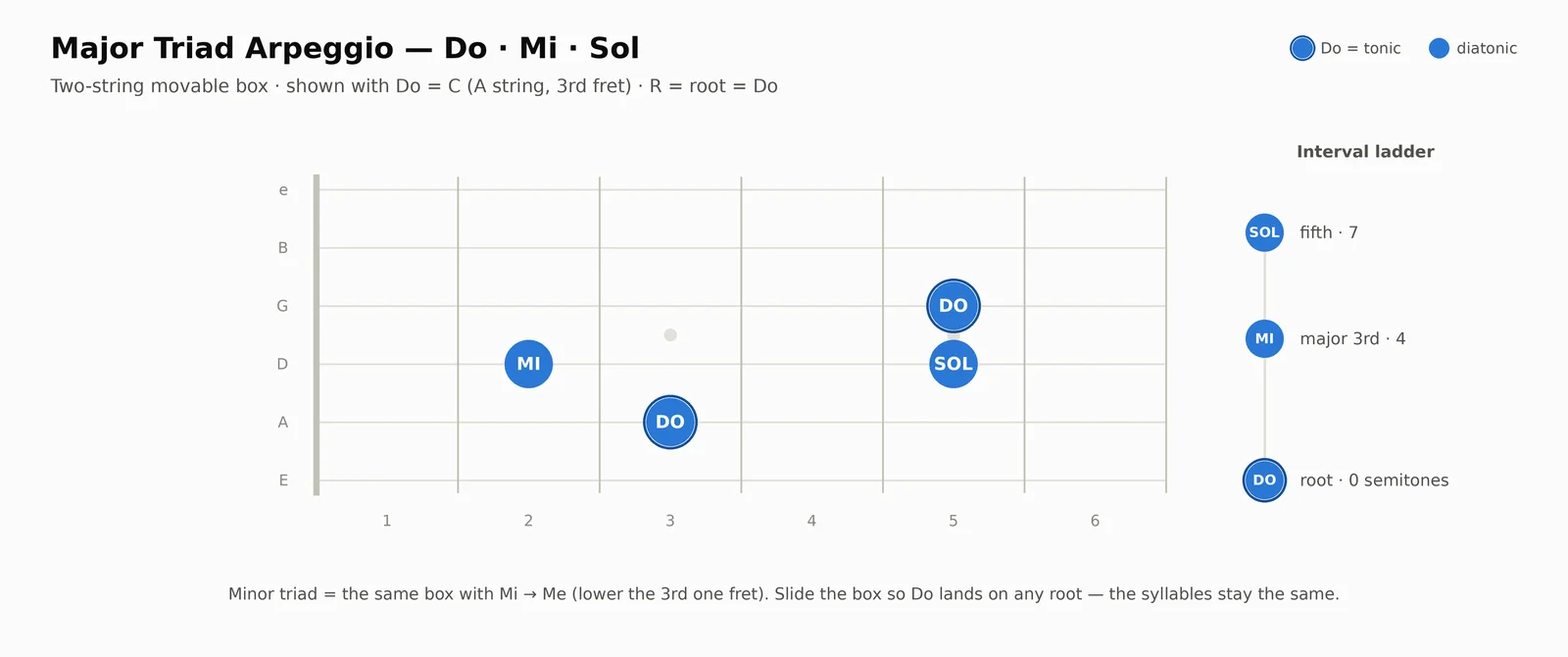
▶ Hear it — Do Mi Sol Do, each chord tone played, then sung on that pitch.
Minor Triad, Do Me Sol
Interval ladder: Sol / Me / Do (lower the 3rd: Mi → Me). The ONLY change from major is Mi → Me. Sing both triads back to back to lock in the major-vs-minor color.
▶ Hear it — Do Me Sol Do, each chord tone played, then sung on that pitch.
Minor 7 (m7), Do Me Sol Te
Interval ladder: Te / Sol / Me / Do (♭3, 5, ♭7, the classic Dorian / ii-chord sound).
▶ Hear it — Do Me Sol Te, each chord tone played, then sung on that pitch.
Dominant 7 (7), Do Mi Sol Te
Interval ladder: Te / Sol / Mi / Do (major 3rd + ♭7). The difference from m7 is Mi vs. Me, the "major-happy" 3rd against the bluesy ♭7 is the whole dominant color.
▶ Hear it — Do Mi Sol Te, each chord tone played, then sung on that pitch.
Major 7 (maj7), Do Mi Sol Ti
Interval ladder: Ti / Sol / Mi / Do. Ti, the natural 7, gives the lush, resolved major-7 sound.
▶ Hear it — Do Mi Sol Ti, each chord tone played, then sung on that pitch.
Half-Diminished (m7♭5), Do Me Se Te
Interval ladder: Te / Se / Me / Do (♭3, ♭5, ♭7). Se is the flat-5. Essential for the ii of a minor key: the "iiø7".
▶ Hear it — Do Me Se Te, each chord tone played, then sung on that pitch.
Diminished 7 (dim7), Do Me Se La
Interval ladder: La / Se / Me / Do (♭3, ♭5, ♭♭7). The ♭♭7 is enharmonically the 6th = La. Symmetrical stack of minor 3rds, every note is 3 frets apart.
▶ Hear it — Do Me Se La, each chord tone played, then sung on that pitch.
Arpeggios as Interval Ladders
Extensions (9-11-13): continue up the ladder past the octave. Over a dominant chord, the tensions are Do · Mi · Sol · Te · Re(9) · Fa(11) · La(13).
Extensions over a Dominant 7
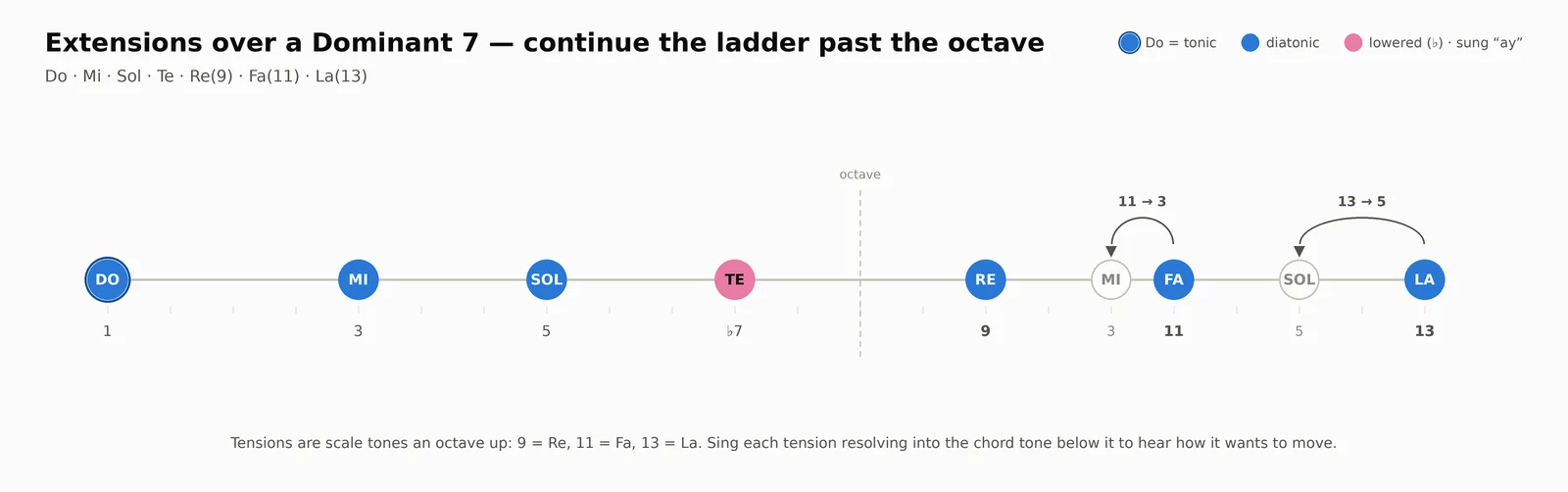
▶ Hear it — Do Mi Sol Te Re Fa La; the tones climb past the octave to the 9th (Re), 11th (Fa) and 13th (La), while the sung tensions drop into a comfortable octave (octave displacement in action).
Sing chord-tone-to-tension resolutions, e.g., Fa → Mi (11 down to 3) or La → Sol (13 down to 5), to hear how tensions want to move.
Guitar-Specific Fingering and Fretboard Guidance
- Start on one string. The single greatest guitar-specific tactic: work each scale and arpeggio up and down one string first. This makes the fretboard behave like a piano keyboard, higher pitch = further right = a physical distance your ear can calibrate to. The standard box shapes hide this pitch-distance relationship across strings.
- Then map to two strings, then to a box. Once the syllables are welded to the sound on one string, move to a two-string arpeggio box, then to full positional shapes. Sing the syllable name of every note as you play the shape, slowly.
- Say-then-play and play-then-say. Sing-then-play (audiate first, then find it) is the harder, more valuable skill, it forces true pre-hearing. Play-then-sing (play a note, then match it with your voice and name it) is the easier on-ramp and a good checkpoint.
- Anchor to a drone. Loop a low Do drone (a held open string, a tuner app, a tanpura app, or a sustained root on a looper). Sing each scale/arpeggio syllable against it, the drone keeps "home" constant so every syllable's function is felt, not guessed.
Handling a Limited Vocal Range: Octave Displacement
Most untrained adult male guitarists comfortably sing only about an octave, roughly from the low A (open 5th string, A2) to the A at the 2nd fret of the G string (A3), and women/tenors sit an octave up. This is completely normal and not a barrier. Two fixes:
- Octave displacement: when a scale or line climbs out of your range, simply drop (or raise) the offending notes an octave and keep singing the correct syllables. You are training function recognition, not performing a concert; "Sol" is "Sol" in any octave.
- Sing in your comfortable octave, play in the guitar's: it is fine, even expected, to sing a note an octave away from where your finger plays it. You've still correctly identified the pitch class and its function.
Don't strain for high notes; humming is fine, and a quiet, private "sausage-making" voice is all that's required. Range does tend to expand gradually with practice, but you should never wait for that to start.
Applying It to Licks, Melodies, and Improvisation
This is where the ear you've built pays off: it lets you solo over chord changes by hearing and targeting the right notes, instead of just running scale patterns.
- Sing the melody first. Before you improvise on a standard, sing the head all the way through, then comp while still singing it, then solo while keeping the melody running "on a second channel" in your inner ear. This keeps your solo tethered to the song.
- Transcribe by singing. Learn a solo (Chet Baker and Lester Young are widely recommended as easy, singable starting points; Charlie Parker and Clifford Brown are cited as too advanced to start with) by singing it note-for-note before you touch the guitar. Many players report they can then play it almost immediately, because the ear already owns it.
- Call-and-response. With a partner or an app: they play a short phrase, you sing it back (with syllables), then play it. Or the reverse. Start with 2-note cells, then 3, 4, 5.
- "Play any note." A liberating tactic from the Improvise For Real method and Hal Galper's teaching: in a key, any note you land on is either in the key or a half-step from a note that is. If you get lost, play any note, hear whether it's stable or wants to resolve, name its syllable, and move accordingly. You are never more than a half-step from home.
A Progressive Practice Plan
- Phase 0, Find Do (a few days). Practice locating the tonic by ear from a piece of music. Sing Do–Re–Mi–Do and Do–Sol–Do until stable.
- Phase 1, Diatonic major, one string (Weeks 1–3). Sing-then-play and play-then-sing the major scale in solfège on one string, against a Do drone. Add the "1, 2, 1, 3, 1, 4, 1, 5…" pattern. Goal: sing any major scale degree on demand over a drone.
- Phase 2, Minor and modes (Weeks 3–8). Add natural minor (Do Re Me Fa Sol Le Te Do), Dorian, and the rest of the modes, one string, over drones. Explicitly contrast La vs. Le and Mi vs. Me. Add minor and major pentatonic. Start singing simple melodies you know in solfège away from the guitar.
- Phase 3, Chromatics and arpeggios (Months 2–4). Sing the full chromatic ladder both directions with correct up/down vowels. Sing the core arpeggios (maj, min, maj7, m7, dom7) in syllables, one string then two-string boxes. Begin singing guide-tone lines (3rds and 7ths) through ii–V–I.
- Phase 4, Application/improvisation (Months 4+). Sing-before-you-play on standards; transcribe by singing; call-and-response; improvise short, mostly-chord-tone lines while singing them; then improvise while only thinking (audiating) the syllables. Extend to m7♭5, dim7, and 9/11/13 tensions.
Daily dose: 10–20 minutes is plenty and more sustainable than occasional long sessions. Bruce Arnold's students report meaningful gains from ~20 minutes a day; Berklee-linked and general ear-training sources put diatonic fluency at a few weeks and chromatic/automatic fluency at 3–6 months of consistent work.
Common Pitfalls and How to Avoid Them
- Training intervals in isolation instead of function. The most common trap. Recognizing a "perfect 4th" out of context doesn't help you improvise. Always sing against a tonic/drone so you're learning function, not naked distance.
- Skipping sing-then-play. Play-then-sing alone lets you cheat with muscle memory. Force yourself to audiate first at least half the time.
- Using the voice as a permanent crutch. Singing while playing is a fantastic training tool and rhythm aid, but Gordon's stricter view is that true audiation means you can hear the whole line internally without voicing it. Wean toward internal audiation over time.
- Chasing perfect pitch instead of relative pitch. David Lucas Burge's Perfect Pitch course is famous, but absolute pitch is not the skill that transfers to improvising, functional/relative pitch is, and it is reliably trainable at any age. A 2019 study (Van Hedger, Heald & Nusbaum, "Absolute pitch can be learned by some adults," PLOS ONE) did find adults could acquire trainable absolute pitch, though "the best learners still did not achieve note classification levels comparable to performance of a typical, 'genuine' AP possessor."
- Straining the voice / quitting over range. Use octave displacement and hum. Don't let a one-octave range stop you.
- Multisyllabic number-singing at speed. If you sing numbers, you'll hit "seven" and "flat-three." Either switch to solfège or clip numbers to single syllables. Solfège avoids the problem entirely.
- Going too fast. Slow, in-tune, correctly-named reps beat fast sloppy ones. Tempo comes last.
- Only practicing recognition apps. Passive "name that interval" testing is a side dish, not the meal. Producing the sound with your voice is what builds the skill.
Recommendations
- Adopt movable-do chromatic solfège as your primary system today. Print the chromatic chart above and put it on your music stand. If you already think in numbers for theory, keep doing so, but sing solfège.
- Buy or borrow one functional-ear method and one concept resource. Bruce Arnold's "Ear Training: One Note" (key-center listening) pairs well with a scale-degree singing app that works over a drone. For the improvisation mindset, watch Hal Galper's free "Illusion of an Instrument" masterclass and read his "Forward Motion"; Mick Goodrick's "The Advancing Guitarist" is the classic guitar companion for exploring this material on the neck.
- Run the four-phase plan, 10–20 minutes daily, always over a drone. Start on one string. Sing-then-play at least half your reps.
Benchmarks that tell you to advance
- Advance past Phase 1 when you can sing any requested major-scale degree over a drone within a second, in tune.
- Advance past Phase 2 when you can hear the difference between Dorian and natural minor (La vs. Le) instantly and sing either mode cold.
- Advance past Phase 3 when you can sing a m7, dom7, and maj7 arpeggio in syllables from any root without your guitar.
- You've arrived when you can pause a recording of your own solo at random and sing where the melody is, and when you can hear a line in your head and play it first try.
If progress stalls for more than ~3 weeks, narrow the material (fewer degrees, slower tempo, more drone time) rather than adding new content, the classic fix reported by long-term ear-training students.

Created by
Giancarlo is a musician (teaching guitar since 2000), software engineer, AI consultant and published researcher