Easy Trick To Break Out Of The Pentatonic Scale Box
Learn How To Play The Pentatonic Scale Along All The Fretboard
The Problem with The 4 Frets Pentatonic Pattern
The 4 frets pentatonic scale box on the 5th fret is a handy and easy pattern that everybody should know.
It allows playing rock and blues lines in a comfortable position.
But there is a problem.
If you have spent enough time on this shape, you should have noticed that it traps you in its 4 frets box.
Probably you found yourself playing the same things again and again, driven by muscle memory and not by your inner melodic sense.
The Solution
This is a common problem with box scale shapes: we learn the patterns, memorize it, and then we stay trapped in this position. But the fretboard has more than 4 frets!
In this quick tutorial, we're going to see how to use the pentatonic scale across all the fretboard, transforming the pentatonic box shape in an extended pattern that will give you more freedom and options.
Have a look at the video above or at the images below to learn this easy trick.
Enjoy it!
This is our well known pentatonic box at fret 5th
This is the classic pattern that every beginner solo guitarist knows.

Expanding the box
We just have to copy a scale fragment (b7 1 b3 and 4) one octave down and one octave up.
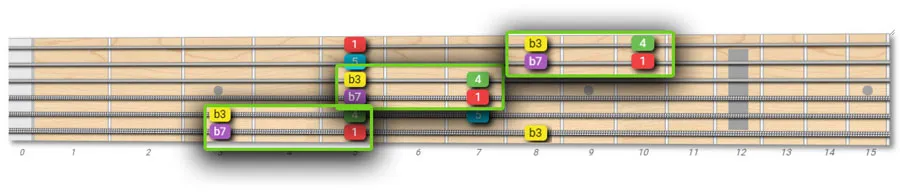
We can shift up and down the neck now
Now we can play our pentatonic also moving horizontally on the fretboard.

Last step: adding two more notes
Finally, we add to the pattern the Fifth, below on the 6th string and on the 1st string.
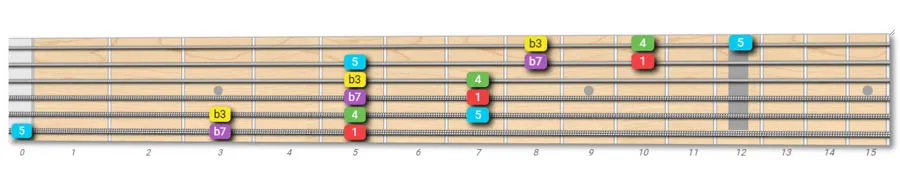
That's all! now you can play furious pentatonic runs literally up and down the neck. Don't forget to subscribe to get updates and free guitar pdf.

Created by
Giancarlo is a musician (teaching guitar since 2000), software engineer, AI consultant and published researcher
FAQ
Why is the common 4-fret pentatonic box considered a 'problem' for guitarists?
While the 4-fret pentatonic box is easy to learn and useful, it often traps guitarists into playing the same licks and patterns. This leads to playing by muscle memory rather than by melodic intention, limiting creativity and preventing exploration of the full fretboard.
What does it mean to 'expand' the pentatonic scale box on the fretboard?
Expanding the pentatonic box means extending its reach beyond the initial 4-fret shape. This involves incorporating additional notes from the same pentatonic scale an octave lower and an octave higher than the original box, connecting these patterns across more of the guitar neck.
How does expanding the pentatonic box help with moving horizontally on the fretboard?
By expanding the pentatonic box with notes from octaves above and below the original shape, you create a larger, interconnected pattern. This larger pattern provides clear pathways and options to move the pentatonic scale both up and down the neck, allowing for horizontal movement rather than being confined to a single static position.
What specific 'scale fragments' are added to initially expand the pentatonic box?
To initially expand the pentatonic box, you copy a specific scale fragment – consisting of the flat 7th (b7), root (1), flat 3rd (b3), and 4th – and add it both one octave down and one octave up from the original box shape. This effectively lengthens the pentatonic pattern across the strings.
Why are two additional 'Fifth' notes added in the final step of expanding the pentatonic pattern?
Adding two more Fifth notes (specifically, one on the 6th string below the pattern and another on the 1st string above the pattern) in the final step completes the extended pentatonic shape. This provides further tonal options and expands the playable range, enabling more versatile and 'furious' pentatonic runs across the entire neck.
Is the expanded pattern still the pentatonic scale, or does it become a different scale?
Yes, the expanded pattern is still fundamentally the pentatonic scale. The process does not introduce new notes outside of the pentatonic structure but instead reveals and connects more notes of the *same* pentatonic scale across a wider area of the fretboard, offering more positional flexibility.
