B maj9 Guitar Chord
Chord Diagrams, Interactive Fretboard and Chord Theory
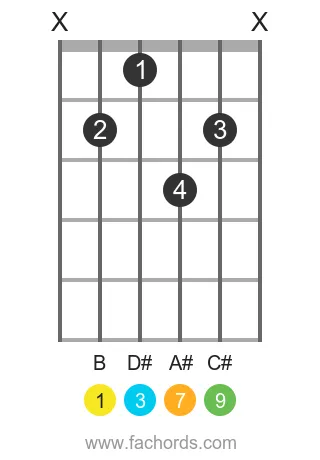
B major 9th guitar chord is also written as Bmaj9, BM9, BΔ9 or Bma9.
Position 1
Movable
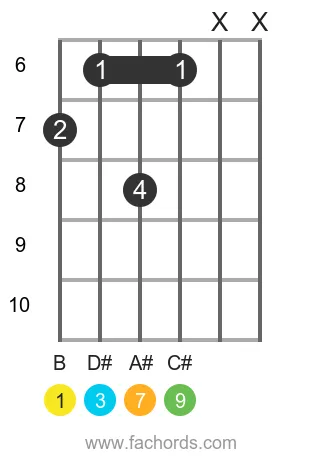
Position 2
Barre
Movable
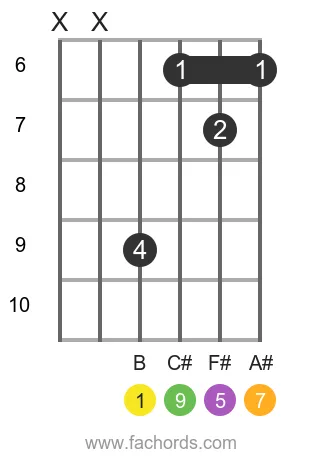
Position 3
Barre
Movable
 Find more shapes in our all guitar chords online library. If you
prefer a printable pdf, download
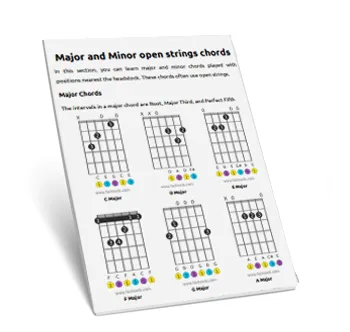
the Free Guitar Chords Chart Pdf
Find more shapes in our all guitar chords online library. If you
prefer a printable pdf, download
the Free Guitar Chords Chart Pdf
You can also use this accessible Bmaj9 chord page, with written diagram instructions and screen-reader support for blind users.
Explore Bmaj9 Guitar Chord Fretboard Positions & Playbacks
Want a structured chord roadmap instead of jumping between pages?
Go to the full guitar chords tutorial.
Discovering the B maj9 chord on guitar starts with visualizing its unique fretboard geometry. Our interactive virtual fretboard lets you explore various fingerings and see how the notes are laid out across the strings. Practice playing these shapes in real-time, and get instant accuracy verification using our innovative microphone feedback. This complex and sophisticated chord is built from the notes B, D#, F#, A#, and C#, representing the 1 (Root), 3 (Major Third), 5 (Perfect Fifth), 7 (Major Seventh), and 9 (Major Ninth) intervals respectively, making it a beautiful and rich sounding chord from the Major Chords family.
The B maj9 chord is a prime example of extended harmony, adding rich color and sophistication to your playing, particularly favored in jazz and contemporary music. Understanding how these extended chords are built involves exploring the additional intervals beyond a basic triad or seventh chord. If you're new to the concept of extended harmony, delving into Ninth Chords can provide a deeper insight into their structure and application. Mastering chords like this also benefits greatly from a solid foundation in Chord Construction. While often challenging due to their five-note structure, practicing efficient chord changes will help you integrate the Bmaj9 smoothly into your musical vocabulary.
Below, you'll find comprehensive diagrams showcasing various fingerings for the B maj9 chord, arranged from the easiest to the more challenging, allowing you to explore different fretboard positions at your own pace. Before committing shapes to memory, we encourage you to experiment with them using our interactive tool, seeing how the notes resonate. Understanding the underlying theory and how this chord fits into different keys will unlock its full potential for songwriting and improvising. Start exploring these shapes now to build your muscle memory and musical intuition!
B maj9 chord Notes:
How to create the Major Ninth chord:
Play This Chord With Other Roots
C maj9 | D maj9 | E maj9 | F maj9 | G maj9 | A maj9 | B maj9 | C#maj9 | D#maj9 | F#maj9 | G#maj9 | A#maj9 | Abmaj9 | Bbmaj9 | Dbmaj9 | Ebmaj9 | Gbmaj9

Created by
Giancarlo is a musician (teaching guitar since 2000), software engineer, AI consultant and published researcher
FAQ
What notes are included in a Bmaj9 chord?
The Bmaj9 chord is composed of five specific notes: B, D#, F#, A#, and C#. These notes together create the chord's distinct rich and complex sound.
What are the musical intervals that construct a Bmaj9 chord?
A Bmaj9 chord is built using a specific set of intervals relative to its root note (B). These intervals are the 1 (Root), 3 (Major Third), 5 (Perfect Fifth), 7 (Major Seventh), and 9 (Major Ninth).
Why is the Bmaj9 chord considered an intermediate-level chord?
The Bmaj9 chord is an intermediate-level chord because it is more advanced than basic major and minor chords. It includes additional notes beyond the simple triad (root, third, fifth), specifically the Major Seventh and Major Ninth, which adds to its complexity and can be more challenging to fret on the guitar.
What gives the Bmaj9 chord its 'complex and sophisticated' sound?
The complex and sophisticated sound of the Bmaj9 chord comes from the inclusion of the Major Seventh (A#) and Major Ninth (C#) intervals, in addition to the standard Major triad. These extended notes create a richer harmonic texture and add distinctive color compared to simpler chords.
When might a guitarist use a Bmaj9 chord in music?
Guitarists often use the Bmaj9 chord in various music genres, especially jazz, due to its complex and sophisticated sound. It's a great choice for adding harmonic richness and color to chord progressions, creating a more advanced and interesting musical palette.
How do notes and intervals relate in the Bmaj9 chord?
The notes (B, D#, F#, A#, C#) are the specific pitches you play to form the Bmaj9 chord. The intervals (Root, Major Third, Perfect Fifth, Major Seventh, Major Ninth) describe the musical distance and quality of each of these notes in relation to the root note, B. Understanding both helps you build and understand the chord structure.