Understand and Play the E7b5 Guitar Chord on Our Interactive Fretboard
Want a structured chord roadmap instead of jumping between pages?
Go to the full guitar chords tutorial.
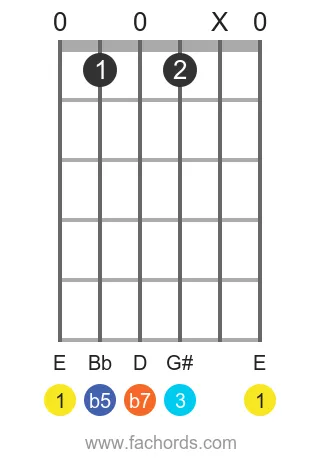
The E7b5 chord is built on a fascinating interval structure of 1, 3, b5, and b7, positioning it as an intriguing member of the Dominant Chords family. This distinctive sound is created by combining the notes E, G#, Bb, and D. To truly grasp its harmonic function and physical shape, our interactive fretboard allows you to visualize every finger position and hear the chord's precise sound. You can even use our real-time mic feedback feature to accurately verify your playing as you practice.
Understanding the distinct interval structure of the E7b5 chord, featuring a diminished fifth (b5), is crucial for appreciating its unique character within the broader family of Dominant Chords. This chord's construction, combining Root, Major Third, Diminished Fifth, and Minor Seventh, can be further explored through our insights on chord construction. Mastering how these intervals translate to the fretboard also opens the door to understanding chord inversions, allowing you to play the E7b5 in various positions across the neck.
As you delve deeper, practice building your dexterity using the provided diagrams, ranked from easiest to most challenging. Combine these with theoretical insights to apply the E7b5 chord effectively in songs and across different keys. Begin your disciplined practice by actively experimenting with the interactive tool to solidify your understanding and ensure accurate finger placement.
Notes in the E 7b5 chord:
Tones in the Dominant Seventh Flat five chord:
E Dominant Seventh Flat five Guitar Chord Diagrams
Position 1
Open
Position 2
Open
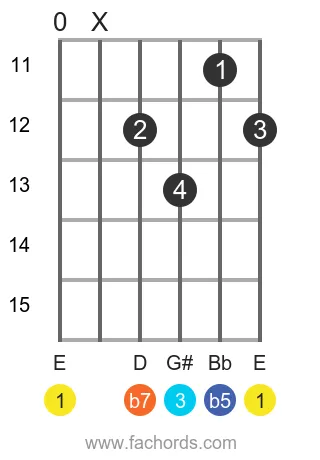
Position 3
Barre
Open
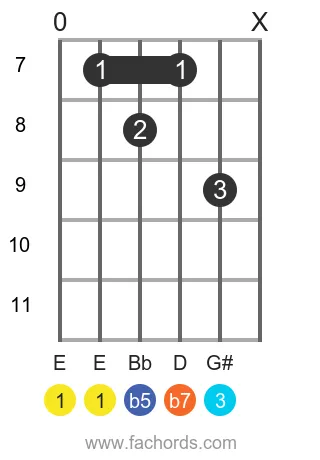
 Find more shapes in our all guitar chords online library. If you
prefer a printable pdf, download
the Free Guitar Chords Chart Pdf
Find more shapes in our all guitar chords online library. If you
prefer a printable pdf, download
the Free Guitar Chords Chart Pdf
You can also use this accessible E7b5 chord page, with written diagram instructions and screen-reader support for blind users.

Created by
Giancarlo is a musician (teaching guitar since 2000), software engineer, AI consultant and published researcher
FAQ
What notes are in an E7b5 chord?
The E7b5 chord is composed of four specific notes: E, G#, Bb, and D. These notes are fundamental to its construction and create its unique sound.
What are the intervals that make up the E7b5 chord?
The E7b5 chord is constructed using the 1 (Root), 3 (Major Third), b5 (Diminished Fifth), and b7 (Minor Seventh) intervals. Understanding these intervals helps define the chord's unique sound.
Why is the E7b5 considered a dominant chord?
The E7b5 is a member of the Dominant Chords family because it features the Root (1), Major Third (3), and Minor Seventh (b7) intervals, which are characteristic of dominant voicings. The diminished fifth (b5) is an alteration that creates its unique characteristic within this family.
What gives the E7b5 chord its 'unique flavor'?
The E7b5 chord's unique flavor is primarily due to the inclusion of the diminished fifth (b5) interval. This specific interval creates an interesting variation from typical dominant chords, defining its distinctive sound.
In what musical styles or situations would I typically use an E7b5 chord?
The E7b5 chord frequently appears in jazz and blues progressions. Its distinctive sound adds a unique flavor, making it a valuable chord for versatility in these genres.