How to Use Drum Machines in Songwriting
A Guide for Guitar Players + Interactive Drum Machine
Practicing guitar with a full band is one of the best ways to grow as a musician, but finding bandmates isn't always easy. That's where drum machines come in: they give you a reliable rhythm section to jam with anytime, helping you develop your timing, explore new grooves, and write better songs.
In this guide, you'll learn the fundamentals of rhythm, discover a collection of ready-to-use drum patterns across multiple genres, and get hands-on with our free interactive drum machine.
Interactive Online Drum Machine
The best way to follow this tutorial is to try each pattern yourself using the FaChords free online drum machine below. Click on the grid to toggle notes on and off, and double-click for accented notes.
Click on the grid: toggle notes (on/off), Double-click: accent notes
Rhythm Basics
Before diving into the drum machine, let's build a solid foundation in the idea of rhythm. The good news? Most drum patterns are like chord progressions, there are only a handful of core patterns, and they get reused across countless songs. In fact, except in rare cases, you can't copyright a groove unless it's integral to the melody.
Beat & Pulse
The beat (or pulse) is the basic unit of rhythm. Each beat can be strong or weak, depending on the accent or flair applied to it. When beats are slightly offset to create forward momentum, we call that syncopation or swing.
The downbeat is the first beat of a measure, and the upbeat is the last. The anticipation of the upbeat resolving back into the downbeat is what gives music its drive.
Beats can also be described as on or off. In popular music, beat 1 is the strongest, beat 3 is slightly less so, and beats 2 and 4 are the off-beats (also called the backbeat). Most rock and pop music emphasizes and syncopates these off-beats, and nearly all modern music still relies on a backbeat.
Tempo
Tempo is simply how fast the beat moves. The patterns in this guide don't specify a tempo on purpose, so you can experiment freely. The same drum pattern can suit entirely different genres just by changing the speed. Any beat you create sounds worth trying at multiple tempos.
Meter
When beats form a repeated pattern, that's called the meter. We'll mostly work with duple (groups of two) and triple (groups of three) meters. Don't confuse meter with measures, a measure (or bar) is a single phrase that contains a set number of beats. When programming drum machines, you may need to adjust your step count to fit the right meter.
Rhythm
Rhythm emerges from the combination of different beats, percussion parts, bass lines, accents, and syncopation. All these elements together create the overall rhythmic feel of a song. You can play your guitar along with your drum machine as a rhythmic accompaniment, or use it as a foundation for lead melodies and solos, the important part is understanding how all these pieces interact.
Groove
Groove is the cyclical, locked-in feeling that comes from a well-executed, repetitive rhythm, sometimes called "playing in the pocket." Achieving a convincing groove on a drum machine takes practice: get to know your software well so you can turn basic patterns into something that truly feels alive. Modern virtual drumming software handles swing and syncopation better than ever, since many use sliced recordings of real drummers.
Polyrhythms
When you layer different rhythms or meters that don't naturally align, you get a polyrhythm. While they can be complex, the results are incredible when all the parts lock together. Some synthesists even connect multiple drum machines to create polyrhythmic patterns.
Time Signatures
A time signature is how we notate meter. Most modern music uses 4/4 (common time), and that's your best bet for writing catchy tunes. However, we'll also show you ways to create different time signatures for fresh song ideas. The more capable your drum machine, the more options you'll have.
Drum Notation
If you're ever stuck finding a rhythm pattern, look up the sheet music for a song and check the drum notation. Just like reading standard notation, you match the drum notes to the key. When you can't find a specific song, search for the genre instead, chances are the drum patterns will be similar. And if all else fails, use your ears. Start paying close attention to the drums in every song you listen to.
Using Your Drum Machine
Here's a quick overview of how the FaChords drum machine works:
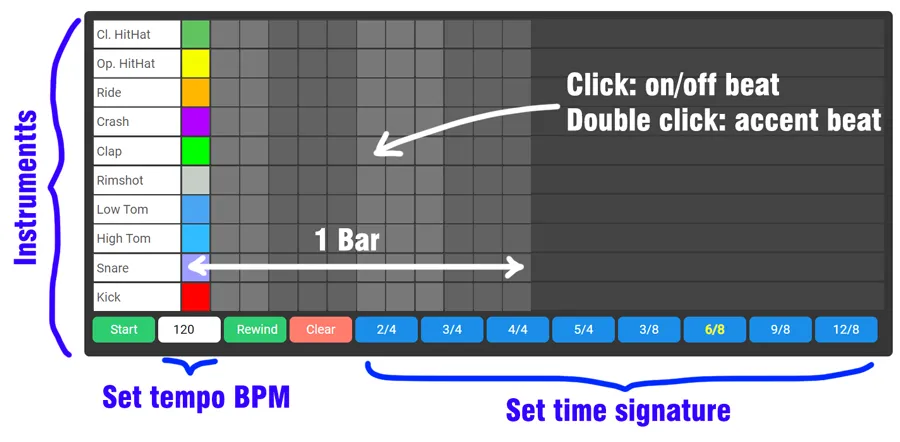
Click on any cell in the grid to toggle a note on or off. Double-click to add an accent (marked with an A in the charts below). The available instruments are:
- Bass Drum
- Snare Drum
- Closed Hi-Hat
- Open Hi-Hat
- Ride Cymbal
- Crash Cymbal
- Lo Tom
- Hi Tom
- Clap
- Rimshot
Rhythm Patterns
Below you'll find a collection of patterns ranging from simple to complex. These are starting templates, experiment as you go! The whole point is to spark creativity in your guitar practice and songwriting. These rhythms work across many genres, so don't feel limited by the genre labels.
4/4 Rock-n-Roll Pattern
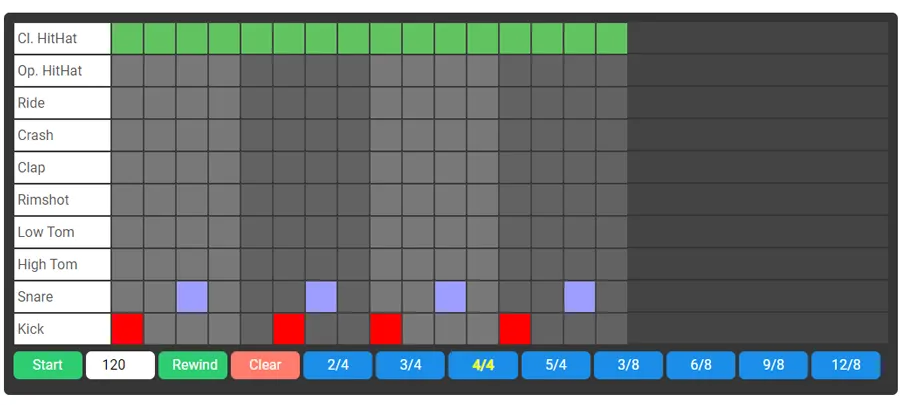
This is the essential rock groove, a backbone of popular music. We count the beats in 1/8 notes, giving us two measures per round. If you have more than 16 steps, simply repeat this pattern.
Remember: beats 2 and 4 are the off-beats that provide syncopation. Accent them harder for an even more driving, rockin' vibe.
Real drummers often open the hi-hat slightly on the "and" after each off-beat. Try replacing some closed hi-hats with open ones and notice how the feel changes, the beat takes on a steady, breathing consistency.
4/4 Rock-n-Roll Pattern v2

Now remove the last open hi-hat without replacing it. Notice how the beat now has a halting feeling at the end of each two-measure phrase. Even the tiniest changes create major differences in feel, and will call for a different lyrical or melodic approach.
4/4 Rock-n-Roll Pattern v3
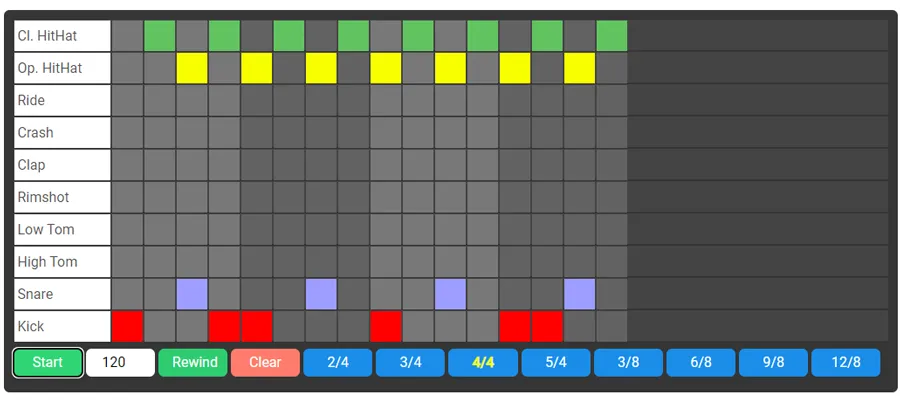
Another way to reshape the beat: cut out some closed hi-hats and add a couple of extra bass drum hits. Small changes, big impact.
Mersey Beat
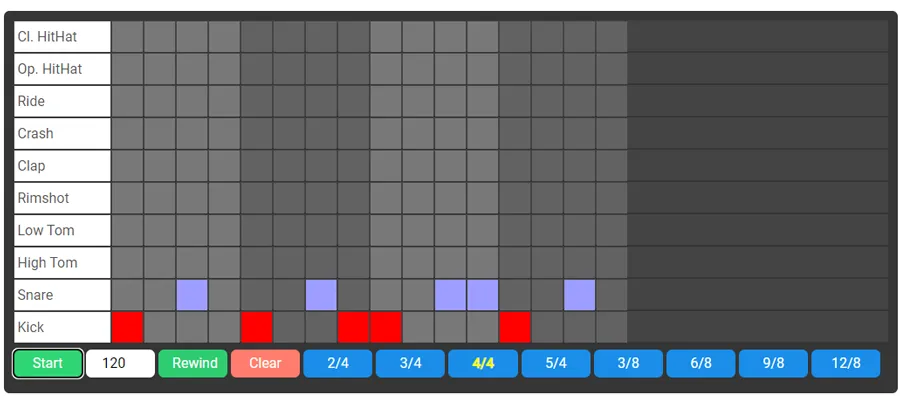
This simple pattern was a key ingredient in the Mersey beat sound made famous by The Beatles. The original had a bit of extra buzz on the snare hits, so try adjusting the snare sound and delay. Then start layering in hi-hats similar to the rock patterns above.
Train Beat
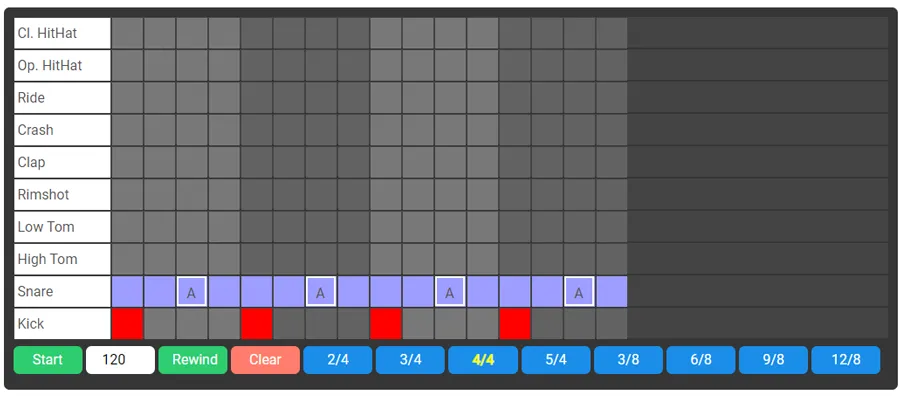
The train beat features a constant snare throughout. The key to making it work is accenting specific snare hits, just like the song "Wipeout." A real drummer varies their striking force, so by adding different accents you can achieve that signature chugging sound. If you have more than 16 steps, vary the accents on the second bar to keep things interesting.
A Country Groove
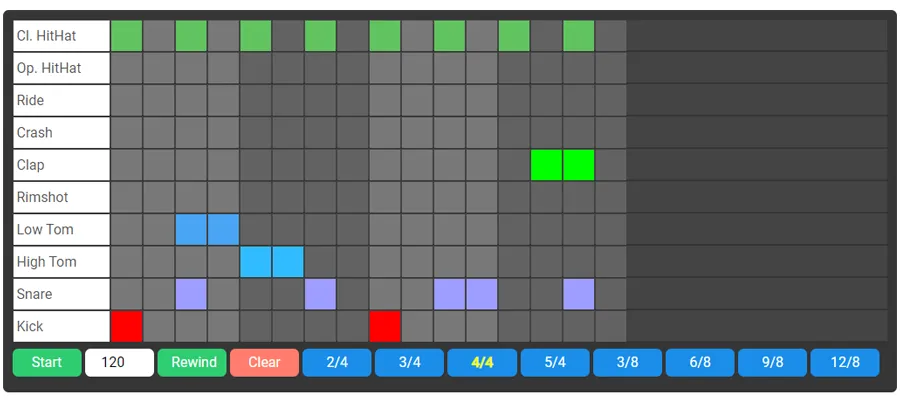
So far we've stuck with bass, snare, and hi-hats, but a lot of rock, pop, and country music brings in toms, cymbal crashes, and claps. Having more than 16 steps allows for less repetitive tom and cymbal parts.

Indie Disco & EDM
Adding just a few extra percussive elements can completely transform the vibe. Try placing open hi-hats on every "and" beat for an even more driving feel. This rhythm works for indie disco, EDM, pop, 80's synthwave, and more, especially when you experiment with accents.
Reggae
Reggae is a challenge on a drum machine, but it can be done. The key is to emphasize the 3rd downbeat and add plenty of syncopation. Mix in extra percussive elements to hint at swing.
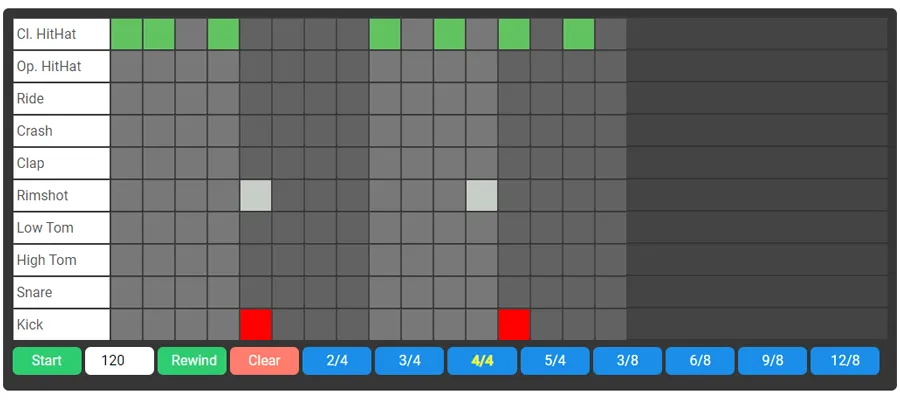
If you don't have a rimshot, substitute snare or another loud hit. Keep a groove going with the hi-hats while making sure to hit that 3rd downbeat. Sometimes the 1st-beat bass drum is played, sometimes not, try adding it and hear the difference.
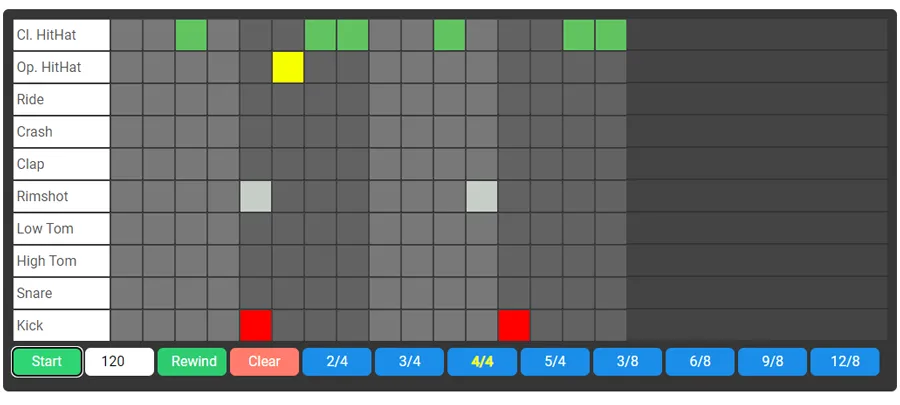
Adding delay to just the bass drum, rimshot, and hi-hat will give you a very groovy reggae vibe. Layer in other parts for more variety.
Funky Drummer
This iconic drum break from James Brown and Clyde Stubblefield is one of the most sampled patterns in music history. Play around with this pattern and you'll likely stumble onto something audiences love.

Impeached

Walk This Way

Upbeat Gospel
Gospel makes heavy use of syncopation and 1/16th notes. At a slow BPM this pattern has an R&B feel, but speed it up and it quickly becomes more like dance music.


Motown Boogaloo
Motown grooves shift where the snare and bass land, creating a unique feel with the same basic elements.

Neo-Soul

All the patterns above are in 4/4. To explore different meters, you'll need to change the number of active steps in your drum machine.
Exploring Drum Machine Types
Most drum machines have 16 steps, and depending on how you divide them you can create different time signatures: slice them into 1/8 notes for rock or 1/16th notes for funk. More steps means more variety, and the potential for fills and changes, since a real drummer rarely plays the exact same thing throughout a song.
Swing and syncopation are some of the hardest aspects to emulate with a machine. Reggae can be especially tricky. But as technology improves, so do our tools. Most modern apps and hardware offer a swing adjustment or time/delay controls that let you offset certain notes to create a groovy, human feel.
Accents are another powerful way to bring drum patterns to life. A steady snare hit isn't very exciting, but accent specific notes and suddenly you have a compelling rhythm.
Some people still think of drum machines as sterile and robotic, but that's a thing of the past. Today's digital and analog hybrid hardware and software can sound just like real drums. You can even find apps that faithfully emulate classics like the Roland TR-808 and TR-909, the backbone of 80's hip hop. Whether you go with hardware or software, look for options with a wide range of sounds and samples.
Hardware, Software & Apps
Volca offers a variety of affordable, compact synths and drum machines for the hardware route.
Patterning
One of the best drum apps available. It offers a huge selection of sounds and fine-grained accent control, which is what gives the beat a human element.
Amplitube
Guitar amp simulators like Amplitube often include a drum accompaniment feature, pick a genre, arrange intro/verse/chorus/bridge/outro sections, and play along without any programming.
Funk Drummer / Latin Drummer
These apps let you play sections or adjust MIDI in the grid. They're worth the cost if you want genres that need more realistic swing.
Open Source Options
If you want to plug your guitar into your smartphone or computer, you'll need an audio interface to record your guitar alongside your drum grooves. Otherwise, simply use the virtual drummer for ideas, practice, and inspiration.
That's all for today. You can subscribe for future updates here.

Created by
Giancarlo is a musician (teaching guitar since 2000), software engineer, AI consultant and published researcher
FAQ
Why should guitarists use drum machines for practice and songwriting?
Drum machines help guitarists practice effectively by simulating a 'band' experience, overcoming the isolation of solo practice. They provide a steady rhythmic foundation, which is crucial for improving timing and feel, and serve as a powerful tool for developing and structuring new song ideas.
What is the difference between 'beat,' 'rhythm,' and 'groove' in the context of drum machines?
The 'beat' or 'pulse' is the basic, consistent unit of time, which can be strong or weak. 'Rhythm' is a broader term encompassing the arrangement of sounds over time, formed by a mix of beats, percussion parts, and accents. 'Groove' refers to the compelling, cyclical, and often repetitive feeling derived from a well-executed rhythm, creating a sense of forward momentum or 'playing in the pocket.'
How can I make drum machine patterns sound more natural and less robotic?
To make drum patterns sound more natural, focus on using accents to emphasize certain beats, which adds dynamic variation. Experiment with 'swing' and 'syncopation' settings, if available, as these subtly offset beats to create momentum. Incorporating open and closed hi-hats, and varying instrument choices, also contributes to a more organic feel.
How do 'accents' change a drum pattern on a drum machine, and how do I apply them?
Accents add emphasis and dynamic force to specific notes within a drum pattern, making it sound more expressive and less monotonous. For example, on the FaChords drum machine, you can typically apply an accent by double-clicking a beat on the grid. This technique is crucial for creating varied dynamics, highlighting syncopation, and giving different genres their characteristic feel, such as stressing the 2 and 4 in rock beats.
Can I create different time signatures beyond 4/4 with a drum machine like the one demonstrated?
Yes, while 4/4 is common, drum machines can be used to create patterns in various time signatures. This typically involves adjusting the number of steps or 'beats' per measure within the drum machine's interface. To explore different meters, you would need to understand how to 'break down' your steps to fit the desired time signature and consult your specific drum machine's instructions for adjusting its settings.
Why are reggae rhythms considered challenging to emulate on a drum machine?
Reggae rhythms are challenging because they heavily rely on complex syncopation, an emphasis on the third downbeat (rather than the first), and a specific 'swing' feel that human drummers naturally impart. Achieving this authentic feel on a drum machine often requires careful programming of accents, subtle timing adjustments, and potentially adding delay effects to individual drum parts to emulate the nuanced human timing.