The Mario Cadence: Two Borrowed Chords Climbing to a Major Finish
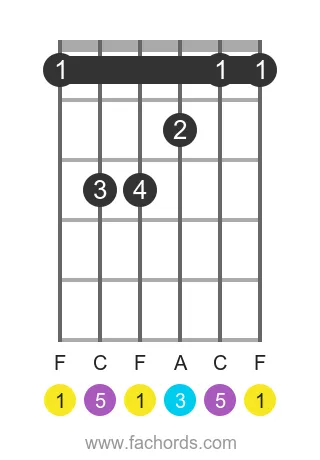
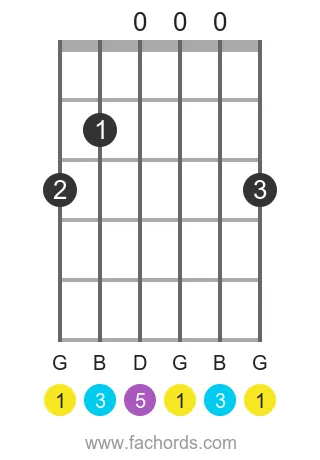
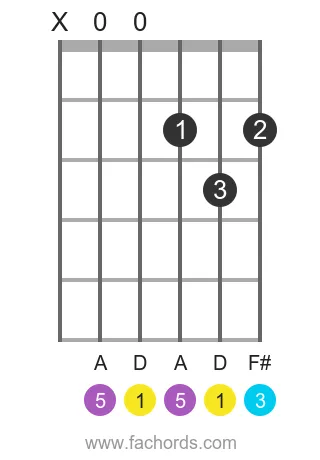
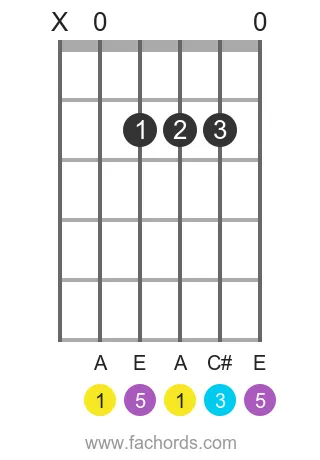
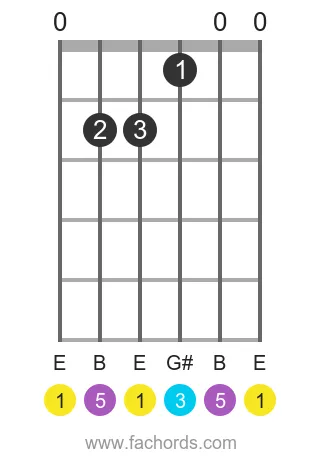
The Mario cadence takes its nickname from the level end fanfare of Super Mario Bros. It's the chord move bVI-bVII-I: in the key of C that's Ab Bb C, and in the key of E it becomes C D E, three open shapes you can play right now.
In the Nashville Number System it's b6 b7 1. You'll also see it called the bVI-bVII-I cadence, or the Aeolian cadence with a major ending. If you want the sound first, here are the diagrams and audio for each key.
Two Steps Up, No Shared Notes
Ab and Bb both sit outside C major. They come from the parallel minor, C minor, and they're borrowed chords doing a very simple job: they climb by step to the tonic. Ab to Bb is a whole step, Bb to C is another.
Look at the notes. Ab is Ab C Eb, Bb is Bb D F, C is C E G. There isn't a single note in common from one chord to the next, so all three voices move together.
On the guitar that means one barre shape sliding up the neck. With a root on the sixth string, play frets 4, 6 and 8 for Ab Bb C, or frets 1, 3 and 5 for F G A. Two frets, two frets, done. No finger changes at all.
A Goal, Not a Loop
Open Music Theory treats this as a goal directed cadence, not a loop. It usually ends on a major chord, like a Picardy third, and its authors link it to success and heroism.
That major last chord is the whole point. Ab and Bb belong to C minor, so you might expect a C minor ending. You get C major instead, with E natural in place of Eb. Compare the two endings in the key of E: play C D, land on E major, then play C D and land on E minor. That second ending stays in E minor, like the i-bVI-bVII loop, and the first is the Mario finish. Which one sounds like you just won something?
Four Ways to Write the Same Idea
Depending on where a chart starts counting, these chords can show up under different labels:
- bVI-bVII-I: the plain cadence, Ab Bb C.
- I-bVI-bVII-I: the tonic comes first, then the climb. P.S. I Love You plays it as D Bb C D.
- I-bVI-bVII: the same thing, stopped before the arrival.
- IV-V-VI: counted from Eb, the relative major of C minor. Ab and Bb are its IV and V, and the C is a major VI. The pop IV-V-vi has a minor last chord instead.
Where It Closes a Phrase
Two of these songs use it to close a riff or a verse, and the other two place it in a verse, an interlude or a refrain.
| Song | Artist | Section | Chords | Key |
|---|---|---|---|---|
| Lady Madonna | The Beatles | end of the main riff | F G A | A major |
| Kiss from a Rose | Seal | verse and interlude | Eb F G | G major |
| Crazy Little Thing Called Love | Queen | verse ending | Bb C D | D major |
| P.S. I Love You | The Beatles | refrain | D Bb C D (plays I-bVI-bVII-I) | D major |
Lady Madonna uses F G A to close the main riff, and Crazy Little Thing Called Love by Queen ends the verse on Bb C D. Kiss from a Rose by Seal plays Eb F G in the verse and interlude. The C D E shapes help here: a capo on the third fret gives you the chords of Kiss from a Rose, and on the fifth fret the Lady Madonna ones.
Mario Cadence: Chords and Audio in C, G, D, A and E
Press play to hear each key. The diagrams show the shapes used in the audio, and every chord links to its full page.


More progressions like this one
- bVII-V7 cadence: Bb G7
- I-v-bVII-IV: C Gm Bb F
- Lydian shuttle: C D
- Puff schema with major III: C E7 F

Created by
Giancarlo is a musician (teaching guitar since 2000), software engineer, AI consultant and published researcher
FAQ
What are the chords of the Mario cadence?
In C major: Ab Bb C. In G major: Eb F G. In D major: Bb C D. In A major: F G A. In E major: C D E.
Why is it called the Mario cadence?
The nickname comes from the level end fanfare of Super Mario Bros. The chords themselves, bVI-bVII-I, are also known as the bVI-bVII-I cadence or the Aeolian cadence with a major ending.
Where do the bVI and bVII chords come from?
They are major chords from the parallel minor. In the key of C, Ab and Bb come from C minor, then climb by whole steps to a C major chord, a bit like a Picardy third.
Is bVI-bVII-I the same as IV-V-VI?
Yes, the chords are the same. IV-V-VI counts from Eb, the relative major of C minor, so Ab and Bb are IV and V and the last chord is a major VI.
Which Beatles songs have the Mario cadence?
Lady Madonna plays F G A at the end of the main riff, in the key of A. P.S. I Love You plays D Bb C D in the refrain, in the key of D.