i v iv: A Minor v, No Leading Tone, and the Groove of Levitating
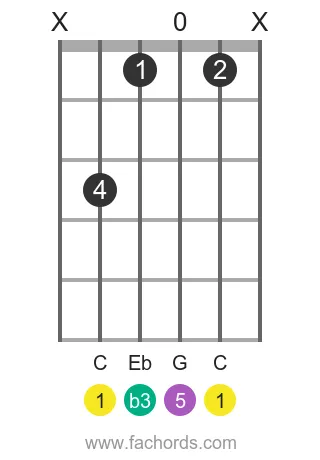
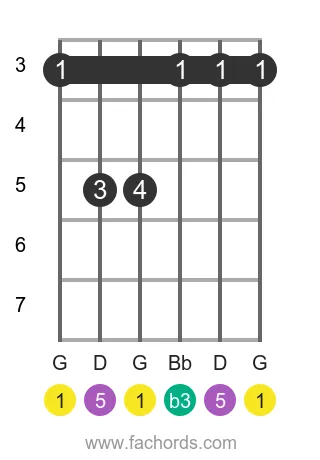
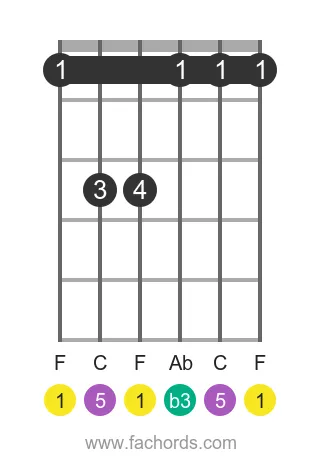
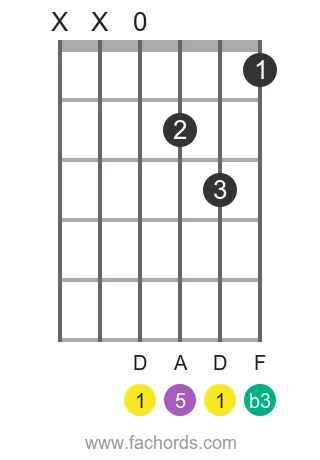
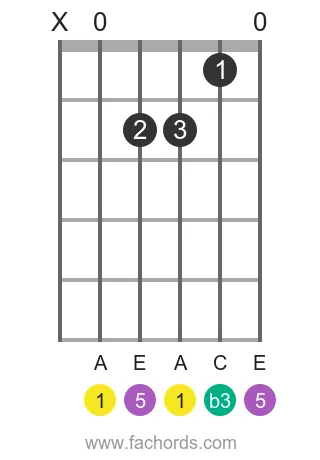
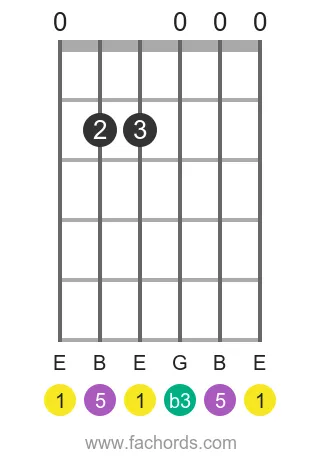
What happens if the V of a minor key stays minor? You get i-v-iv, which in A minor is Am Em Dm: a loop that never pushes you anywhere. In the Nashville Number System it is 1m 5m 4m, and in C minor the chords are Cm Gm Fm.
The sound is smooth and laid-back, and it is a favourite in disco-influenced pop. You can hear it in five keys while you read.
The Missing G#
Em is the chord natural minor gives you on the fifth degree. Its middle note is G, a whole step below A. A major E would have G# there, the leading tone, a half step below A, and that note is what asks for the tonic.
Compare them. Play Am Em Am, then Am E Am, which is the minor tonic-dominant vamp. Listen to the return to Am in each. With a minor v there is no real pull to the tonic, so this loop can sit and groove.
A Bass That Falls an Octave
Here is something you can try on one string. The bass drops a fourth, steps down a whole step, then drops another fourth, and those three moves add up to exactly one octave. On the A string:
- Am: fret 12
- Em: fret 7
- Dm: fret 5
- Am again: open string
Play that line a few times, so you can hear the loop sink and start again. The move from Em to Dm in the middle is the only whole step.
Sevenths Glue the Middle Together
As plain triads, Em and Dm share no notes, so the middle change is a clean shift. Am and Em share E, and Dm and Am share A. Look at what happens when you add sevenths, the way Levitating does with Bm7 F#m7 Em7:
- Bm7 to F#m7: F# and A stay.
- F#m7 to Em7: E stays, where the triads shared nothing.
- Em7 to Bm7: B and D stay.
All three chords stay inside B natural minor, so the colour doesn't change. The joins simply get softer. For more on this idea, have a look at voice leading on guitar.
Triads, Sevenths, Ninths
The four songs make a good listening test, because they go from plain to rich.
| Song | Artist | Section | Chords | Key |
|---|---|---|---|---|
| Levitating | Dua Lipa | verse and chorus | Bm7 F#m7 Em7 | B minor |
| Mirrors | Justin Timberlake | outro | Cm Gm Fm | C minor |
| Never as Good as the First Time | Sade | verse | F#m9 C#m7 Bm7 | F# minor |
| i | Kendrick Lamar | chorus | Cm7 Gm7 Fm9 | C minor |
Mirrors and i (yes, Kendrick Lamar's song is really called that) both sit in C minor. Mirrors plays bare Cm Gm Fm in the outro, and i dresses the same roots as Cm7 Gm7 Fm9 in the chorus. Play one after the other on your guitar. Sade goes for a similar richness in Never as Good as the First Time, with F#m9 C#m7 Bm7 in the verse.
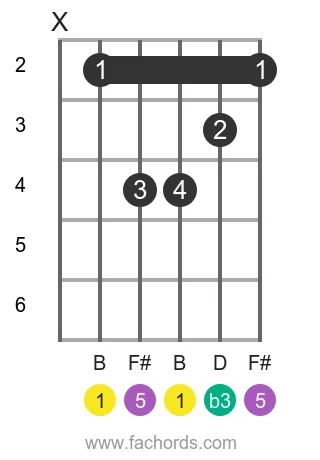
For Levitating, a capo on fret 2 turns Am Em Dm into the B minor version of the loop, used in the verse and chorus. Add the sevenths when the triads feel comfortable.
Two Close Relatives
Swap the last two chords and you get i-iv-v, Am Dm Em, where the bass climbs instead of sinking. Keep this order but make Am and Dm major, and you land on the Mixolydian I-v-IV, A Em D.
Minor i-v-iv Chord Progression: Chords and Audio in C, G, D, A and E
Press play to hear each key. The diagrams show the shapes used in the audio, and every chord links to its full page.
More progressions like this one
- Minor i-v-bVI-bVII: Cm Gm Ab Bb
- Subtonic shuttle (minor): Cm Bb
- Minor i-iv vamp: Cm Fm
- Minor tonic-dominant vamp: Cm G

Created by
Giancarlo is a musician (teaching guitar since 2000), software engineer, AI consultant and published researcher
FAQ
What is the i v iv loop in each key?
In C minor: Cm Gm Fm. In G minor: Gm Dm Cm. In D minor: Dm Am Gm. In A minor: Am Em Dm. In E minor: Em Bm Am.
Why does the i v iv loop use a minor v?
It stays in natural minor, where the chord on the fifth degree is minor. With no leading tone there is no real pull to the tonic, so the loop sounds smooth and laid-back.
Which chords does Levitating by Dua Lipa play?
The verse and chorus play Bm7 F#m7 Em7 in B minor. That is i-v-iv with sevenths added, the same loop as Am Em Dm in A minor.
What is the difference between i v iv and i iv v?
The last two chords swap places. Am Em Dm drops a fourth, steps down and drops again, while Am Dm Em climbs. Both use the same three natural minor chords.
