Diagonal Guitar Scale Patterns
An Easy Way To Break Fixed Schemes And Move Across The Neck
In this tutorial, we will learn how to play guitar scales in a way that allows us to move horizontally across the neck.
One of the problems of beginner lead guitar players is that, after a while, they feel trapped in the same, boring scale box.
The method you'll learn in the following helps fix this issue and provide you with better fretboard fluidity. So let's introduce diagonal guitar scales!
What Are Diagonal Guitar Scales
Diagonal scales, also referred as scale chunking, can be seen as a series of one-octave patterns repeated moving up the fretboard.
Here's below you find the diagonal pattern for the G major pentatonic scale, notice how the sequence G A B D E is repeated 3 times on 3 different octaves:

This method provides some remarkable advantages:
- You can learn the mechanics of a simple one-octave pattern, and transfer finger skills to the upper octaves, by simply shifting your left hand.
- You have a clearer vision of the fretboard because the shape is the same for each octave.
- You move horizontally along the neck, so it's easier to overlay 3-note-per-strings shapes or connecting 4-frets scale boxes.
Important note: On the guitar, to go one octave higher you move by 2 frets and 2 strings up. Be sure to shift one extra fret (3 frets) when you traverse the 3rd and 2nd strings.
Important note 2: Be sure to start each octave with the same finger. For example, in the image above, place your index finger on the 3rd fret for octave 1, on the 5th fret for octave 2, and on the fret 8 for the octave 3.
Practical Application Of Diagonal Scales
To fully take advantage of this particular fingering configuration, and at the same time break the boring scalar sound, it's helpful to drop a note in a scale.
The picture below shows you the diagonal pattern for the A minor scale, without the 7th note, G.

Here we elaborate the concept a bit further and use groups of 4 notes: A B D and E:

And here we show how to play the G Blues scale moving diagonally (please notice that we dropped the F):

Diagonal Scales: Further Suggestions
Using this method you can see 3 main fretboard areas that you can enter or leave to your taste. Here are some pointers:
- Create a melody of 3/4 notes and play it on each chunk, moving it up and down. You'll find yourself moving freely across the entire fretboard.
- Drop some other notes and keep only the root, thirds, fifths and maybe seventh. In this way, you'll play diagonal arpeggios, which are even more musical. Add9 Arpeggios are a great application of this concept.
- Try to solo over a song or progression you like, forcing yourself to use the fretboard navigation method just shown. You'll come up with interesting ideas that go beyond the 4-frets-box cage.
Diagonal Pattern Exercise On The A Blues Scale
I'll leave you with a quick recap exercise that shows the concepts we've been talked about so far. It's base on the A minor blues scale.
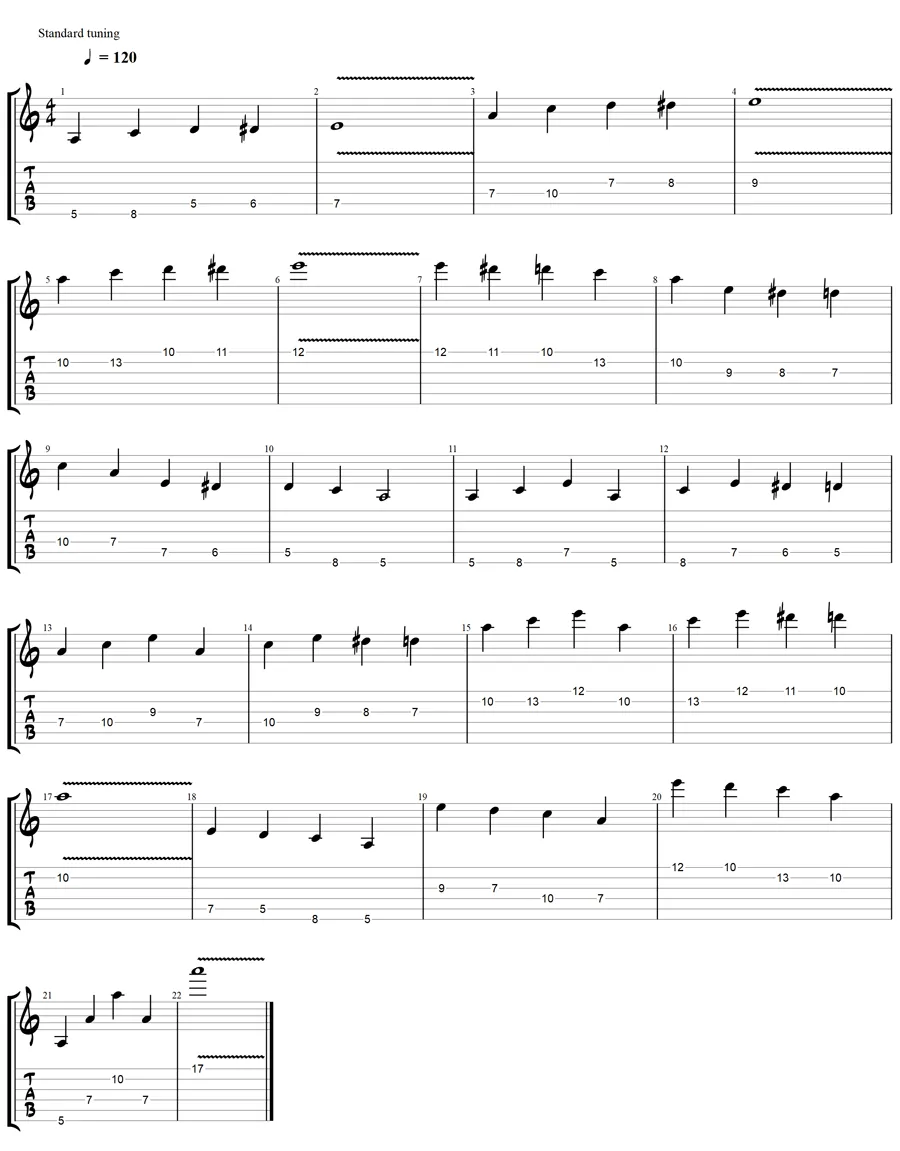
Happy practice! To stay updated on new tutorials, subscribe here.

Created by
Giancarlo is a musician (teaching guitar since 2000), software engineer, AI consultant and published researcher
FAQ
What are diagonal guitar scales and how do they differ from typical scale boxes?
Diagonal scales, also known as scale chunking, involve repeating a single one-octave pattern as you move horizontally up the guitar neck. This approach differs from typical fixed scale boxes by enabling greater fretboard fluidity and allowing you to break out of confined positions, providing a clearer vision of how scale shapes repeat across the neck.
What are the main advantages of learning diagonal scale patterns on guitar?
Learning diagonal scale patterns offers several advantages: they help break the feeling of being 'trapped' in the same scale box, improve overall fretboard fluidity, provide a clearer visual understanding of the fretboard due to consistent one-octave shapes, and make it easier to connect with other patterns like 3-note-per-string or 4-fret scale boxes.
How do I correctly shift up an octave when playing diagonal scale patterns on guitar?
To shift up one octave with diagonal scale patterns, you generally move your hand two frets and two strings up the neck. However, there's a specific rule: when you move from the 3rd string (G) to the 2nd string (B), you must shift an extra fret, meaning you move three frets forward instead of two, to maintain the correct interval.
How can I make diagonal scale patterns sound more musical and less like a rigid exercise?
To enhance the musicality of diagonal scale patterns, try dropping certain notes from the scale to create shorter melodic phrases or arpeggios. For instance, focusing on just the root, thirds, fifths, and perhaps sevenths will allow you to play diagonal arpeggios, which are often more musical than full scales. You can also create short 3-4 note melodies and play them across the different octave chunks.
