Drop D Tuning for Guitar
How to Tune to D A D G B E, One-Finger Power Chords and What Else Changes on the Fretboard
Drop D is the smallest change you can make to a guitar and still feel like you picked up a different instrument. One string, two frets lower, ten seconds of work.
What do you get for it? A low D that standard tuning doesn't have, power chords you can play with a single finger, and a D chord that suddenly uses all six strings. That's why drop D tuning shows up in heavy rock riffs and in quiet acoustic songs alike.
Most pages about drop D give you a tuner and say goodbye. Here you'll tune the string with a reference tone, and then we'll see what actually changes: the power chords, the chord shapes drawn for drop D, a riff in tab, all with audio.
Drop D tuning in one sentence: it is standard tuning with the 6th string lowered a whole step from E to D, so the strings are D A D G B E (low to high).
What it gives you: the three lowest strings (D A D) form a D power chord, so one finger across them is a power chord at any fret.
Drop D Tuning Notes
Here is the fretboard in drop D. Compare the bottom string with the one you know: every note on it has moved two frets higher. The G that lived on the 3rd fret is now on the 5th, the A on the 5th fret is now on the 7th.

(The map writes the notes between the natural ones as flats: Gb is F#, Db is C#.)
The other five strings are untouched, so everything you know about them still works. That's the beauty of drop D: you learn one new string, not a new fretboard. If the notes are still a bit foggy, our guide to the guitar fretboard notes shows the standard layout to compare with.
The six open strings in drop D, low to high, then a full D chord
How to Tune to Drop D
Only the 6th string moves. Lower it a whole step, from E down to D.
| String | Standard | Drop D | What to do |
|---|---|---|---|
| 6th | E (E2, 82.41 Hz) | D (D2, 73.42 Hz) | Down a whole step |
| 5th | A | A (A2, 110 Hz) | Leave it |
| 4th | D | D (D3, 146.83 Hz) | Leave it |
| 3rd | G | G (G3, 196 Hz) | Leave it |
| 2nd | B | B (B3, 246.94 Hz) | Leave it |
| 1st | E | E (E4, 329.63 Hz) | Leave it |
Play the reference tone and bring your 6th string down until the two notes sound like one:
Reference tone: the 6th string in drop D (low D)
Before and after: the low E of standard tuning, then the low D
How to tune to drop D by ear
No tuner around? The guitar already has the note you need:
- Use the open 4th string. It's a D. Pluck it, then pluck the 6th string and lower it until you hear the same note, one octave below.
- Check with the 7th fret. Press the 6th string at the 7th fret: it must sound exactly like the open 5th string (A). In standard tuning that match was on the 5th fret.
- Or use the harmonic. The 12th-fret harmonic of the 6th string is the same pitch as the open 4th string. When the slow wobble between the two disappears, you're there.
Check 1: open 4th string, open 6th string, together. Check 2: 6th string at the 7th fret, open 5th string, together
Going back to standard is the same trip in reverse: raise the 6th string until its 5th fret matches the open 5th string again. You can switch as often as you like, it's a small change and the guitar doesn't mind.
Drop D Power Chords: One Finger Is Enough
Here's the reason most people drop the string. A power chord is a root, a 5th and usually the root again one octave up. Look at the three low strings in drop D: D, A, D. Root, 5th, root. It's already a power chord, and it stays one wherever you lay a finger across those three strings.
D5 (open)

F5 (3rd fret)

G5 (5th fret)

D5 - F5 - G5 - F5 - D5, all downstrokes
The fret tells you the chord. Learn this row and you can follow almost any drop D song:
| Fret (one finger, strings 6-5-4) | 0 | 1 | 2 | 3 | 5 | 7 | 8 | 10 | 12 |
|---|---|---|---|---|---|---|---|---|---|
| Power chord | D5 | Eb5 | E5 | F5 | G5 | A5 | Bb5 | C5 | D5 |
Since one finger does the job, you can change chord as fast as you can slide. Fast riffs that would be a workout with the standard two-finger shape become easy, and that is a big part of the heavy rock sound of the last decades.
A Drop D Riff in Tab
Let's use that low string. This riff stays on the 6th string and uses four notes of the D blues scale: D (open), F (3rd fret), G (5th fret) and Ab (6th fret). Keep the open D chugging between the other notes, and rest the side of your picking hand on the strings near the bridge for a tighter sound.
E|-------------------|------------------|
B|-------------------|------------------|
G|-------------------|------------------|
D|-------------------|------------------|
A|-------------------|------------------|
D|--0-0-3-0-5-0-6-5--|--0-0-3-0-5-3-0---|
The riff on the 6th string, played twice
Now make it bigger. Flatten your finger over the three low strings and play the same kind of move with power chords, two strokes each: D5, F5, G5, F5.
E|--------------------|
B|--------------------|
G|--------------------|
D|--0-0-3-3-5-5-3-3---|
A|--0-0-3-3-5-5-3-3---|
D|--0-0-3-3-5-5-3-3---|
D5 - F5 - G5 - F5, three times, ending on D5
For solos and fills over riffs like these, the notes of the D minor pentatonic scale are the first place to look. And if you want more ideas to steal, here is our list of famous guitar riffs.
Drop D Chords: What Changes and What Doesn't
Do you have to relearn your chords? Mostly no. There is one rule:
The drop D chord rule: any note you used to play on the 6th string is now two frets higher. Chords that don't use the 6th string don't change at all.
The big D chords
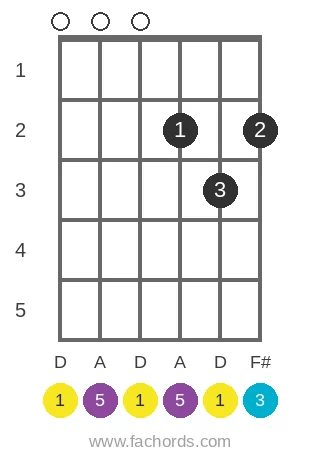
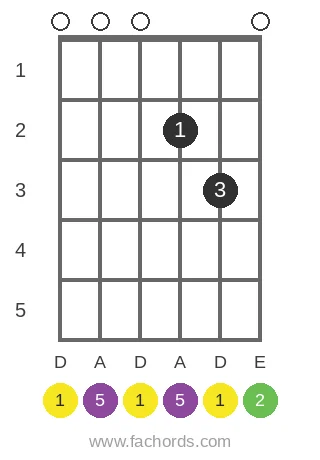
In standard tuning a D chord has its root on the 4th string, and the low E string has to stay out of it. In drop D you can hit all six: the low strings are D, A and D, all notes of the chord. Same fingers as always, a much bigger sound.
D
Dsus2
Dm
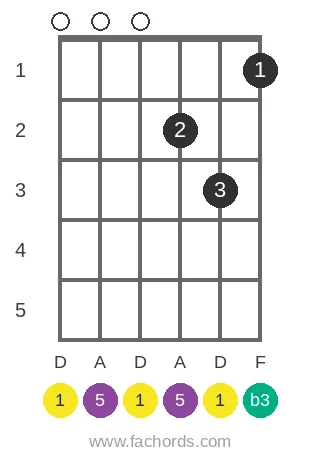
D - Dsus2 - D - Dm, one strum each, all six strings
Chords that use the 6th string: move the bass note
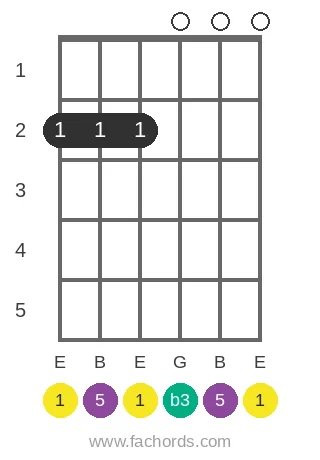
Em
G

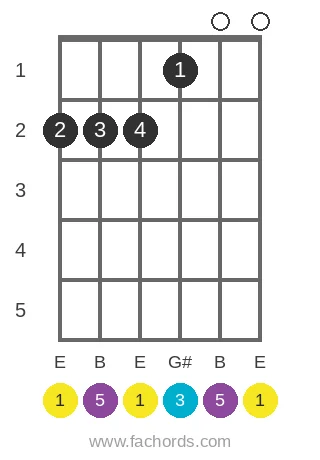
E
- Em (2-2-2-0-0-0): the open 6th string is no longer an E, so you fret it at the 2nd fret. One finger flat across the three low strings does it, a power chord with the open top strings ringing.
- G (5-x-0-0-0-3): the bass G moves from the 3rd to the 5th fret. Mute the 5th string with the side of the finger that plays the bass, and keep the 3rd fret of the 1st string.
- E (2-2-2-1-0-0): like Em, plus the 1st fret of the 3rd string. Three fingers on the 2nd fret, index on the G#.
Chords on strings 5 to 1: nothing to learn
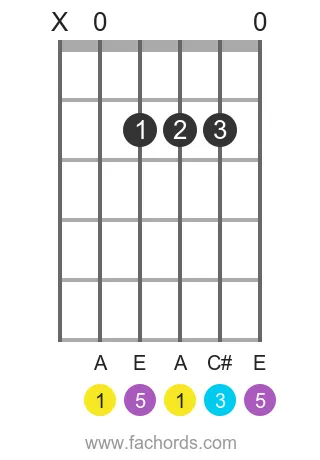
A, Am, C, B7, and every chord with its root on the 5th or 4th string are played exactly as before. Just keep muting or skipping the 6th string where you already did.
A (unchanged)
C (unchanged)

Same shapes
Neither chord touches the 6th string, so drop D doesn't change them.
With D, Em, G and A you already have four of the chords in the key of D major, the natural home of this tuning.
D - G - Em - A - D in drop D
Drop D chord chart
Frets are written from the 6th string to the 1st, x is a muted string.
| Chord | Standard tuning | Drop D | Notes in drop D (low to high) |
|---|---|---|---|
| D5 | x-x-0-2-3-x | 0-0-0-x-x-x | D A D |
| F5 | 1-3-3-x-x-x | 3-3-3-x-x-x | F C F |
| G5 | 3-5-5-x-x-x | 5-5-5-x-x-x | G D G |
| D | x-x-0-2-3-2 | 0-0-0-2-3-2 | D A D A D F# |
| Dm | x-x-0-2-3-1 | 0-0-0-2-3-1 | D A D A D F |
| Dsus2 | x-x-0-2-3-0 | 0-0-0-2-3-0 | D A D A D E |
| Em | 0-2-2-0-0-0 | 2-2-2-0-0-0 | E B E G B E |
| E | 0-2-2-1-0-0 | 2-2-2-1-0-0 | E B E G# B E |
| G | 3-2-0-0-0-3 | 5-x-0-0-0-3 | G D G B G |
| F (barre) | 1-3-3-2-1-1 | 3-3-3-2-1-1 | F C F A C F |
| A | x-0-2-2-2-0 | x-0-2-2-2-0 (same) | A E A C# E |
| C | x-3-2-0-1-0 | x-3-2-0-1-0 (same) | C E G C E |
Songs in Drop D Tuning
Drop D is not only for heavy music. Have a listen to how different these sound, all with the same low D:
| Song | Artist | What to listen for |
|---|---|---|
| Dear Prudence | The Beatles | Fingerpicking over a low D that keeps ringing |
| Moby Dick | Led Zeppelin | A blues-rock riff built on the low string |
| Harvest Moon | Neil Young | Soft acoustic strumming around the D chord |
| Black Hole Sun | Soundgarden | Heavy chorus chords on the low strings |
| Killing in the Name | Rage Against the Machine | Riffs that lean on the open low D |
Drop D vs D Standard, Double Drop D, Drop C and Open D
The names are similar, the tunings are not. Here is the family:
| Tuning | Strings (6th to 1st) | What changes from standard |
|---|---|---|
| Drop D | D A D G B E | 6th string down a whole step |
| Double drop D | D A D G B D | 6th and 1st strings down a whole step |
| D standard | D G C F A D | All six strings down a whole step: same shapes as standard, lower sound |
| Drop C | C G C F A D | Drop D with every string one more whole step down |
| DADGAD | D A D G A D | 6th, 2nd and 1st strings down a whole step |
| Open D | D A D F# A D | Four strings down: the open strings are a D major chord |
Drop D, DADGAD and open D share the same three low strings, so your one-finger power chords work in all three. If you like where this is going, open D tuning is the natural next step, and the full tour is in our list of alternate guitar tunings.
Conclusion
Drop D is the easiest alternate tuning to try and the easiest to leave: one string down, one string back up. Here is the recap:
| Notes | D A D G B E (D2 A2 D3 G3 B3 E4) |
| From standard | 6th string down a whole step, E to D |
| Tune by ear | 6th string = open 4th string, one octave lower. 7th fret of the 6th = open 5th |
| Power chords | One finger on strings 6-5-4: open = D5, 3rd fret = F5, 5th = G5, 7th = A5 |
| Chord rule | Notes on the 6th string move two frets higher, everything else stays |
| Best for | Riffs, fast power chord changes, songs in D with a deep bass |
Your next step: drop the string, play the riff above until it grooves, then strum that six-string D chord and enjoy the low end.
That's all for today.
Remember that you can subscribe here to stay updated on new tutorials and gain access to the free download area, where you'll find some free chords and scales PDFs.

Created by
Giancarlo is a musician (teaching guitar since 2000), software engineer, AI consultant and published researcher
FAQ
What is drop D tuning?
Drop D tuning is standard tuning with the 6th (lowest) string lowered a whole step, from E to D. The strings become D A D G B E, low to high. The other five strings do not change. The three lowest strings (D A D) form a D power chord, which is why one finger across them plays a power chord at any fret.
Is drop D tuning just the low E string?
Yes. Only the 6th string changes: it goes down a whole step (two frets) from E to D. Strings 5 to 1 stay in standard tuning, A D G B E. That is the difference with D standard tuning, where all six strings go down a whole step, and with open D tuning, where four strings change.
How do you tune to drop D without a tuner?
Play the open 4th string, which is a D, and lower the 6th string until it sounds like the same note one octave lower. To check, press the 6th string at the 7th fret: it should sound exactly like the open 5th string (A). The harmonic at the 12th fret of the 6th string should also match the open 4th string.
Do chords change in drop D tuning?
Only the chords that use the 6th string. Any note you used to play on the 6th string is now two frets higher: G becomes 5-x-0-0-0-3 instead of 3-2-0-0-0-3, E minor becomes 2-2-2-0-0-0, an F barre chord becomes 3-3-3-2-1-1. Chords played on strings 5 to 1, like A, C, Am or B7, stay exactly the same.
How do you play power chords in drop D?
Lay one finger flat across the three lowest strings at the same fret. The open strings are D5, the 3rd fret is F5, the 5th fret is G5, the 7th fret is A5 and the 10th fret is C5. The 6th string gives the root, the 5th string the fifth and the 4th string the root one octave higher.
What is the difference between drop D and D standard tuning?
In drop D only the 6th string goes down a whole step (D A D G B E), so every chord and scale shape on the other five strings is unchanged. In D standard all six strings go down a whole step (D G C F A D): the shapes are the same as in standard tuning, but everything sounds a whole step lower.
Is drop D tuning bad for the guitar or the strings?
No. You are lowering one string by a whole step, which reduces the tension slightly. You can switch between standard and drop D as often as you like. The low string feels a little looser and can buzz if you hit it hard with very light strings; a slightly heavier 6th string fixes that.