Guitar Rhythm
Count beats, read time signatures and lock in your strumming, from your first downstroke to odd meters and polyrhythms
Rhythm is what turns a list of chords into music. Great rhythm guitar comes down to three skills: feeling the pulse, knowing how each bar divides, and keeping your strumming hand steady. This hub collects every FaChords rhythm lesson and free interactive tool, in the order that works best for learning them.
Your Rhythm Learning Path
Each step builds on the one before it, so start with the first step that feels new to you.
- Learn to count music: note values, rests and the beat, the base of everything else.
- Understand time signatures: what 4/4, 3/4 and 6/8 mean and how each one feels.
- Train your ear for rhythm: hear and see rhythms through everyday words.
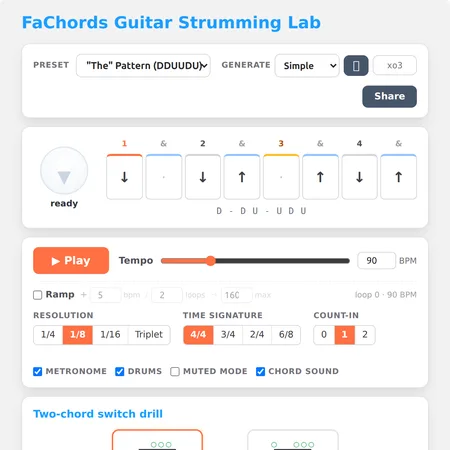
- Play strumming patterns: 10 essential patterns with tabs, audio and an interactive trainer.
- Improve your strumming: practical tips for a looser, steadier strumming hand.
- Explore odd meters and polyrhythms: 5/4, 7/8, 11/8, 6/8, 12/8 and how to count them.
- Discover hemiola: two notes in the space of three, and how to use that tension in your playing.
Rhythm Basics
Timing, phrasing and articulation all come from rhythm, and rhythm is a skill you build slowly. These are the six ideas everything else rests on.
1. Tempo and BPM, the Speed of the Pulse
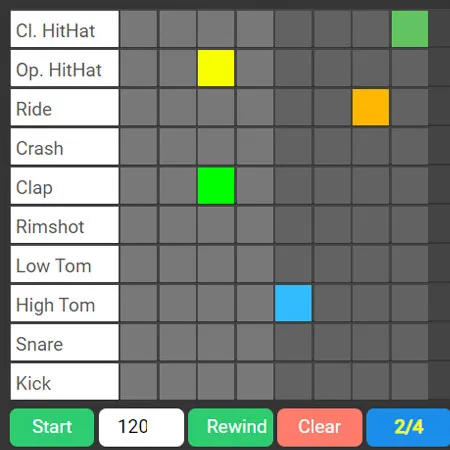
The pulse is the steady beat you tap your foot to. Its speed is the tempo, measured in BPM (beats per minute). The single most important habit: practice slow, lock to a click, and only raise the BPM once it's clean. Use the online drum machine (or a metronome) as the heartbeat for every exercise.
2. Beat, Downbeat and the Backbeat
Beats alternate between stressed and unstressed motion, which gives music forward drive. In 4/4 the 1 is the strongest downbeat and the 3 is secondary. Accenting the 2 and 4 instead, the backbeat, is the engine of rock, pop and dance. Shifting accents onto offbeats is syncopation, and it's where groove lives.
3. Meter and Time Signature
A repeating pattern of pulses is the meter, and the time signature notates it. The bottom number is the note value that gets one beat, and the top number is how many of those fit in a bar. So 4/4 ("common time") is four quarter-note beats per measure. Read more in What Are Time Signatures.
4. Note Values and Counting Syllables
To count a bar you subdivide the beat. In 4/4, work up through these one at a time, saying them out loud before you play them:
| Subdivision | Per 4/4 bar | Count it | On guitar |
|---|---|---|---|
| Quarter notes | 4 | 1 2 3 4 | Four downstrokes |
| Eighth notes | 8 | 1 & 2 & 3 & 4 & | Down on numbers, up on "&" |
| Sixteenth notes | 16 | 1 e & a 2 e & a 3 e & a 4 e & a | Alternate down and up across all |
Then mix them, 1 2 & 3 4, 1 & 2 3 4 &, 1 2 e & a 3 4, keeping the metronome slow and your foot tapping. Engaging the body genuinely speeds up rhythmic learning. The full method is in How To Count Music.
5. Rests
A rest is counted silence. You still count it (often in brackets: 1 2 3 (4)) and keep your strumming hand moving in the usual down and up pattern without striking the strings, so the time never drifts.
6. Beyond 4/4
Once 4/4 is solid, meet the others by feel: 3/4 (waltz, 1 2 3), 6/8 (flowing folk feel, counted 1 2 3 4 5 6 with stress on 1 and 4), and the irregular 5/4 (Take Five, Mission Impossible) and 7/4 (Pink Floyd's "Money"), which you group into pockets of 2s and 3s. For why odd groupings work, see hemiola.
Free Rhythm Tools
Rhythm is easier to learn when you can hear it. These tools run in your browser, with nothing to install.
Rhythmic Dictation Trainer
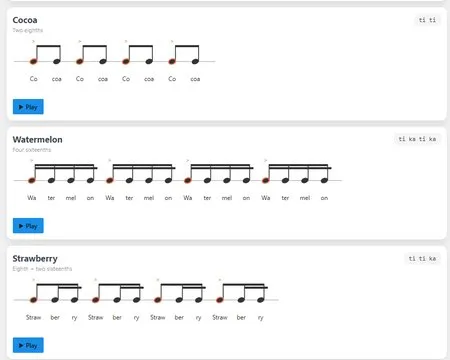
Turn everyday words into rhythms, from quarter notes to triplets and syncopation.

Keep Practicing
Good time comes from slow, regular practice. Learn how to use a metronome, read strumming and rhythm notation, then put your sixteenth notes and syncopation to work with funk guitar. When you are ready for something to strum, pick a loop from our guitar chord progressions.

Created by
Giancarlo is a musician (teaching guitar since 2000), software engineer, AI consultant and published researcher
FAQ
What is the best way to learn rhythm on guitar?
Start by counting out loud and tapping your foot, then learn time signatures and add strumming patterns at a slow tempo with a metronome or drum machine. Raise the speed only once the pattern is clean.
What do the numbers in a time signature mean?
The top number tells you how many beats are in each bar, and the bottom number tells you which note value gets one beat. In 4/4 there are four beats per bar and the quarter note gets one beat.
How do you count eighth and sixteenth notes?
Count eighth notes as 1 & 2 & 3 & 4 &, with downstrokes on the numbers and upstrokes on the "&". Count sixteenth notes as 1 e & a 2 e & a 3 e & a 4 e & a, alternating down and up across all of them.
What is the difference between odd meters and polyrhythms?
An odd meter such as 5/4 or 7/8 groups the beats of a bar unevenly, in mixes of 2s and 3s. A polyrhythm plays two different rhythmic groupings at the same time, such as 3 against 2.