G aug Guitar Chord
Chord Diagrams, Interactive Fretboard and Chord Theory
G augmented guitar chord is also written as Gaug, G+, G(#5) or Gmaj(#5).
Position 1
Movable
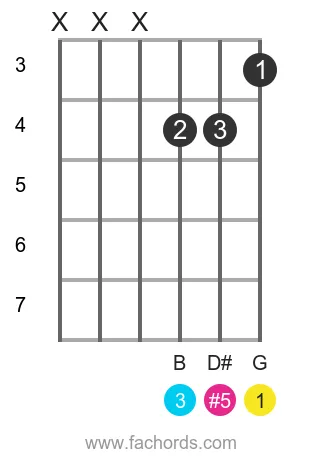
Position 2
Movable
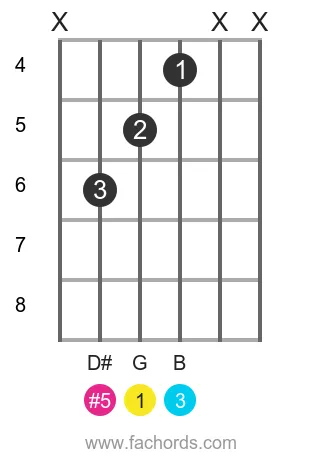
Position 3
Movable
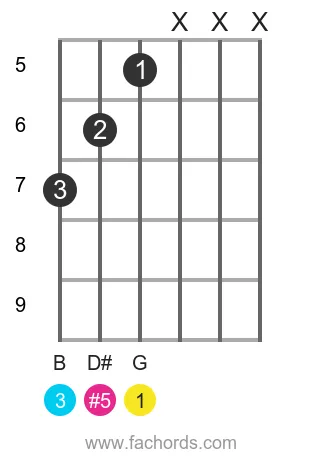
Position 4
Movable
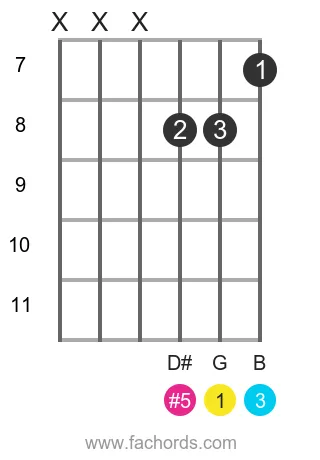
Position 5
Movable
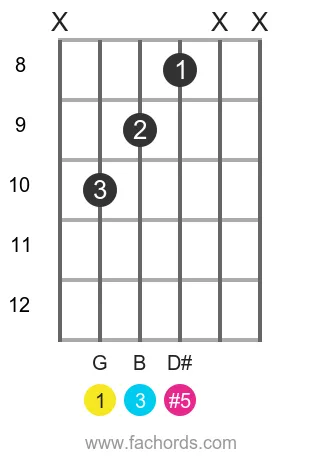
Position 6
Movable
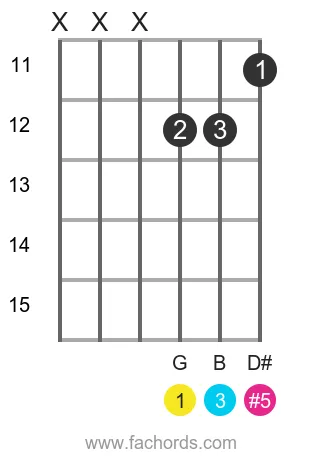
Position 7
Movable
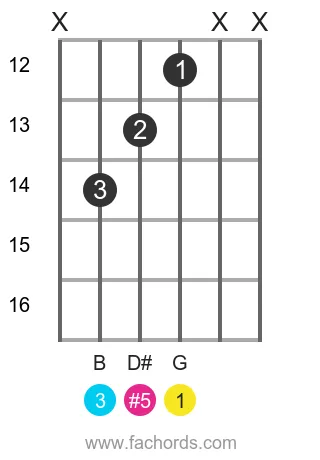
Position 8
Movable
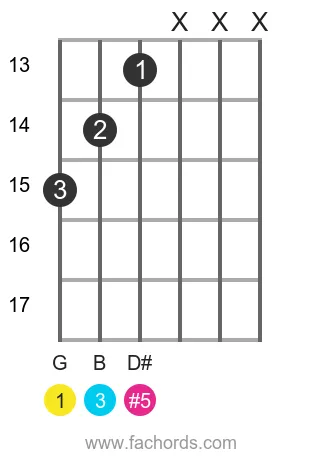
Position 9
Movable
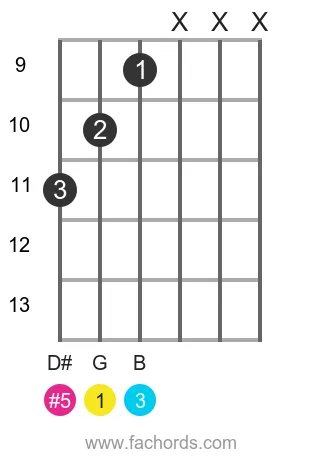
Position 10
Movable
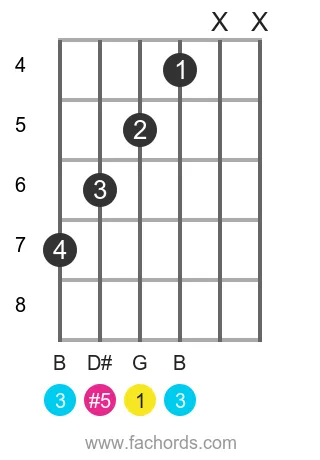
Position 11
Movable
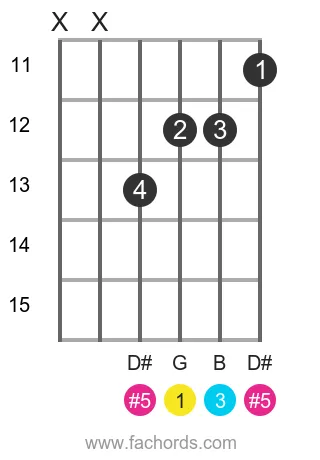
Position 12
Barre
Movable
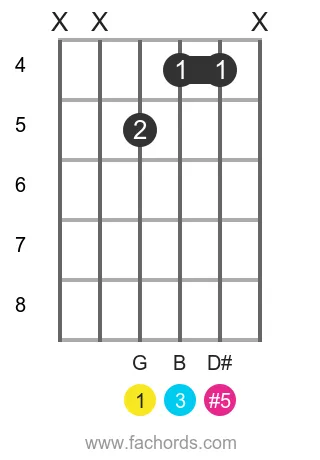
Position 13
Barre
Movable
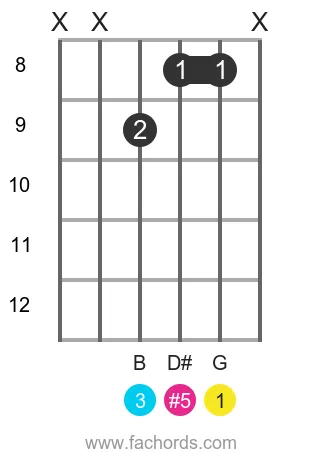
Position 14
Barre
Movable
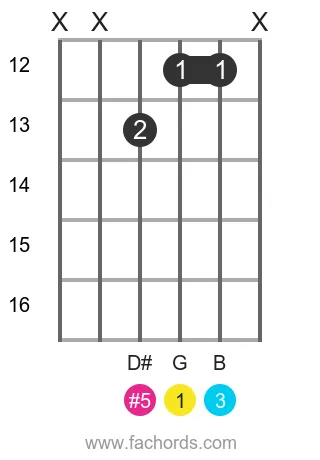
Position 15
Barre
Movable
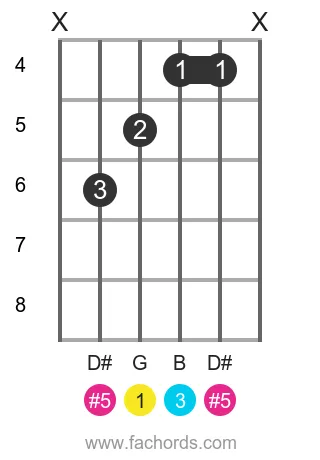
 Find more shapes in our all guitar chords online library. If you
prefer a printable pdf, download
the Free Guitar Chords Chart Pdf
Find more shapes in our all guitar chords online library. If you
prefer a printable pdf, download
the Free Guitar Chords Chart Pdf
You can also use this accessible Gaug chord page, with written diagram instructions and screen-reader support for blind users.
Explore G Augmented: Play & Master this Unique Chord
Want a structured chord roadmap instead of jumping between pages?
Go to the full guitar chords tutorial.
Unleash the expressive power of the G augmented (G aug) chord, a captivating sound often heard in jazz and film scores to create tension or a dreamy atmosphere. This unique member of the Augmented Chords family is built upon the notes G, B, and D#, defined by its characteristic Root (1), Major Third (3), and Augmented Fifth (#5) intervals. Dive in and experience it on our interactive fretboard; instantly hear its unique sound with playback and confirm your finger placement accuracy through real-time mic feedback.
Understanding how the G aug chord is built-specifically, the equidistant nature of its augmented fifth-is key to mastering its versatility. The symmetrical structure means that G augmented, B augmented, and D# augmented are all the same collection of notes, just in different inversions. Our virtual fretboard highlights these chord construction principles, showing you how these intervals lay out across the strings. Explore this by experimenting with different voicings, and deepen your understanding of Understanding Chord Inversions to see how this symmetry works in practice.
Below, you'll find a range of G augmented chord diagrams, progressing from simpler voicings to more complex shapes. While theory is important, we encourage you to first grab your guitar and play along with the virtual fretboard above. Experiment with the different chord shapes, listen to their unique sound, and try incorporating them into practice songs in various keys. This hands-on approach will fast-track your journey to mastering the G aug chord.
Notes that compose the G+ chord:
Chord structure of the Augmented Fifth chord:
Play This Chord With Other Roots
C aug | D aug | E aug | F aug | G aug | A aug | B aug | C#aug | D#aug | F#aug | G#aug | A#aug | Abaug | Bbaug | Dbaug | Ebaug | Gbaug

Created by
Giancarlo is a musician (teaching guitar since 2000), software engineer, AI consultant and published researcher
FAQ
What defines an augmented chord, and how does the G augmented chord fit into that definition?
An augmented chord is characterized by its specific interval structure: a Root, a Major Third (3), and an Augmented Fifth (#5). The G augmented chord precisely follows this pattern, with G as the Root, B as the Major Third, and D# as the Augmented Fifth, which together create its unique sound.
Why are the notes G, B, and D# specifically chosen for the G augmented chord?
These notes are chosen because they represent the essential intervals that define an augmented chord, starting from G as the root. G is the 1 (Root), B is the 3 (Major Third) above G, and D# is the #5 (Augmented Fifth) above G, forming the complete G augmented chord.
What gives the G augmented chord its 'unique sound'?
The 'unique sound' of the G augmented chord primarily comes from the Augmented Fifth (#5) interval. This interval, which is D# in a G augmented chord, creates an 'expanded' or slightly dissonant quality that distinguishes it from major or minor chords, adding a distinctive color to the harmony.
When would I typically use a G augmented chord in music?
The G augmented chord can be used to add a new and interesting dimension to your music. It is particularly effective in jazz chord progressions, where its unique sound can create harmonic tension, add flavor, or facilitate smooth transitions between other chords.