How To Use Vibrato On Guitar
Make Your Guitar Sing Like Frank Sinatra
When it comes to vibrato one of the best musical examples is Frank Sinatra. Yeah, it's true he is not a guitar player, but good vibrato has a place in all music, and you must give credit where it is due. Below we will discuss this musical feat of vibrato and how you can get better at playing it on your guitar.
When you listen to Frank, notice how he often ends his syllables in a wavy or shaky manner. This pulsating of a note is known as vibrato, and it can vary in pitch and speed. Frank Sinatra is a great example of fast vibrato, while the Tarzan call would be a poor example of slow and bad vibrato!
The reason vibrato exists on string instruments is to mimic the human voice, so our goal on the guitar is to make pleasant and regular pulsating sounds.
How to Play Vibrato | Simple Vibrato Exercise
We started this article with a singing example of vibrato because that is exactly what you are going to do. You want to make your guitar sing those notes like a soul vocalist, they need emotion and the proper speed to fit the mood. First, we will go over the quickest method of using your hands.
Have a look at the video above, in which I play some vibrato with the note of the Minor Blues Pentatonic Scale. Pay attention to the different ways I apply vibrato, with the index finger, the ring finger, fast, slow, strong. Notice also how I bend a string and then vibrate the note:
As vibrato is a matter of expression and feeling, the best way to deal with it is to freely experiment. Try to imitate what I'm doing in the video.
Test different types of vibrato: slow, fast, aggressive, soft... pay attention to the sound nuances. Unlike scales or chords, vibrato belongs to the realm of the soul, it's not easy to write it on a guitar tab.
Vibrato Finger Motion
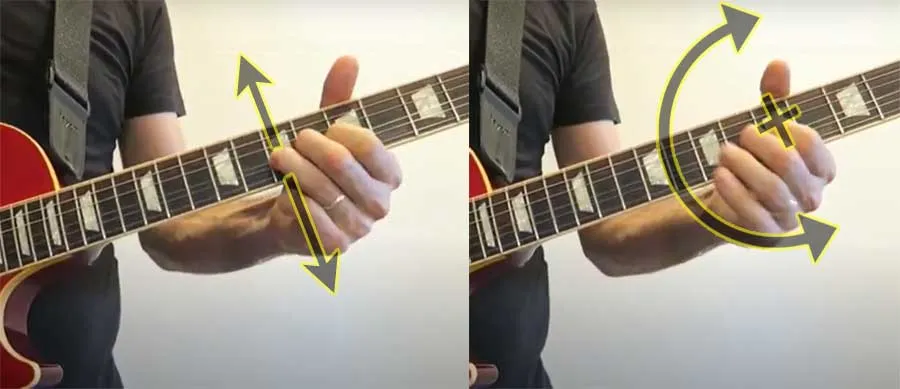
Vibrato with Index Finger
These are not strict rules, but some suggestions may help. When you vibrate a note fretted with the index finger, is useful to think about this finger as a pivot on which the left hand rotate around.
Your wrist will play a part in the movement depending on how much you want the string to change its pitch (refer to the video above to see clearly this movement)
Vibrato with Other Fingers
Even if you can use a left-hand rotation motion also with other fingers, often is more efficient to vibrate the note by moving the finger up and down, perpendicularly to the fretboard.
Sometimes all you need is a little finger bending to get a very light vibrato. Practice different strings with small and large amounts of vibrato, see how long you can hold a note with just one string pluck.
Bending and Vibrato
If you haven't learned string bending yet, now would be a good time. By quickly bending a string slightly up and down you will get the standard guitar vibrato. Generally, you will lightly pull the string up or down and then give it a shake. Most of that movement will be in the wrist.
Be sure to keep moving in the same direction (whether you decide to bend up or down). And keep your finger pressed tight, so it doesn't slip when moving the string.
Obviously, this is harder to do on the 1st and 6th strings as you have less room to move. And the more you move the string the more the pitch changes. If you are playing hard rock, you will want hard strikes with the pick and large vibrato movements. For a slow song you will play quieter and keep the movements as close as possible.
Vibrato Pointers
It may seem obvious but always be sure to let the note ring out before starting the vibrato movement. The more sound the more pulsating you can get.
Practice humming and singing the parts that you want to have vibrato in. Don't underestimate the vocal power of cementing the vibrato in your head.
Practice on acoustic guitars, even ones with kind of bad action and heavy strings. If you can do it on a guitar like that, then your electric guitar will be a breeze.
While you usually use one finger to anchor and vibrate the string, there are times when other fingers can be used for support.
The speed is very important, too fast, or too slow can make the vibrato sound out of place or bad.
And most of all, do not overuse vibrato! It is common for a musician to play it way too much when they first learn it. Use it sparingly when the song needs that extra soul.
Vibrato Bars and Effects Pedals
If you have a Fender Strat or any guitar with a whammy bar it will help you get the feel for the vibrato. This bar stretches the strings to produce the pitch variation. The key is not to hold and move it in a robotic manner, keep the hand loose and vibrate the notes in time with the music.
When you play vibrato, it is important to match the note pitch changes with the tempo or rhythm of the piece.
For a beginner this can take some time, but one shortcut is vibrato pedals that not only create the effect, but they also match it to the BPM. Fender was one of the first companies to facilitate vibrato with their Vibrolux.
It is common to see tremolo and vibrato pedals in the same box as their effects can be simulated easily with the same components, but remember they are not the same effect on the guitar.
If you listen to enough vibrato pedals, you may notice they don't have as real of an effect as a whammy bar or quick finger string bend.
But vibrato pedals still have their place when you are searching for that perfect guitar tone.
Notable examples of Great Vibrato Technique
Blues as a genre is going to be filled with vibrato, especially played by the greats like B.B. King. He is the gold standard of vibrato when it comes to guitar. And one of the earlier influences was the light vibrato of "Rumble" (it makes use of tremolo too, more near the end).
The Everly Brothers also used early vibrato and tremolo effects in "The Price of Love". And later rock n roll Jimi was a regular vibrato user, and Angus lightly pops it in his riffs in "Back in Black". More rock examples are "Bad Penny" and "Parsienne Walkways".
Some great examples of slow and smooth vibrato are "Many Rivers to Cross" and "Cryin". In many cases vibrato is used alongside tremolo and other techniques. And here are a few more kinds of vibrato from Steve Vai.
It would be nice to give more pointers on vibrato and how to succeed in doing it correctly, but it is one of those guitar skills that just needs done over and over. The ultimate secret is to make it sound exactly like a singer would.
If you struggle with vibrato just listen to as many songs as possible.
A good use of vibrato is what differentiates beginners from advanced players, so be sure to practice this skill.
That's all for today.
To stay updated on new content, subscribe here.

Created by
Giancarlo is a musician (teaching guitar since 2000), software engineer, AI consultant and published researcher
FAQ
What are the primary techniques for performing vibrato with the fretting hand?
There are a few key techniques for finger vibrato. When using your index finger, you often pivot your hand around it, utilizing wrist movement. For other fingers, it's generally more efficient to move the finger slightly up and down, perpendicular to the fretboard. Fundamentally, guitar vibrato is built upon quickly bending the string a small amount up and down to create the pulsating pitch.
How is finger vibrato different from using a whammy bar or a vibrato pedal?
Finger vibrato is a manual technique where you physically manipulate the string with your fretting hand. A whammy bar (or tremolo system) mechanically stretches the strings for pitch variation. Vibrato pedals are electronic effects that simulate the pitch modulation. While all aim to create a similar effect, finger vibrato and whammy bars offer a more direct, organic connection to the instrument, whereas pedals, while useful, may not always capture the same 'real' feel.
What are some essential tips for developing good, expressive vibrato?
To develop good vibrato, always let the note ring out clearly before starting the movement. Practice humming or singing the parts to internalize the desired vocal quality. Practicing on acoustic guitars can build strength and control. Pay close attention to the speed and depth of your vibrato, ensuring it suits the mood and tempo of the music. Most importantly, use vibrato judiciously; overusing it can detract from its impact.
How does string bending relate to achieving vibrato on the guitar?
String bending is the foundational technique for guitar vibrato. Vibrato on guitar is essentially a rapid, slight, and controlled string bend. You achieve the pulsating effect by quickly and repeatedly raising and lowering the pitch of a fretted note through small, consistent bends and releases, often initiated by the wrist.
