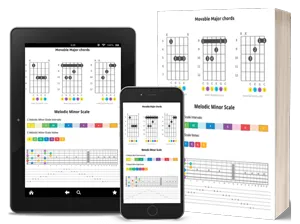
A# m-maj9 Guitar Chord
Chord Diagrams, Interactive Fretboard and Chord Theory
A# minor major 9th guitar chord is also written as A#m(maj9), A#mM9, A#minmaj9 or A#-Δ9.
 Download
the Free Guitar Chords Chart Pdf
Download
the Free Guitar Chords Chart PdfGuitar chord A#m(maj9) - diagrams and theory
Welcome to this tutorial on the A# m(maj9) chord, a member of the Minor Chords family. This chord is composed of the notes A#, C#, E#, G##, and B# and is built using the intervals 1, b3, 5, 7, and 9. These intervals correspond to the Root, Minor Third, Perfect Fifth, Major Seventh, and Major Ninth, respectively.
The A# m(maj9) chord is a little more advanced than some of the beginner chords you might be used to, but don't worry, we'll guide you through every step of the way. If you're interested in learning more about how chords are built by stacking intervals, you can check out this tutorial that teaches how to build chords by stacking intervals.
The A# m(maj9) chord is a Ninth chord, which means it includes the ninth interval. If you're interested in learning more about this type of chord, you might find this tutorial on ninth guitar chords helpful. Understanding the intervals that make up a chord can really help you master the fretboard and improve your playing. For more on this, take a look at this tutorial about fretboard intervals.
Once you've mastered the A# m(maj9) chord, you might want to start experimenting with different chord progressions. This tutorial on the most common chord progressions is a great place to start. And if you're ever unsure about a chord shape, this interactive tool to analyze chord shapes is a fantastic resource.
So, let's dive in and learn how to play the A# m(maj9) chord!
Notes in the A# m(maj9) chord:
Chord Formula:
Play This Chord With Other Roots
C m(maj9) | D m(maj9) | E m(maj9) | F m(maj9) | G m(maj9) | A m(maj9) | B m(maj9) | C#m(maj9) | D#m(maj9) | F#m(maj9) | G#m(maj9) | A#m(maj9) | Abm(maj9) | Bbm(maj9) | Dbm(maj9) | Ebm(maj9) | Gbm(maj9)

Created by
Giancarlo is a musician (teaching guitar since 2000), software engineer, AI consultant and published researcher
FAQ
What do the 'm' and 'maj9' signify in the A# m(maj9) chord name?
The 'm' in A# m(maj9) indicates the chord has a minor third interval, establishing its minor quality. The 'maj' specifically refers to the Major Seventh interval within the chord. The '9' denotes the inclusion of a Ninth interval, which in this specific chord is a Major Ninth.
Why does the A# m(maj9) chord contain notes like G## and B#?
The notes G## and B# are used to maintain the correct interval qualities when building the chord from the root A#. For example, to achieve a Major Seventh interval from A#, the note must be spelled as G##. Similarly, B# is the correct spelling for the Major Ninth interval from A#, ensuring each note accurately reflects its intended interval relationship.
How do the intervals (1, b3, 5, 7, 9) relate to the specific notes of the A# m(maj9) chord?
Starting from the root note A#, the 1st interval is A# itself. The b3 (Minor Third) corresponds to C#. The 5 (Perfect Fifth) is E#. The 7 (Major Seventh) is G##. And the 9 (Major Ninth) is B#. Each note is precisely determined by its interval quality and position relative to the root.
What makes the A# m(maj9) chord a 'Ninth chord'?
The A# m(maj9) chord is classified as a Ninth chord because its construction includes the ninth interval. Specifically, it features a Major Ninth, extending its harmonic structure beyond the standard seventh chord.