A7b5 Guitar Chord | Play, Hear and Practice Interactively
Want a structured chord roadmap instead of jumping between pages?
Go to the full guitar chords tutorial.
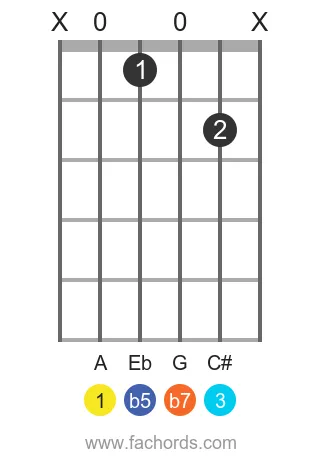
The A7b5 chord, a unique and intriguing member of the Dominant Chords family, is built from the notes A, C#, Eb, and G. These notes correspond to the intervals Root (1), Major Third (3), Diminished Fifth (b5), and Minor Seventh (b7), giving it a distinctive sound. Use the interactive fretboard tool at the top of this page to visualize every fingering, listen to the chord played as a strum or arpeggio, and check your own playing with real-time microphone feedback.
The A7b5's diminished fifth interval creates a unique tension, common in jazz and fusion, making it a powerful chord for adding harmonic color. Understanding its construction is key to unlocking its potential. Explore the broader family of Dominant Chords to see how this chord fits in, and deepen your theoretical knowledge with our Chord Construction tutorial. If you're encountering new shapes, especially those that involve pressing across multiple strings, our guide to Guitar Bar Chords can help you master the technique. And don't forget to practice smooth chord changes to integrate the A7b5 seamlessly into your playing.
Below, you'll find a comprehensive collection of A7b5 chord diagrams, presented from the easiest open positions to more challenging barre shapes. We also include a deeper dive into its music theory, a list of songs where the A7b5 chord shines, and the musical keys where it commonly appears. Before you explore the diagrams, spend some time with the interactive tool above - use the drum and BPM feature to set a rhythm, strum the chord, and let the real-time feedback guide your hand. This active practice loop is the fastest way to truly master this distinctive chord.
A 7b5 chord Notes:
Chord Structure:
Fingerings for the A7b5 guitar chord
Position 1
Open
Position 2
Open
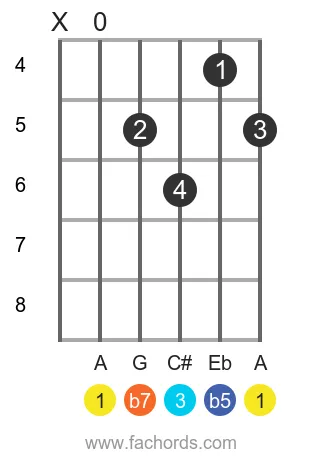
Position 3
Open
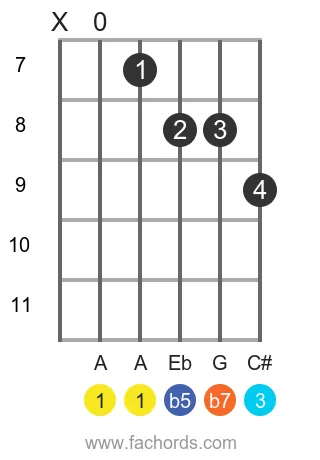
 Find more shapes in our all guitar chords online library. If you
prefer a printable pdf, download
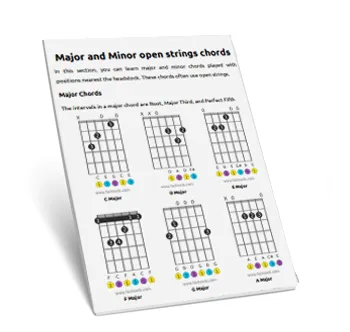
the Free Guitar Chords Chart Pdf
Find more shapes in our all guitar chords online library. If you
prefer a printable pdf, download
the Free Guitar Chords Chart Pdf
You can also use this accessible A7b5 chord page, with written diagram instructions and screen-reader support for blind users.
FAQ
What notes make up the A7b5 guitar chord?
The A7b5 chord is composed of the notes A, C#, Eb, and G. These notes correspond to the root, a major third, a diminished fifth, and a minor seventh interval, respectively, from the root note A.
How do the specific intervals (1, 3, b5, b7) define the A7b5 chord?
The intervals 1 (root), 3 (major third), b5 (diminished fifth), and b7 (minor seventh) are the building blocks of the A7b5 chord. The root establishes the chord's name, the major third gives it its major quality, the minor seventh defines it as a dominant chord, and the diminished fifth (lowered by a half-step from a perfect fifth) provides its unique, often tense and distinctive sound.
Why is the A7b5 chord classified as a 'Dominant Chord'?
The A7b5 chord is part of the Dominant Chords family because it contains a major third and a minor seventh interval (1, 3, b7). This specific interval combination is the hallmark of dominant chords, giving them a strong tendency to resolve and making them key components in styles like blues and jazz music.
In what musical contexts or genres is the A7b5 chord typically used?
As a member of the Dominant Chords family, the A7b5 chord is often utilized in musical styles such as blues and jazz. Its distinctive sound, characterized by the diminished fifth and minor seventh intervals, adds tension, complexity, and a rich harmonic color characteristic of these genres.