D# 6 Guitar Chord
Chord Diagrams, Interactive Fretboard and Chord Theory
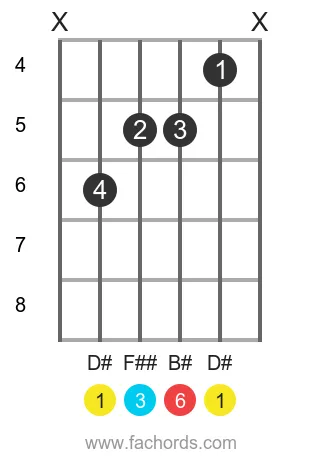
D# major 6th guitar chord is also written as D#6, D#maj6, D#M6 or D#add6.
Position 1
Movable
Position 2
Barre
Movable
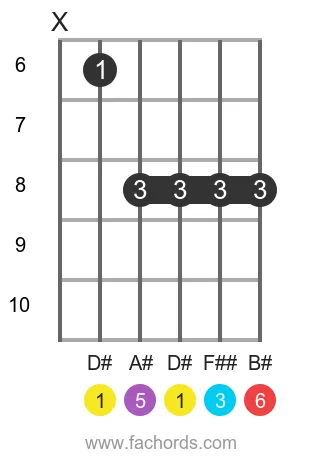
Position 3
Barre
Movable
 Find more shapes in our all guitar chords online library. If you
prefer a printable pdf, download
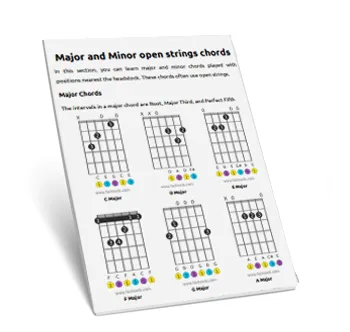
the Free Guitar Chords Chart Pdf
Find more shapes in our all guitar chords online library. If you
prefer a printable pdf, download
the Free Guitar Chords Chart Pdf
You can also use this accessible D#6 chord page, with written diagram instructions and screen-reader support for blind users.
Practice D#6 Guitar Chord: Master It With Mic Feedback
Want a structured chord roadmap instead of jumping between pages?
Go to the full guitar chords tutorial.
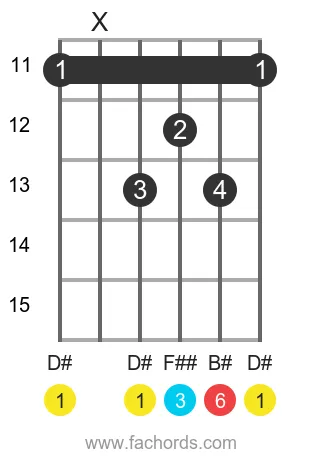
Struggling to hit every note of the D#6 chord accurately? Our interactive fretboard tool provides instant gratification, guiding your hand placement with real-time microphone feedback, telling you if you're nailing it. Visualize every fingering and hear the chord played as a strum or arpeggio as you learn this Major Sixth family chord, built from D#, F##, A#, and B#, corresponding to the intervals Root (1), Major Third (3), Perfect Fifth (5), and Major Sixth (6).
The D#6 chord brings a rich, vintage sweetness to your progressions, often associated with jazz and R&B sounds. This sixth chord expands on basic major triads; understanding its construction is vital to fully mastering its sophisticated feel. Dive deeper into how intervals build these sounds with our Chord Construction tutorial. Many shapes for the D#6 involve movable barre chord fingerings, so focusing on smooth transitions will significantly improve chord changes in your playing.
Below, you’ll find comprehensive D#6 chord diagrams, ranked from open positions to more challenging movable shapes, alongside detailed music theory, example songs, and common keys where this chord shines. But don't just passively read; truly test yourself with the interactive tool above first. Set your rhythm with the drum and BPM tool, strum away, and trust the mic feedback to validate your technique before consulting any static charts. This active approach is the fastest way to build confidence and accuracy.
Notes of the D# 6 chord:
How the Major Sixth chord is built:
Play This Chord With Other Roots
C 6 | D 6 | E 6 | F 6 | G 6 | A 6 | B 6 | C#6 | D#6 | F#6 | G#6 | A#6 | Ab6 | Bb6 | Db6 | Eb6 | Gb6

Created by
Giancarlo is a musician (teaching guitar since 2000), software engineer, AI consultant and published researcher
FAQ
What specific notes are used to build the D#6 guitar chord?
The D#6 chord is composed of four distinct notes: D# (the root), F## (F double sharp, representing the major third), A# (the perfect fifth), and B# (B sharp, representing the major sixth).
Why does the D#6 chord contain an F## (F double sharp) instead of a G natural?
The F## is used to maintain the theoretical spelling of the chord's intervals. When building a chord from D#, the third scale degree must be some form of F. Using F## correctly identifies it as the major third interval relative to D#, adhering to the music theory rules for stacking intervals (1, 3, 5, 6), even though F## is enharmonically equivalent to G natural.
How do the intervals 1, 3, 5, and 6 define the D#6 chord?
These numbers represent the specific scale degrees from the D# major scale that are included in the chord: '1' is the Root (D#), '3' is the Major Third (F##), '5' is the Perfect Fifth (A#), and '6' is the Major Sixth (B#). Stacking these four intervals creates the unique sound of the D#6 chord.
Is the D#6 chord categorized as a major chord, or is it a different type?
Yes, the D#6 chord is fundamentally a type of major chord. It belongs to the 'Major Chords family' because it combines a major triad (Root, Major Third, Perfect Fifth) with an added Major Sixth interval. This addition gives it a richer, more sophisticated flavor while retaining its overall major quality.
What makes the D#6 chord an 'intermediate' level chord for guitarists?
The D#6 chord is considered intermediate because it involves four notes, often resulting in more complex fingerings than basic three-note major or minor chords. Understanding its theoretical construction, particularly the addition of the major sixth interval, also requires a slightly deeper grasp of music theory beyond beginner-level concepts.