Practice E 13(b9) Guitar Chord: Get Instant Feedback
Want a structured chord roadmap instead of jumping between pages?
Go to the full guitar chords tutorial.
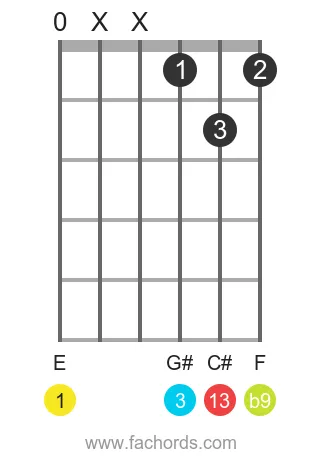
Ready to tackle the complex E 13(b9) chord? This advanced dominant chord, built from the notes E, G#, B, D, F, A, and C#, features the intervals 1, 3, 5, b7, b9, 11, and 13. Our interactive fretboard challenges you to play it correctly, offering immediate and precise mic feedback to verify every note you hit. You can also explore its sound with chord and arpeggio playback, making learning both effective and engaging.
Understanding the intricate interval structure of the E 13(b9) is crucial. As a member of the extended dominant family, it adds rich harmonic color, often providing unique tension before resolving. The inclusion of the b9 and 13 makes it particularly expressive. For a deeper dive into how these complex harmonies are built, our Chord Construction guide is an excellent resource. This chord specifically extends the typical Dominant Chord sound by adding further extensions like the ninth and thirteenth, making it a powerful choice in jazz and funk. You can explore more about these color tones in our Ninth Chords tutorial.
Scroll down to find comprehensive diagrams, ranging from the most accessible shapes to more challenging voicings of the E 13(b9) chord. Each diagram provides a visual map, showing the exact notes and fretboard positions. Beyond the shapes, you'll also find relevant music theory explanations, examples of songs that utilize this chord, and how it functions in different keys. Before memorizing anything, challenge yourself to play along with our interactive tool above and really get a feel for this chord.
E 13th with flat 9th guitar chord is also written as E13(b9), E13b9 or E13-9.
Notes in the E 13(b9) chord:
Tones in the Dominant Thirteen Flat Nine chord:
E 13(B9) Guitar Chord Diagrams
Position 1
Open
 Find more shapes in our all guitar chords online library. If you
prefer a printable pdf, download
the Free Guitar Chords Chart Pdf
Find more shapes in our all guitar chords online library. If you
prefer a printable pdf, download
the Free Guitar Chords Chart Pdf
You can also use this accessible E13(b9) chord page, with written diagram instructions and screen-reader support for blind users.

Created by
Giancarlo is a musician (teaching guitar since 2000), software engineer, AI consultant and published researcher
FAQ
What is an E 13(b9) chord and why is it considered complex?
The E 13(b9) is a complex dominant chord defined by its unique combination of intervals: Root, Major Third, Perfect Fifth, Minor Seventh, Minor Ninth, Perfect Eleventh, and Major Thirteenth. It is considered complex due to the large number of notes involved (seven) and the specific tensions (b9, 11, 13) that extend beyond a basic dominant seventh chord, which gives it a rich, sophisticated sound.
What specific notes and intervals comprise the E 13(b9) chord?
For an E 13(b9) chord, the notes are E, G#, B, D, F, A, and C#. These correspond to the intervals of Root (E), Major Third (G#), Perfect Fifth (B), Minor Seventh (D), Minor Ninth (F), Perfect Eleventh (A), and Major Thirteenth (C#) respectively.
Why is the E 13(b9) chord classified as a 'Dominant Chord'?
The E 13(b9) chord is classified as a dominant chord because its fundamental structure includes a root, major third, and minor seventh (E, G#, D). These core intervals create a characteristic tension and strong pull towards a tonic chord, defining its dominant function in harmony. The added b9, 11, and 13 are extensions that enhance this dominant quality.
In what musical contexts is the E 13(b9) chord commonly used?
The E 13(b9) chord is highly versatile and a staple in jazz chord progressions due to its rich and colorful sound. Beyond jazz, its unique character makes it suitable for adding complexity and sophistication to blues, rock, and various other contemporary genres.