Practice F# m11 Guitar Chord with Real-Time Feedback
Want a structured chord roadmap instead of jumping between pages?
Go to the full guitar chords tutorial.
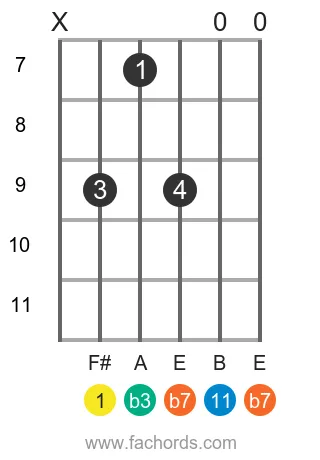
Struggling to articulate the rich F# m11 chord cleanly? Jump right in with our interactive fretboard tool. Use the real-time microphone feature to receive instant, precise feedback on your playing, ensuring every note rings true. This complex minor eleventh chord is built from the notes F#, A, C#, E, G#, and B, representing the intervals Root (1), Minor Third (b3), Perfect Fifth (5), Minor Seventh (b7), Major Ninth (9), and Perfect Eleventh (11). You can also listen to the chord played as a strum or arpeggio to train your ear.
This extended chord adds sophisticated harmonic color, moving beyond standard seventh chords to deepen your musical palette. To truly master its unique sound, understanding its construction is key; delve deeper into how complex chords are built with our Chord Construction guide. For more insights into extended harmonies like this one, explore our Ninth Chords tutorial. Many fingerings for the F# m11 chord are movable shapes, so refining your technique with our Guitar Bar Chords resource will be beneficial. Once you can fret it, practicing smooth chord changes will integrate it musically into your playing.
Below, you'll find over 20 F# m11 chord diagrams, ranging from open positions to challenging movable shapes, accompanied by music theory insights, song examples, and common keys where this chord shines. But before exploring these, challenge yourself with the interactive tool above. Set a comfortable tempo using the drum and BPM tool, play the chord, and let the mic feedback guide you towards perfect articulation. This immediate, hands-on practice is the most efficient way to build new chords into your guitar vocabulary.
F# minor 11th guitar chord is also written as F#m11, F#min11 or F#-11.
Notes that compose the F# m11 chord:
Chord structure of the Minor Eleventh chord:
F# M11 Guitar Chord Diagrams
Position 1 Movable
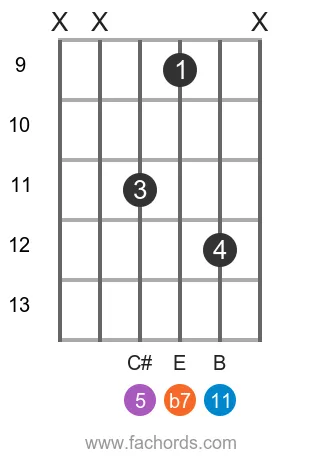
Finger Positions
- Mute the low E string
- Mute the A string
- Mute the high E string
- Place your index finger (1) on the fret 9 of the G string
- Place your ring finger (3) on the fret 11 of the D string
- Place your pinky finger (4) on the fret 12 of the B string
Position 2 Open
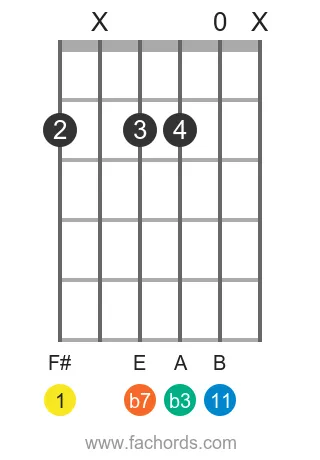
Finger Positions
- Mute the A string
- Let the B string play without pressing any fret
- Mute the high E string
- Place your middle finger (2) on the fret 2 of the low E string
- Place your ring finger (3) on the fret 2 of the D string
- Place your pinky finger (4) on the fret 2 of the G string
Position 3 Open
Finger Positions
- Mute the low E string
- Let the B string play without pressing any fret
- Let the high E string play without pressing any fret
- Place your index finger (1) on the fret 7 of the D string
- Place your ring finger (3) on the fret 9 of the A string
- Place your pinky finger (4) on the fret 9 of the G string
Position 4 Open
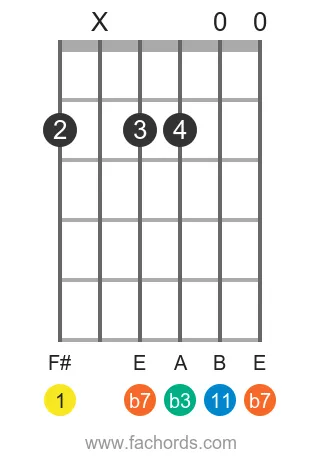
Finger Positions
- Mute the A string
- Let the B string play without pressing any fret
- Let the high E string play without pressing any fret
- Place your middle finger (2) on the fret 2 of the low E string
- Place your ring finger (3) on the fret 2 of the D string
- Place your pinky finger (4) on the fret 2 of the G string
Position 5 Open
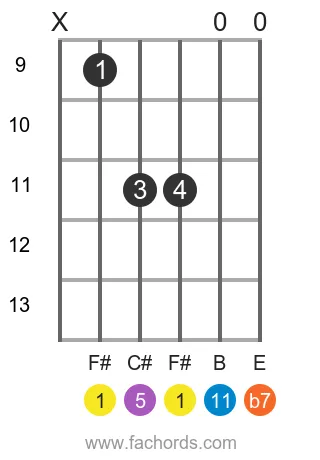
Finger Positions
- Mute the low E string
- Let the B string play without pressing any fret
- Let the high E string play without pressing any fret
- Place your index finger (1) on the fret 9 of the A string
- Place your ring finger (3) on the fret 11 of the D string
- Place your pinky finger (4) on the fret 11 of the G string
Position 6 Barre Movable
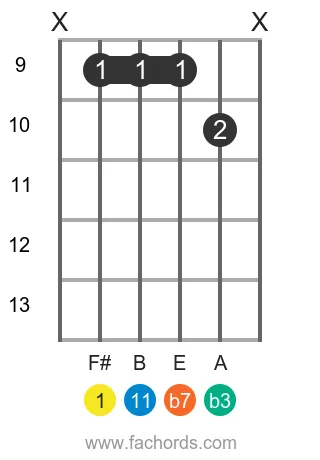
Finger Positions
- Mute the low E string
- Mute the high E string
- Place your index finger (1) on the fret 9 of the A, D and G strings at the same time
- Place your middle finger (2) on the fret 10 of the B string
Position 7 Barre Open
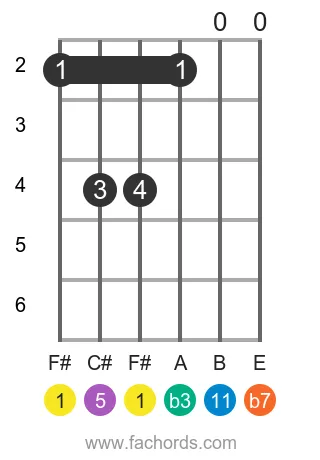
Finger Positions
- Let the B string play without pressing any fret
- Let the high E string play without pressing any fret
- Place your index finger (1) on the fret 2 of the low E and G strings at the same time
- Place your ring finger (3) on the fret 4 of the A string
- Place your pinky finger (4) on the fret 4 of the D string
Position 8 Barre Movable
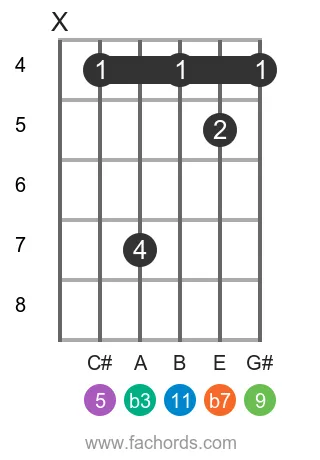
Finger Positions
- Mute the low E string
- Place your index finger (1) on the fret 4 of the A, G and high E strings at the same time
- Place your middle finger (2) on the fret 5 of the B string
- Place your pinky finger (4) on the fret 7 of the D string
 Find more shapes in our all guitar chords online library. If you
prefer a printable pdf, download
the Free Guitar Chords Chart Pdf

Created by
Giancarlo is a musician (teaching guitar since 2000), software engineer, AI consultant and published researcher
FAQ
What specific notes make up the F# m11 guitar chord?
The F# m11 chord is composed of six distinct notes: F#, A, C#, E, G#, and B. These notes are derived from specific intervals relative to the root note F#.
What do the 'm' and '11' signify in the F# m11 chord name?
The 'm' indicates that the chord is a minor chord, meaning it includes a Minor Third (A) and Minor Seventh (E) interval. The '11' signifies that the chord extends to include the Perfect Eleventh interval (B), along with the Major Ninth (G#), built upon the chord's foundational structure.
What intervals are used to construct the F# m11 chord?
The F# m11 chord is constructed using the following intervals: the Root (1), Minor Third (b3), Perfect Fifth (5), Minor Seventh (b7), Major Ninth (9), and Perfect Eleventh (11).
Why is the F# m11 chord considered an advanced chord for guitarists?
This chord is considered advanced because it contains six notes and incorporates extended intervals like the Major Ninth and Perfect Eleventh. Understanding and executing its fretboard patterns typically requires a solid grasp of music theory and more developed guitar skills than a beginner possesses.