G m6 Guitar Chord
Chord Diagrams, Interactive Fretboard and Chord Theory
G minor 6th guitar chord is also written as Gm6, Gmin6 or G-6.
Position 1
Movable
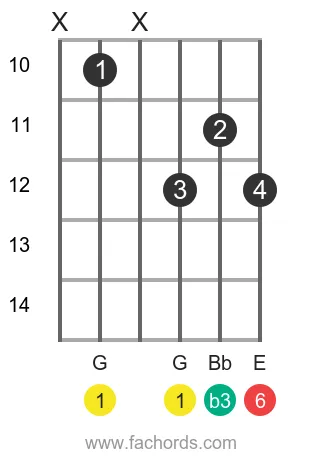
Position 2
Open
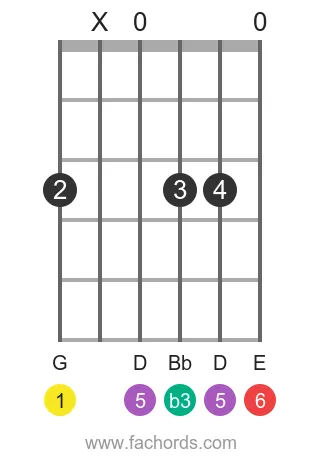
Position 3
Barre
Movable
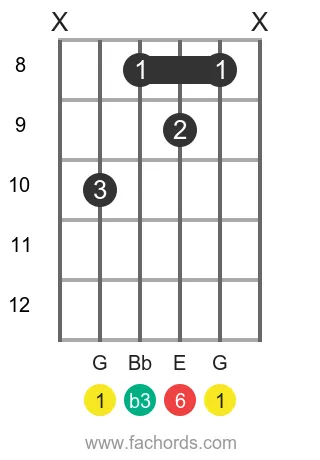
Position 4
Barre
Movable
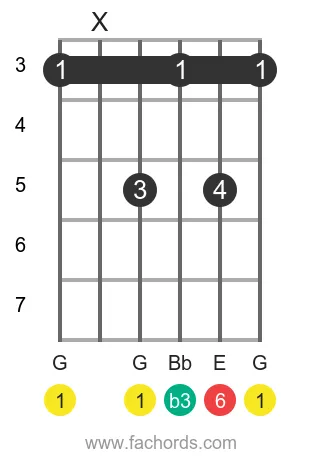
 Find more shapes in our all guitar chords online library. If you
prefer a printable pdf, download
the Free Guitar Chords Chart Pdf
Find more shapes in our all guitar chords online library. If you
prefer a printable pdf, download
the Free Guitar Chords Chart Pdf
You can also use this accessible Gm6 chord page, with written diagram instructions and screen-reader support for blind users.
Practice Your Gm6 Guitar Chord: Real-time Coaching
Want a structured chord roadmap instead of jumping between pages?
Go to the full guitar chords tutorial.
Ready to conquer the Gm6 guitar chord? Dive in now with our interactive fretboard. You'll receive instant mic analysis to verify your playing accuracy as you practice. This intriguing chord belongs to the Minor Chords family and is built from the notes G, Bb, D, and E, corresponding to the intervals 1 (Root), b3 (Minor Third), 5 (Perfect Fifth), and 6 (Major Sixth). Utilize the chord/arpeggio playback to hear its distinct sound.
Understanding the construction of the Gm6 chord reveals its vintage sweetness, often used to add a sophisticated, smooth color to jazz or soul progressions. This flavor comes from its unique combination of intervals: 1, b3, 5, and 6. For a deeper dive into how intervals create chords, explore our guide on Chord Construction. The Gm6 chord is a compelling variant within the family of 6th Chords, which offer rich harmonic possibilities. Mastering these can significantly enhance your harmonic vocabulary and stylistic range.
Below, you'll find various chord diagrams, organized from the easiest to the more challenging voicings. Before you commit them to memory, we encourage you to use our interactive fretboard to test your understanding and ensure your fingers are hitting the right notes. This hands-on approach, combined with a solid grasp of the underlying theory, will help you integrate the Gm6 chord seamlessly into your playing and apply it across different songs and musical keys. Challenge yourself and see the results!
Notes in the G m6 chord:
Tones in the Minor Sixth chord:
Play This Chord With Other Roots
C m6 | D m6 | E m6 | F m6 | G m6 | A m6 | B m6 | C#m6 | D#m6 | F#m6 | G#m6 | A#m6 | Abm6 | Bbm6 | Dbm6 | Ebm6 | Gbm6

Created by
Giancarlo is a musician (teaching guitar since 2000), software engineer, AI consultant and published researcher
FAQ
What notes and intervals make up the Gm6 chord?
The Gm6 chord is composed of the notes G, Bb, D, and E. These notes correspond to the intervals of a Root (G), a Minor Third (Bb), a Perfect Fifth (D), and a Major Sixth (E).
How does the Gm6 chord relate to the 'Minor Chords family'?
The Gm6 chord is categorized within the Minor Chords family because it retains the characteristic root, minor third, and perfect fifth intervals. The addition of the major sixth interval creates a specific variant within this family.
What does the '6' signify in the name 'Gm6 chord'?
The '6' in the Gm6 chord name signifies the presence of a Major Sixth interval (E in the key of G) in addition to the standard root, minor third, and perfect fifth that define a minor chord. This interval gives the chord its distinct sound.
What is the theoretical difference between a G minor chord and a Gm6 chord?
A standard G minor chord typically consists of the root (G), minor third (Bb), and perfect fifth (D). The Gm6 chord adds an extra note, the major sixth (E), to this basic minor triad, resulting in the intervals of 1, b3, 5, and 6.