Arabic Scale (Major Locrian) on Guitar
The Arabic scale on this page is built as 1 2 3 4 b5 b6 b7, a Locrian scale with a major second and a major third, which is why it is also called Major Locrian. Names for Arabic scales vary between sources, so this is the version used throughout the site.
Its step pattern starts with two whole steps and two half steps, a combination that sounds unsettled. Open a key below for the notes and shapes, or compare it with other exotic guitar scales.
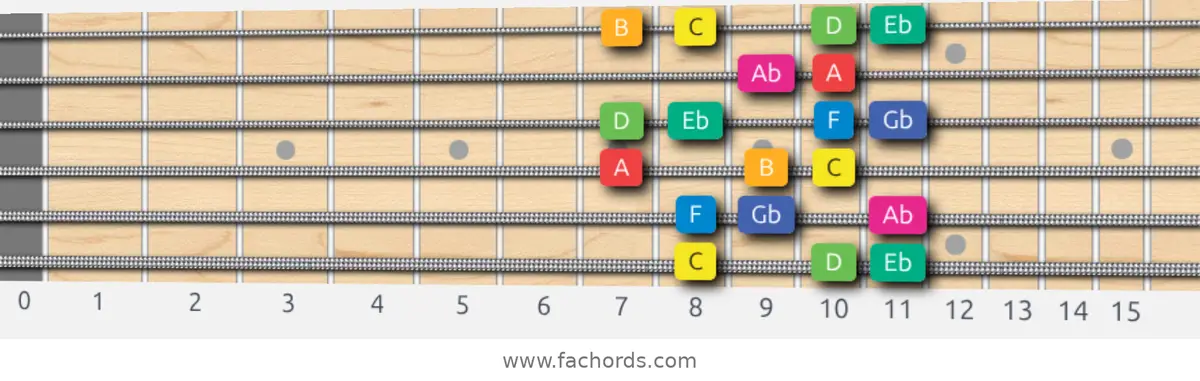
C Arabic Scale: box pattern, position 1
Structure
How the arabic scale is built:
The arabic scale is built from the degrees 1 2 3 4 b5 b6 b7, which gives the step pattern W-W-H-H-W-W-W (W = whole step, H = half step).
Counting in semitones from the root: 0, 2, 4, 5, 6, 8, 10. That makes it a 7-note scale.
It is also known as Major Locrian.
Choose a key
The Arabic Scale at a glance
Scales close to Arabic
- Bizantine Scale: shares 4 notes
- Persian: shares 5 notes
- Spanish Phrygian: shares 5 notes
- Mixolydian b6 Scale: 5 instead of b5
- Aeolian b5: b3 instead of 3
More Exotic Scales
Keep learning

Created by
Giancarlo is a musician (teaching guitar since 2000), software engineer, AI consultant and published researcher
FAQ
What is the Arabic Scale?
A bright start and a dark finish, moving between tension and release. Its formula is 1 2 3 4 b5 b6 b7, a 7-note scale. Typical use: Exotic melodies built on the b5 arriving after a major 3rd.
What are the notes of the C Arabic scale?
The C Arabic scale is C, D, E, F, Gb, Ab, Bb.
What chords can I play the Arabic Scale over?
In the key of C, try Caug, C7b5 and C7#5.