A m9 Guitar Chord
Chord Diagrams, Interactive Fretboard and Chord Theory
A minor 9th guitar chord is also written as Am9, Amin9 or A-9.
Position 1
Open
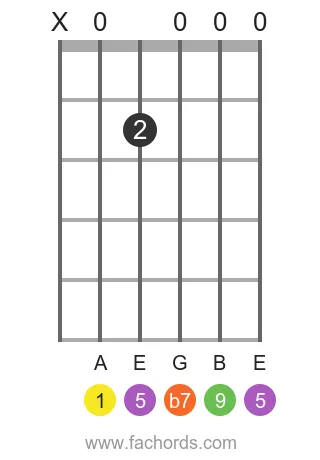
Position 2
Open
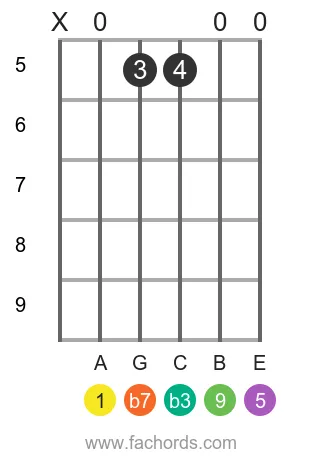
Position 3
Movable
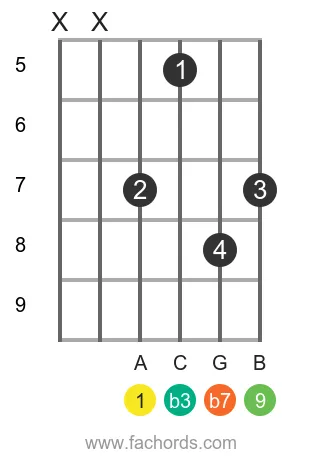
Position 4
Movable
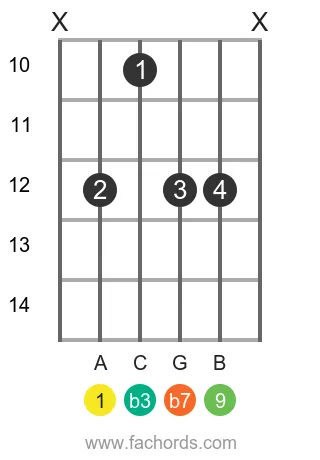
Position 5
Open
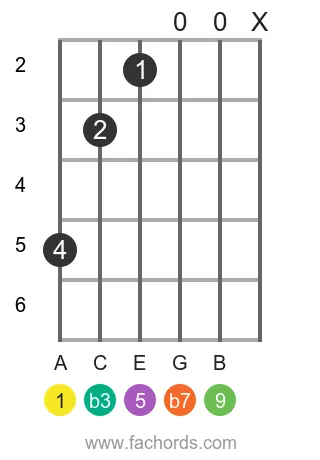
Position 6
Open
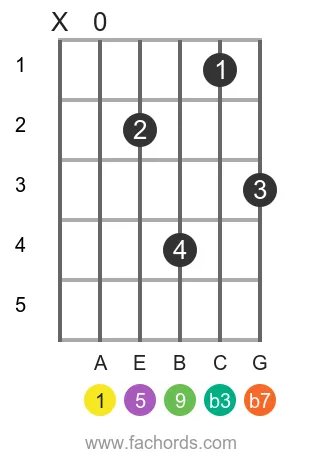
Position 7
Open
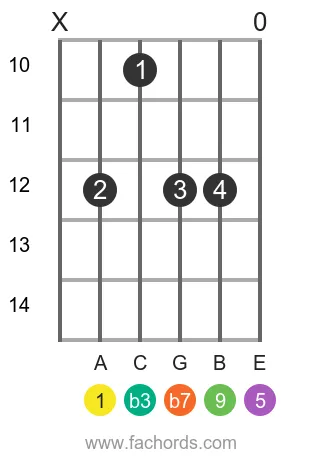
Position 8
Barre
Open
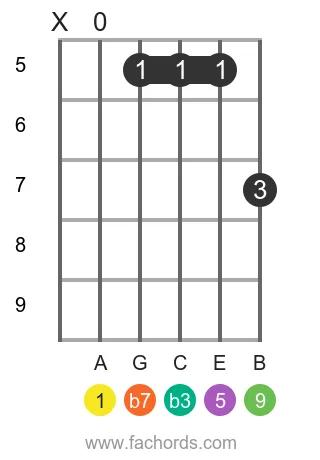
Position 9
Barre
Open
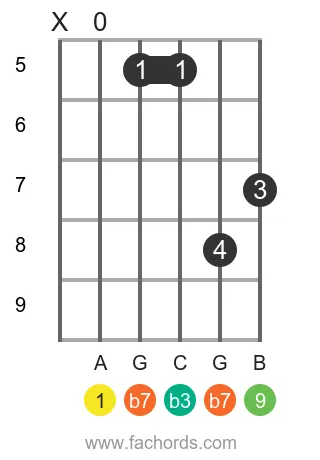
Position 10
Barre
Movable
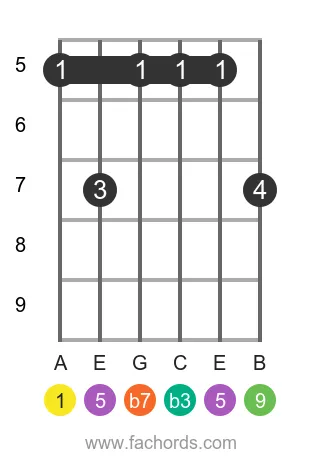
 Find more shapes in our all guitar chords online library. If you
prefer a printable pdf, download
the Free Guitar Chords Chart Pdf
Find more shapes in our all guitar chords online library. If you
prefer a printable pdf, download
the Free Guitar Chords Chart Pdf
You can also use this accessible Am9 chord page, with written diagram instructions and screen-reader support for blind users.
Am9 Guitar Chord | Play, Hear and Practice Interactively
Want a structured chord roadmap instead of jumping between pages?
Go to the full guitar chords tutorial.
The Am9 chord is a rich, complex member of the Minor Chords family, built from the notes A, C, E, G, and B. These notes correspond to the intervals Root (1), Minor Third (b3), Perfect Fifth (5), Minor Seventh (b7), and Major Ninth (9). Use the interactive fretboard tool at the top of this page to visualize every fingering, listen to the chord played as a strum or arpeggio, and check your own playing with real-time microphone feedback – the tool will instantly show you if you're hitting the right notes.
The addition of the ninth gives the Am9 its distinctive, sophisticated sound, often found in jazz, funk, and R&B. To understand how these extended chords are built and used, explore our guide to Ninth Chords or dive deeper into the fundamentals with our Chord Construction tutorial. Many Am9 shapes involve barre forms; if you're working on those, our Guitar Bar Chords guide can help. Mastering smooth transitions will make this chord shine, so also check out tips to Improve Chords Change.
Scrolling down, you'll find a comprehensive set of chord diagrams, ordered from the easiest open positions to more complex movable shapes. We also cover the theory behind the Am9 chord, suggest songs that feature it, and list the keys in which it commonly appears. Before you delve into the diagrams, make sure to engage with the interactive tool above – set a comfortable tempo with the drum machine, strum the chord, and let the mic feedback guide your practice. This hands-on approach is the most effective way to internalize new chords.
Notes that compose the A m9 chord:
Chord Formula:
Play This Chord With Other Roots
C m9 | D m9 | E m9 | F m9 | G m9 | A m9 | B m9 | C#m9 | D#m9 | F#m9 | G#m9 | A#m9 | Abm9 | Bbm9 | Dbm9 | Ebm9 | Gbm9

Created by
Giancarlo is a musician (teaching guitar since 2000), software engineer, AI consultant and published researcher
FAQ
What is the difference between an A minor chord and an A m9 chord?
An A minor chord typically consists of three notes: A, C, and E (Root, Minor Third, Perfect Fifth). The A m9 chord expands on this by adding two more notes: G (Minor Seventh) and B (Major Ninth). This makes the A m9 a richer, more complex chord with a distinct sound.
What do the 'b3', 'b7', and '9' in the A m9 chord's intervals mean?
The 'b3' indicates a Minor Third, which is one semitone lower than a Major Third and defines the minor quality of the chord. The 'b7' signifies a Minor Seventh, which is one semitone lower than a Major Seventh. The '9' refers to a Major Ninth, an interval two whole steps (or a major second) above the octave, adding a specific color and complexity to the chord.
Why does the A m9 chord include five specific notes: A, C, E, G, and B?
These five notes are derived from the specific intervals (1, b3, 5, b7, 9) that define a minor 9th chord. A is the Root (1), C is the Minor Third (b3), E is the Perfect Fifth (5), G is the Minor Seventh (b7), and B is the Major Ninth (9). Together, these intervals create the characteristic sound of the A m9 chord.
In what types of music is the A m9 chord commonly used, and why is it considered a sophisticated chord?
The A m9 chord is frequently found in genres such as jazz and progressive rock. It is considered sophisticated because its five-note structure (Root, Minor Third, Perfect Fifth, Minor Seventh, Major Ninth) provides a rich, complex harmonic texture that goes beyond basic triads, offering a nuanced and expressive sound.