Train Your Skills: The Cm13 Chord on Guitar
Want a structured chord roadmap instead of jumping between pages?
Go to the full guitar chords tutorial.
Ready to tackle a complex sound? The Cm13 chord is a rich addition to the Minor Chords family, built from the notes C, Eb, G, Bb, D, F, and A, embodying the intervals 1, b3, 5, b7, 9, 11, and 13. Before diving into the theory, challenge yourself by attempting to play this advanced chord on our interactive virtual fretboard. Our real-time mic feedback system will instantly verify your accuracy, showing if you've hit the right notes, making your practice highly effective. Hear its arpeggio playback to internalize its unique sound and get immediate feedback on your performance.
Unpacking the structure of this extended chord reveals its theoretical depth: the 1 is the Root, b3 the Minor Third, 5 the Perfect Fifth, b7 the Minor Seventh, 9 the Major Ninth, 11 the Perfect Eleventh, and 13 the Major Thirteenth. Understanding these specific intervals is crucial for not only playing the Cm13 chord but also for applying it musically. This chord's intricate interval structure, extending beyond a simple 7th or even 9th chord, adds a sophisticated color, often found in jazz. To truly grasp how to place these tones on the fretboard, exploring how chords are built by stacking intervals is invaluable. You can deepen your theoretical understanding and learn about the foundations of chord creation in our dedicated article on Chord Construction. For those interested in advanced harmonic concepts, delving into Ninth Chords will provide a strong basis for understanding these extensions.
Once you've challenged yourself with the interactive tool, scroll down to explore comprehensive chord diagrams, arranged from easiest to hardest, alongside detailed theory explanations. Discover how the Cm13 chord fits into various musical songs and keys. Make disciplined practice a habit by using the virtual fretboard and mic feedback to refine your technique, ensuring each note is played perfectly before you apply these concepts in a musical context.
C minor 13th guitar chord is also written as Cm13, Cmin13 or C-13.
Notes in the C m13 chord:
Chord Structure:
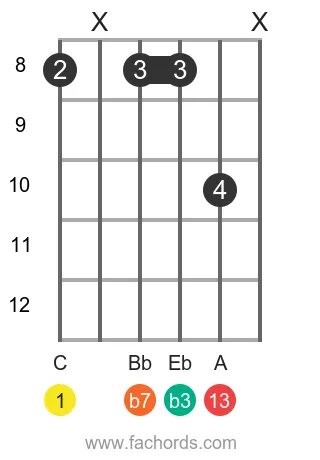
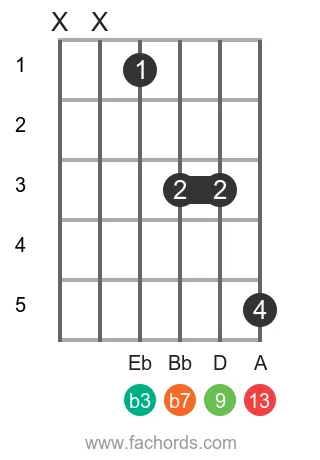
C M13 Guitar Chord Diagrams
Position 1
Barre
Movable
Position 2
Barre
Movable
 Find more shapes in our all guitar chords online library. If you
prefer a printable pdf, download
the Free Guitar Chords Chart Pdf
Find more shapes in our all guitar chords online library. If you
prefer a printable pdf, download
the Free Guitar Chords Chart Pdf
You can also use this accessible Cm13 chord page, with written diagram instructions and screen-reader support for blind users.

Created by
Giancarlo is a musician (teaching guitar since 2000), software engineer, AI consultant and published researcher
FAQ
What specific notes form the Cm13 chord?
The Cm13 chord is composed of seven distinct notes: C, Eb, G, Bb, D, F, and A. These notes are derived by stacking specific musical intervals from the root note, C.
Which musical intervals are present in a Cm13 chord?
The Cm13 chord is built by stacking seven specific intervals from the root. These are the 1 (Root), b3 (Minor Third), 5 (Perfect Fifth), b7 (Minor Seventh), 9 (Major Ninth), 11 (Perfect Eleventh), and 13 (Major Thirteenth).
How does the Cm13 chord get its 'minor' quality?
The 'minor' quality of the Cm13 chord is defined by two key intervals: the b3 (Minor Third) and the b7 (Minor Seventh). These characteristic intervals create the fundamental minor sound, which is then enhanced by the additional extensions.
Why is the Cm13 described as a 'rich and complex' chord?
The Cm13 chord is considered rich and complex because it incorporates a significant number of notes (seven) and a wide array of intervals, extending all the way up to the 13th. This extensive harmonic structure produces a sophisticated and full sound, adding considerable depth to musical arrangements.
In what musical styles or contexts is the Cm13 chord typically used?
The Cm13 chord is frequently used to add sophisticated harmonic color, particularly within jazz music. Its rich and extended sound makes it a common choice for creating advanced harmonies and is often found in jazz chord progressions, enhancing both improvisation and accompaniment.
