Eb m6 Guitar Chord
Chord Diagrams, Interactive Fretboard and Chord Theory
Eb minor 6th guitar chord is also written as Ebm6, Ebmin6 or Eb-6.
Position 1
Movable
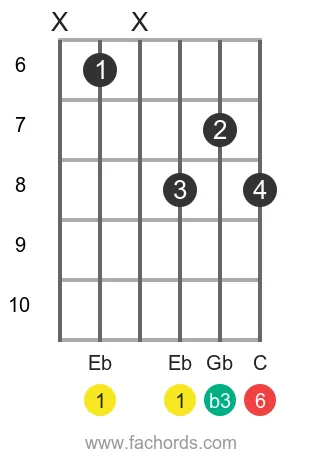
Position 2
Barre
Movable
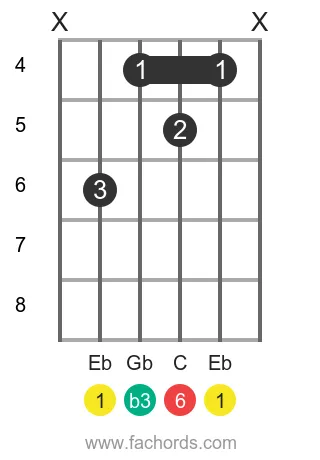
Position 3
Barre
Movable
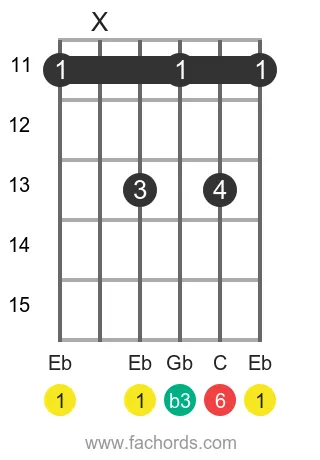
 Find more shapes in our all guitar chords online library. If you
prefer a printable pdf, download
the Free Guitar Chords Chart Pdf
Find more shapes in our all guitar chords online library. If you
prefer a printable pdf, download
the Free Guitar Chords Chart Pdf
You can also use this accessible Ebm6 chord page, with written diagram instructions and screen-reader support for blind users.
Eb m6 Guitar Chord | Play, Hear and Practice with our Tool
Want a structured chord roadmap instead of jumping between pages?
Go to the full guitar chords tutorial.
The Eb m6 chord is a captivating member of the Minor Chords family, constructed from the notes Eb, Gb, Bb, and C. These correspond to the intervals Root (1), Minor Third (b3), Perfect Fifth (5), and Major Sixth (6). Unlock the secrets of this chord with our interactive fretboard tool, where you can visualize fingerings, listen to the chord as a strum or arpeggio, and perfect your technique using real-time microphone feedback.
As a sixth chord, the Eb m6 possesses a rich and sophisticated sound, adding depth to any musical context. Understanding how these chord construction principles apply will deepen your musical knowledge. Many voicings for 6th chords often involve guitar bar chords, so practicing those shapes is key. And once you've learned the voicings, focus on smooth chord changes to integrate it seamlessly into your playing.
Below, you'll discover a comprehensive collection of Eb m6 chord diagrams, ranked from the easiest open positions to more advanced barre shapes. We'll also dive into the underlying music theory, explore songs that beautifully incorporate this chord, and list the keys where it commonly appears. Before you explore these static resources, we highly recommend engaging with the interactive tool above. Use the drum & BPM tool to practice in time, and let the mic feedback guide you to perfect finger placement. This hands-on approach will accelerate your learning and ensure you truly master the Eb m6.
Eb m6 chord Notes:
Chord formula for the Minor Sixth chord:
Play This Chord With Other Roots
C m6 | D m6 | E m6 | F m6 | G m6 | A m6 | B m6 | C#m6 | D#m6 | F#m6 | G#m6 | A#m6 | Abm6 | Bbm6 | Dbm6 | Ebm6 | Gbm6

Created by
Giancarlo is a musician (teaching guitar since 2000), software engineer, AI consultant and published researcher
FAQ
What notes make up the Eb m6 chord on guitar?
The Eb m6 chord is composed of the notes Eb, Gb, Bb, and C. These notes are derived from the root (Eb), minor third (Gb), perfect fifth (Bb), and major sixth (C) intervals of the Eb scale.
What is the difference between an Eb minor chord and an Eb m6 chord?
An Eb minor chord typically consists of the root, minor third, and perfect fifth (Eb, Gb, Bb). The Eb m6 chord adds one more note: the major sixth (C) of the Eb scale, giving it a distinctively richer and more complex sound compared to a simple Eb minor triad.
Why is it called an 'm6' chord when the sixth interval is major?
The 'm' in Eb m6 refers to the minor third interval (Gb) that defines the chord's minor quality. The '6' refers to the major sixth interval (C) added to the minor triad. In chord notation, '6' alone (without a 'b' or 'M') typically implies a major sixth interval.
What kind of sound does the Eb m6 chord produce?
The Eb m6 chord has a rich, complex sound. The addition of the major sixth interval over a minor triad creates a sophisticated and sometimes melancholic or jazzy quality that adds depth to your music, making it a step up from basic beginner chords.
How do the intervals (1, b3, 5, 6) correspond to the notes in the Eb m6 chord?
The intervals correspond directly to the notes based on the root Eb: the 1st is Eb (the root), the b3 (minor third) is Gb, the 5th (perfect fifth) is Bb, and the 6th (major sixth) is C. Understanding these interval relationships is fundamental to building and recognizing chords.