Master the F 9b5 guitar chord with interactive tools
Want a structured chord roadmap instead of jumping between pages?
Download the step-by-step Guitar Chord Ebook
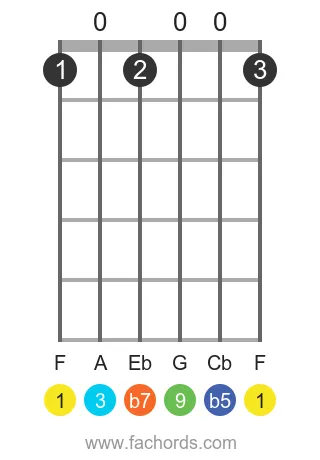
Dive into the expressive world of the F 9b5 guitar chord, a rich member of the Dominant Chords family often found adding unique color in jazz progressions. This complex harmony is built from the notes F, A, Cb, Eb, and G, revealing its core intervals as the 1 (Root), 3 (Major Third), b5 (Diminished Fifth), b7 (Minor Seventh), and 9 (Major Ninth). Use our interactive virtual fretboard as your personal exploration lab, where you can instantly hear chord playback and verify your accuracy in real-time with our innovative mic feedback feature.
The F 9b5 chord, with its flattened fifth and added ninth, pushes the boundaries of traditional harmony, offering an extended color to the foundational Dominant Chord sound. Understanding the intricate relationships between its intervals is key to mastering its application, and you can delve deeper into how these sounds are built with our guide to chord construction. For a broader exploration of these rich harmonies, be sure to check out our comprehensive resource on Ninth Chords, which are pivotal in modern music.
Ready to bring the F 9b5 guitar chord to life? Instead of just memorizing, begin by actively playing with our interactive tool below. You'll find clear diagrams, ranked from easiest to hardest, alongside fretboard patterns showcasing the notes across different keys. Explore the underlying theory, then apply your new skills to real songs. Stop analyzing and start playing – let your ears be your guide!
Notes of the F 9b5 chord:
Tones of the Dominant Ninth Flat five chord:
F9b5 Guitar Chord Voicings
Position 1
Open
Position 2
Barre
Movable
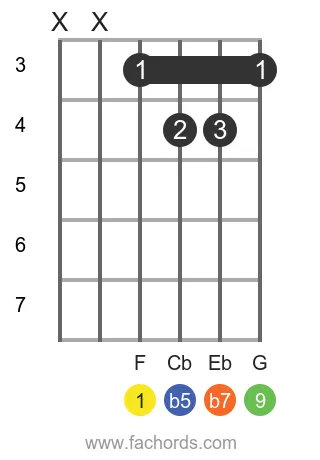
Position 3
Barre
Movable
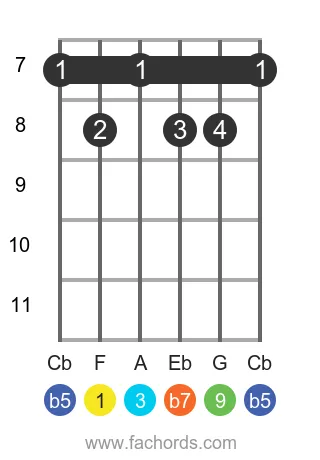
 Find more shapes in our all guitar chords online library. If you
prefer a printable pdf, download
the Free Guitar Chords Chart Pdf
Find more shapes in our all guitar chords online library. If you
prefer a printable pdf, download
the Free Guitar Chords Chart Pdf
You can also use this accessible F9b5 chord page, with written diagram instructions and screen-reader support for blind users.
FAQ
What does 'F 9b5' mean in a guitar chord name?
In the 'F 9b5' chord name, 'F' indicates the root note of the chord. The '9' signifies that the chord includes a Major Ninth interval from the root. The 'b5' (pronounced 'flat five') indicates that the fifth interval of the chord is lowered or diminished by a half step, providing a specific alteration to the chord's sound.
What are the specific notes that make up the F 9b5 chord?
The F 9b5 chord is composed of five distinct notes: F (the Root), A (the Major Third), Cb (the Diminished Fifth), Eb (the Minor Seventh), and G (the Major Ninth).
Why is 'Cb' used as a note in the F 9b5 chord instead of 'B'?
Cb is used to correctly represent the diminished fifth interval from the root note F. The natural fifth of F is C. To diminish this interval, C is lowered a half step to Cb. Using Cb maintains the theoretical integrity of the interval spelling, ensuring that the chord's construction follows the proper alphabetical sequence of notes, rather than implying a different interval like an augmented fourth (B).
How does the F 9b5 chord belong to the 'Dominant Chords' family?
The F 9b5 chord is part of the Dominant Chords family because it contains a minor seventh interval (Eb from F). The presence of this minor seventh is the defining characteristic of a dominant chord. The additional ninth (9) and the altered diminished fifth (b5) are extensions and alterations built upon this dominant foundation, adding unique harmonic tension and color.
Why is the F 9b5 considered an 'advanced' or 'complex' guitar chord?
The F 9b5 chord is considered advanced due to its structure. It involves five notes, which is more than basic triads or standard seventh chords. Furthermore, it incorporates specific altered intervals, such as the diminished fifth (b5), and an extended interval like the major ninth (9). Understanding these specific intervals and their application requires a solid grasp of music theory and chord construction beyond beginner levels.
When should I use the F 9b5 chord in my guitar playing?
The F 9b5 chord is frequently used in jazz chord progressions. Its unique combination of a diminished fifth and major ninth creates a distinct harmonic color and tension. It's typically employed to provide a sophisticated, often slightly dissonant, dominant sound that can resolve in interesting ways or add a specific flavor to a musical phrase.