Guitar Phrasing: Play Your Solos Like a Horn Player
Why Leaving Room to Breathe Makes Your Lead Lines Sound Like a Voice
A trumpet player can't play sixty-four bars of sixteenth notes in a row. Not for lack of technique: sooner or later, the air runs out.
We guitarists don't have this problem. Our fingers don't need oxygen, so nothing stops them, and when nothing stops them they do what they have practiced for years: up the box, down the box, one scale pattern after the other.
Here is the paradox: that limit is exactly what makes a horn solo sound like somebody talking. So let's steal it. You're going to see what guitar phrasing is, why the breath is its secret ingredient, and five ways to make your solos breathe, each one with a tab and an audio example.
Guitar phrasing in one sentence: phrasing is how you group the notes of a solo into musical sentences: where each phrase starts, how long it lasts, which note it lands on, and how much silence you leave before the next one.
Example: instead of running the A minor pentatonic up and down for four bars, play four notes (A, C, D, E), stop for a full bar, then answer with four more.
The Guitar Has No Lungs, and That's the Problem
In jazz slang, horns are the instruments you blow into: trumpet, trombone, saxophone (the sax is technically a woodwind, but on the bandstand nobody cares). They all share one thing with singers: they run on air.
This means that a phrase can only last as long as a breath. Then the player has to stop, inhale, and start a new one. Brass players also need to rest their lips. Written music even has a sign for it: the breath mark, a small comma above the staff that tells the player where to take air.
Have you ever seen a breath mark on a guitar tab? Me neither. We can go on until the song ends (or until the drummer throws a stick at us).
And when the mind has no idea ready, the hands fill the gap with what they know best. It's pure muscle memory: the fingers play, the brain watches. If this sounds familiar, you'll like our lesson on thinking before you play.
Let's hear what it sounds like. All the examples in this lesson use the same five notes, the first box of the A minor pentatonic scale, on the top four strings:
Formula: 1 b3 4 5 b7

A minor pentatonic, box 1: A, C, D, E, G
Example 1: the Solo That Never Breathes
Four bars of eighth notes, up and down the box. In the audio, the low open A string at the start of each bar is not part of the solo: it's a marker, like a bass player hitting the downbeat, so you can hear where the bars begin.
   1 & 2 & 3 & 4 &   1 & 2 & 3 & 4 &   1 & 2 & 3 & 4 &   1 & 2 & 3 & 4 &
e|-----------5-8-5-|-----------------|-------5-8-5-----|-----------------|
B|-------5-8-------|-8-5-------------|---5-8-------8-5-|---------------5-|
G|---5-7-----------|-----7-5-------5-|-7---------------|-7-5-------5-7---|
D|-7---------------|---------7-5-7---|-----------------|-----7-5-7-------|
A|-0---------------|-0---------------|-0---------------|-0---------------|
Example 1: 32 notes in 4 bars, no rests
Thirty-two notes, zero mistakes, and nothing you can remember ten seconds later. It doesn't even end: it just stops. It's the musical version of somebody who talks for a whole minute without a single comma. After a while, you stop listening.
What Guitar Phrasing Really Is: a Solo Is a Discourse
Think about how you talk. You don't deliver words at a constant speed until you faint. You say a sentence, you pause, you stress one word, you ask a question, you wait for the other person to react.
A good solo works the same way, and almost every element of speech has its twin on the fretboard:
| When you speak | When you play a solo |
|---|---|
| Word | A note, or a short motif of 2 to 4 notes |
| Sentence | A phrase: a group of notes with a clear start and a clear landing |
| Comma | A short rest, an eighth or a quarter note long |
| Full stop | A phrase that lands on a stable note (the root or another chord tone), followed by a long rest |
| Question | A phrase that ends on an unstable note and stays up in the air |
| Stress on a word | An accent, a louder note, a bend, a touch of vibrato |
| Letting the other person talk | Leaving room for the band |
So phrasing is not about which notes you play. It's about where your sentences begin, where they end, and what happens in between: nothing. And that nothing is the part we guitarists usually skip.
Example 2: the Same Notes, With Breaths
Same box, same tempo, same four bars. This time the line is cut into three sentences. The dots under the tab show the eighth notes where the lead guitar is silent.
   1 & 2 & 3 & 4 &   1 & 2 & 3 & 4 &   1 & 2 & 3 & 4 &   1 & 2 & 3 & 4 &
e|-----------------|-----------------|---------5-8-5---|-----------------|
B|-------5---------|-------8-5-------|---------------8-|-5---------------|
G|---5-7-----------|-----------7-5---|-----------------|-----7-5---------|
D|-7---------------|-----------------|-----------------|---------7-------|
A|-0---------------|-0---------------|-0---------------|-0---------------|
             . . .   . . .             . . . .
Example 2: 16 notes in 4 bars, three phrases
Look at where the sentences land. The first one climbs A, C, D, E and stops on the 5th. The second one answers going down, G, E, D, C. The third one is longer and comes home: A, C, A, G, E, D, C, A, the root.
Half the notes of Example 1, and you could already sing it back. Which of the two would you whistle on your way home?
What the Breath Does for a Solo
Why does a simple pause change so much? Because the breath gives a horn player four gifts, all for free:
- It sets the size of the phrase. An idea has to fit into one breath, so it can't ramble. Short ideas are the ones people remember.
- It frames what was just played. During the silence the listener takes in the last phrase. Without silence, every new note erases the previous one.
- It gives the player time to hear the next idea. While the air goes in, the next line takes shape in the head. The ear leads and the fingers follow, not the other way around. (This is the skill you train when you sing every note you play.)
- It lets the band in. A fill from the drummer, a chord from the piano, a line from the bass: they all happen in the gaps. A solo with no gaps is a monologue.
Guitarists figured this out a long time ago. Charlie Christian, who made the electric guitar a solo voice in Benny Goodman's band at the end of the 1930s, is the textbook case: his single-note lines are usually described as horn-like, and the influence that always gets named is a tenor saxophonist, Lester Young.
B.B. King built a whole style on the same idea. He rarely played while he sang: he sang a line, stopped, and let his guitar Lucille answer. Voice, breath, guitar, breath. You can hear how much one note can say in "The Thrill Is Gone", one of our picks among the best slow guitar solos.
And then there is the line usually attributed to Miles Davis, a trumpet player, of course: "It's not the notes you play, it's the notes you don't play."
5 Ways to Make Your Guitar Breathe
Good news: you don't need new scales, new licks or more speed. You need a few rules that stop your fingers at the right moment. Try them over a backing track or a drone in A minor (you'll find jam tracks on our chord progressions page).
1. Breathe With Your Phrases (for Real)
This is the most direct way to borrow a horn player's lungs, and yes, it feels silly for the first minute.
- Take a normal breath in. Don't play.
- Start your phrase and breathe out slowly while you play, as if you were blowing the notes into the guitar.
- When the air is over, the phrase is over. Land on a note and stop.
- Breathe in again: that's your rest. Listen to the backing track, then play the next phrase.
After a few rounds you'll notice two things: your phrases have a shape, with a start, a peak and an ending, and the pauses stop feeling like mistakes.
Tip: the next step is humming or singing the phrase while you play it. If your voice can't follow, the phrase is probably too long or too fast to be a melody. We have a full method for this in Vocalize Your Solos.
2. Play One Bar, Rest One Bar
If breathing along is too abstract, use the metronome version: rest as long as you play. One bar of notes, one bar of silence. Then two and two.
The silent bar is not a break from the music. A rest has a length and gets counted exactly like a note, so keep tapping your foot and say "1, 2, 3, 4" in your head. If you need a refresher on rest values, here they are (more in our guide on how to count music):
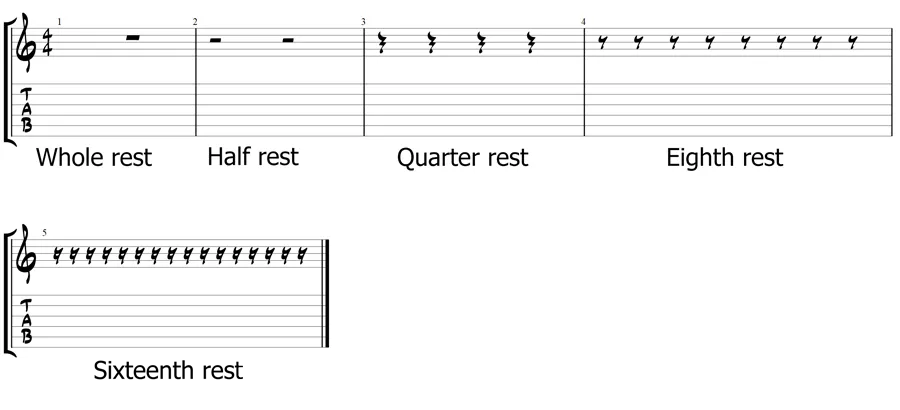
Rests are counted like notes: a whole rest fills a bar of 4/4
The hard part is not the playing, it's the not playing. Your fingers will try to sneak in a couple of notes. Mute the strings with your picking hand and wait for your turn.
Tip: one bar of rest feels endless while you play and perfectly natural when you listen back. Record thirty seconds and check: the pause is always shorter than it felt.
3. Ask a Question, Then Answer It
Two phrases that belong together are the oldest trick in music: call and response. The first phrase asks, the second one answers. It's what B.B. King's voice and guitar were doing, and you can do both parts yourself.
How do you make a phrase sound like a question? End it on an unstable note, as your voice goes up at the end of "really?". In A minor, the D (the 4th) does the job. The answer starts with the same words and ends on the root:
   1 & 2 & 3 & 4 &   1 & 2 & 3 & 4 &   1 & 2 & 3 & 4 &   1 & 2 & 3 & 4 &
e|-----5-----------|-----------------|-----5-----------|-----------------|
B|-5-8-----8-5-----|-----------------|-5-8-----8-5-----|-----------------|
G|-------------7---|-----------------|-------------5---|-----------------|
D|-----------------|-----------------|-----------------|-7---------------|
A|-0---------------|-0---------------|-0---------------|-0---------------|
                     . . . . . . . .                             . . . .
Example 3: the question ends on D, the answer comes home to A
Bar 1 asks: E, G, A, G, E, D. Bar 2 is one full bar of breath, and that's where the question hangs in the air. Bar 3 repeats the first five notes, then changes the ending: C, and finally A on the downbeat of bar 4.
Harmony has its own commas and question marks too: a chord progression that stops on the V chord, the half cadence, leaves the listener waiting in the same way. And if you want more notes for your answers, see how to mix scales and arpeggios in a blues guitar solo.
4. Say It Again: Repeat a Motif Before You Change It
When you tell a story, you don't change subject at every sentence. Yet that's what we do in solos: one lick, then a completely different lick, then another one.
Try the opposite. Play a tiny motif, repeat it, and only the third time develop it. It's the AAB shape of a classic blues verse: one line, the same line again, then the line that closes the thought (the lyrics of a 12-bar blues often work exactly like this).
   1 & 2 & 3 & 4 &   1 & 2 & 3 & 4 &   1 & 2 & 3 & 4 &   1 & 2 & 3 & 4 &
e|-5---------------|-5---------------|-5---------------|-----------------|
B|---8-5-----------|---8-5-----------|---8-5-------5---|-----------------|
G|-----------------|-----------------|-------7-5-7---5-|-----------------|
D|-----------------|-----------------|-----------------|-7---------------|
A|-0---------------|-0---------------|-0---------------|-0---------------|
           . . . .           . . . .                             . . . .
Example 4: motif, same motif, then the development
The motif is just three notes, A, G, E, followed by half a bar of silence. The second time the listener recognizes it. The third time they expect it, so when it keeps going (D, C, D, E, C and down to A) it feels like a story moving forward.
Repetition is not a lack of ideas. It's how you tell the listener "this is what I'm talking about".
5. Don't Always Start on Beat 1
Here is a detail you'll hear in almost any sax or trumpet solo: the phrase often begins after the downbeat. The player breathes in on the beat and comes in a moment later.
Guitarists tend to do the contrary: every lick starts on beat 1, like a soldier marching. Listen to the same five notes, C, D, E, G, A, played twice: first starting on beat 1, then starting on the "and" of beat 2.
   1 & 2 & 3 & 4 &   1 & 2 & 3 & 4 &   1 & 2 & 3 & 4 &   1 & 2 & 3 & 4 &
e|---------5-------|-----------------|---------------5-|-----------------|
B|-----5-8---------|-----------------|-----------5-8---|-----------------|
G|-5-7-------------|-----------------|-------5-7-------|-----------------|
D|-----------------|-----------------|-----------------|-----------------|
A|-0---------------|-0---------------|-0---------------|-0---------------|
               . .   . . . . . . . .   . . .             . . . . . . . .
Example 5: the same phrase on beat 1, then after a breath
Same notes, different meaning. In bar 3 the downbeat belongs to the band, the phrase enters late and its last note lands right before the next bar, pushing the music forward. Moving a phrase around the bar is one of the cheapest ways to get new music out of old licks, and a good reason to spend some time on your rhythm skills.
What to Do While You're Not Playing
A rest is not dead time. A horn player is busy during the breath, and you should be too:
- Keep counting. Tap your foot through the silence, so your next entrance is a choice and not an accident.
- Finish the last note properly. The note before a rest is the one everybody hears. Hold it, give it some vibrato, then cut it cleanly.
- Listen to the band. What did the drummer just play? Where is the chord going? Your next phrase can be an answer to that.
- Hear the next idea first. If nothing comes, wait one more bar. Nobody ever complained about a solo for having one rest too many.
One more thing you can borrow from horn players is the way they connect notes inside a single breath. They call it a slur. Our version is hammer-ons, pull-offs and slides, the legato technique: pick the first note of the phrase and let the others flow out of it.
"But Won't My Solo Sound Empty?"
That's the fear behind every wall of notes. A few honest answers:
- The silence is longer for you than for the listener. You're standing there with a guitar and nothing to do. The audience is still enjoying your last phrase.
- Fast playing is not banned. A fast run is still a phrase if it has a start and a landing, and it hits much harder when it comes out of a pause than as bar 12 of a nonstop stream.
- It's not a jazz thing. Blues, rock, country, metal: whenever you find yourself singing a solo, it's because it's made of sentences.
- Your scales are not wasted. You still need to know the fretboard, and scale exercises that break the linear sound help a lot. Phrasing decides how you spend those notes.
A 10-Minute Guitar Phrasing Routine
Put a backing track in A minor on loop and add these guitar phrasing exercises to your practice routine:
| Minutes | Exercise | Rule |
|---|---|---|
| 0 to 2 | Breath phrases | Play only while you breathe out, rest while you breathe in |
| 2 to 4 | One bar on, one bar off | Count the silent bar, strings muted |
| 4 to 6 | Question and answer | Same beginning, the question ends on D, the answer on A |
| 6 to 8 | One motif | 3 or 4 notes: play, repeat, develop (AAB) |
| 8 to 10 | Free solo, recorded | Listen back and count the breaths |
If a horn player couldn't have played your recording without fainting, you know what to fix.
Guitar Phrasing - Conclusion
Let's recap the key points:
| Idea | What to do on the guitar |
|---|---|
| A phrase lasts one breath | Play while you breathe out, stop when the air is over |
| Rests are part of the music | Rest as long as you play, and keep counting |
| Question and answer | End the first phrase on an unstable note, the second on the root |
| Repeat before you change | Motif, same motif, development |
| Move the entrance | Start some phrases after beat 1 |
Next time you take a solo, forget about the box for a moment and picture a trumpet player standing next to you. Play a sentence. Breathe. Listen. Then say the next thing.
When the sentences come easily, the next step is choosing notes that follow the harmony: see how to solo over chord changes. And if you're just getting started with solos, our lead guitar guide for beginners covers the basics.
That's all for today.
Remember that you can subscribe here to stay updated on new tutorials and gain access to the free download area, where you'll find some free chords and scales PDFs.

Created by
Giancarlo is a musician (teaching guitar since 2000), software engineer, AI consultant and published researcher
FAQ
What is guitar phrasing?
Guitar phrasing is the way you group the notes of a solo into musical sentences: where each phrase starts, how long it lasts, which note it lands on and how much silence you leave before the next one. Two players can use the same five notes of the A minor pentatonic scale and sound completely different, because phrasing is about how and when you play the notes, not which notes you choose.
How do I get better at phrasing on guitar?
Limit how long you are allowed to play. Play one bar and rest one bar while counting, or play only while you breathe out and stop when you run out of air. Then practice question and answer phrases, repeat a short motif before changing it, and start some phrases after beat 1. Record yourself and count the pauses: a solo with good phrasing has clear gaps between its sentences.
Why do my guitar solos sound like scales?
Because nothing forces your fingers to stop. A singer or a trumpet player has to breathe, so the music is cut into sentences automatically. On guitar the hands can keep running the pattern they have memorized, and the result is an unbroken stream of notes with no beginning and no ending. Add rests and clear landing notes and the same scale starts to sound like a melody.
What does it mean to play guitar like a horn player?
It means phrasing as if you had to breathe. Horn players (trumpet, trombone, saxophone) can only play as long as their air lasts, so they build solos from short and medium phrases separated by pauses, a lot like spoken sentences. On guitar you copy this by ending each phrase on purpose, resting for real, and starting the next idea only when you can hear it.
How long should I rest between phrases in a guitar solo?
A good starting rule is to rest as long as you played: one bar of notes, one bar of silence, or two and two. It feels very long while you play and sounds natural when you listen back. Once this is comfortable, vary it: a short comma of one beat between related phrases, a full bar or more after a phrase that closes an idea.
What is call and response on guitar?
Call and response is a pair of phrases that work like a question and an answer. The first phrase ends on an unstable note and stays up in the air, then after a pause the second phrase starts in a similar way and ends on a stable note such as the root. In A minor pentatonic, a question can end on D and the answer can come back home to A.
Are rests really part of a guitar solo?
Yes. A rest is counted in time exactly like a note, so it belongs to the rhythm of the phrase. The silence gives the listener time to take in what you just played, gives you time to hear your next idea, and leaves room for the rest of the band. Keep counting and keep the strings muted during the rest, then come back in on purpose.
