The Backdoor Progression: Am7 D7 E and a Sighing Way Home
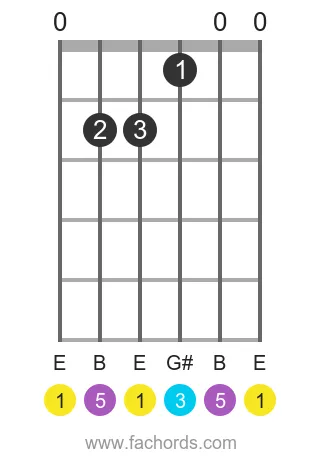
What if you came home without ever touching the V chord? That's the backdoor progression, iv7-bVII7-I. In the key of E it's Am7 D7 E, three open shapes, so you can hear it before you read another line.
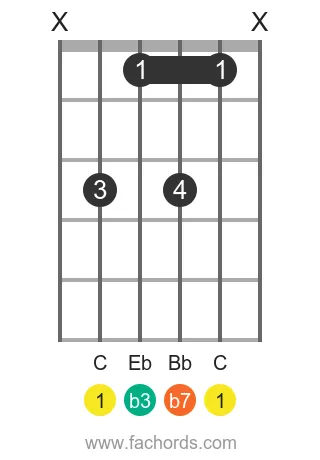
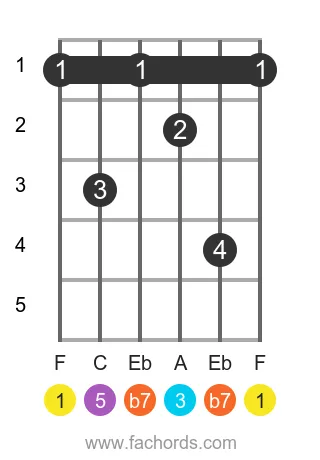
In the key of C the same move is Fm7 Bb7 C, and the first two chords sit outside the key: Fm7 brings in Ab and Eb, Bb7 brings in Bb and Ab. Both are borrowed from the parallel minor, C minor, so they're a jazz case of borrowed chords. With a major seventh on the last chord it's written iv7-bVII7-Imaj7, and in the Nashville Number System it's 4m(7) b7(7) 1. The chords and audio in five keys are further down.
Front Door, Back Door
The usual way home is through V7, the front door: Dm7 G7 C. The backdoor comes in through bVII7, a dominant chord a whole step below the tonic. Play the two one after the other and compare the last change:
- G7 to C: the G carries over, and F drops a half step to E.
- Bb7 to C: nothing carries over, because Bb D F Ab and C E G have no note in common. Ab falls a half step to G, and F falls to E.
Listen for that Ab sliding down to G. It gives the arrival a warm, sighing quality. To hear it alone, play Ab at fret 1 of string 3, then let the open G string ring.
A ii-V That Lands Somewhere Else
Look at Fm7 Bb7 on a chart. It's shaped exactly like a ii-V, and it would be the ii-V of Eb. That's what the iv7 is doing here: it prepares Bb7 the way a ii prepares a V. So you read a ii-V going to Eb, and then the music walks in on C instead.
That's why it's clearly a variation on the jazz ii-V-I, with iv7 and bVII7 reaching the tonic in place of ii and V. It works as a turnaround, and often it's only a short move back home. In Lady Bird by Tadd Dameron it carries the first line into the second as Fm7 Bb7 Cmaj7.
Same Door, Different Last Chord
The list is a nice lesson in how far you can dress this up. Read the Chords column and watch the final chord:
| Song | Artist | Section | Chords | Key |
|---|---|---|---|---|
| No Such Thing | John Mayer | chorus | Am9 D9 E9 | E major |
| I Wanna Be Where You Are | Jackson 5 | verse | Gm7 C7 D7 | D major |
| What A Girl Wants | Christina Aguilera | chorus | Fm Bb C | C major |
| Yardbird Suite | Charlie Parker | head | Fm7 Bb7 C7 | C major |
| Misty | Erroll Garner | A section, bars 4 and 5 | Abm7 Db7 | Ebmaj7 (plays iv7-bVII7-Imaj7) | Eb major |
| Lady Bird | Tadd Dameron | first line into the second line | Fm7 Bb7 Cmaj7 (plays iv7-bVII7-Imaj7) | C major |
| Groovin' High | Dizzy Gillespie | bars 29 to 31 | Fm | Abm Db7 | Eb (plays iv7-bVII7-Imaj7) | Eb major |
| Just Friends | John Klenner | bars 3 to 5 | Cm7 | F7 | Gmaj7 (plays iv7-bVII7-Imaj7) | G major |
- Plain triads: What A Girl Wants plays Fm Bb C in the chorus.
- A major seventh: Misty lands on Ebmaj7, and Just Friends on Gmaj7.
- A dominant on the tonic: Yardbird Suite ends on C7 and I Wanna Be Where You Are on D7.
- Ninths all the way: No Such Thing plays Am9 D9 E9, the same roots as our open E version.
Groovin' High is the odd one out: it gets to Abm Db7 from an Fm.
Here's a quick way to play along with Just Friends. With a capo on the third fret, the Am7 D7 E shapes sound Cm7 F7 G. Give each chord one bar, like the tune does in bars 3 to 5, then take the capo off and play Am7 D7 G, the front door to the same key. When your ear can tell front door from back door, try slipping the backdoor in at the end of a tune in place of the V7.
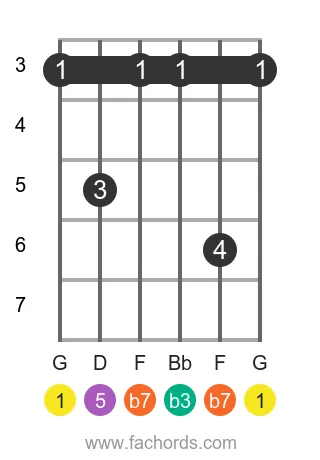
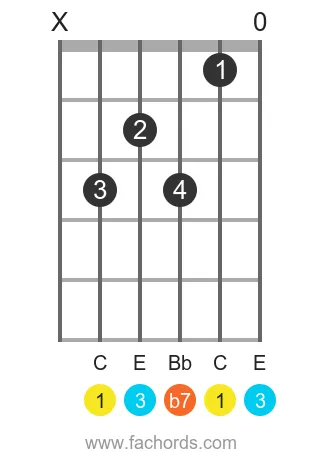
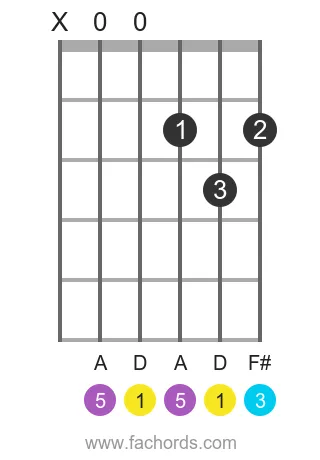
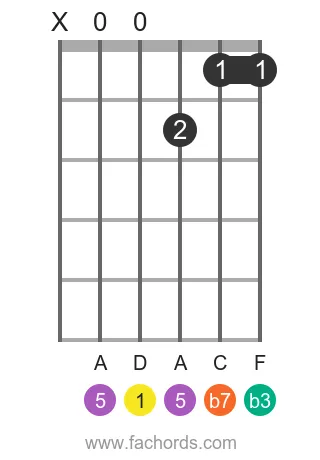
Backdoor Progression: Chords and Audio in C, G, D, A and E
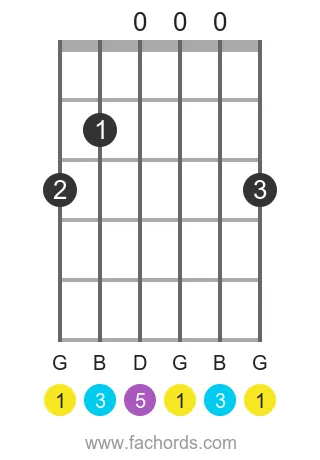
Press play to hear each key. The diagrams show the shapes used in the audio, and every chord links to its full page.


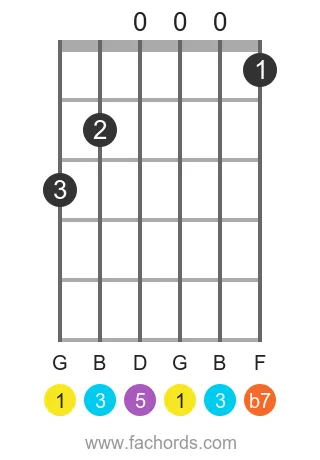
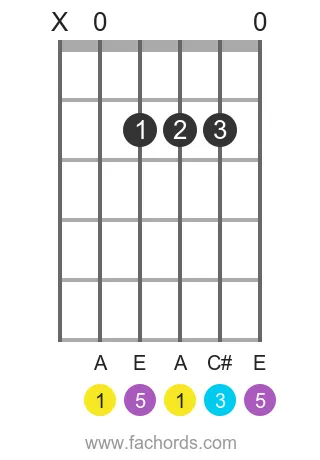
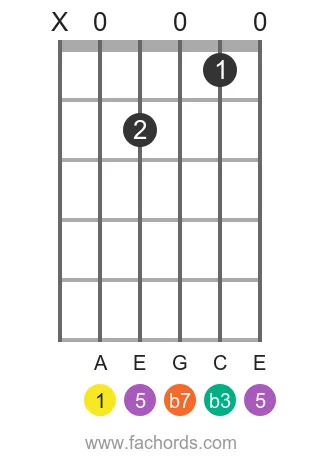
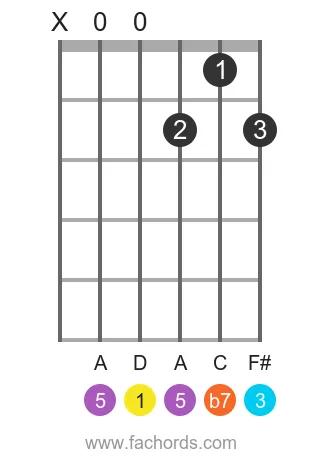
More progressions like this one
- I-#Idim-ii-V: C C#dim Dm G
- Ascending augmented: C Caug C6 C7
- Ragtime progression: C A7 D7 G7
- I-IV-II-V: C F D G

Created by
Giancarlo is a musician (teaching guitar since 2000), software engineer, AI consultant and published researcher
FAQ
Can you list the backdoor chords key by key?
In C major: Fm7 Bb7 C. In G major: Cm7 F7 G. In D major: Gm7 C7 D. In A major: Dm7 G7 A. In E major: Am7 D7 E.
Why is it called a backdoor progression?
V7 is the front door to the tonic. This move arrives through bVII7 instead, a dominant chord a whole step under the tonic, so it comes in by the other side.
Are Fm7 and Bb7 in the key of C?
No. They are borrowed from the parallel minor, C minor. Fm7 brings in Ab and Eb, and Bb7 brings in Bb and Ab, all notes from outside C major.
How is the backdoor progression different from a ii-V-I?
It is a variation on it. Instead of ii and V, the chords iv7 and bVII7 reach the tonic. Fm7 Bb7 looks like the ii-V of Eb, but it resolves to C.
Which jazz standards use the backdoor progression?
Lady Bird by Tadd Dameron plays Fm7 Bb7 Cmaj7, Misty plays Abm7 Db7 Ebmaj7 and Just Friends by John Klenner plays Cm7 F7 Gmaj7 in bars 3 to 5.