The Minor Line Cliche: One Chord, One Voice Sinking by Half Steps
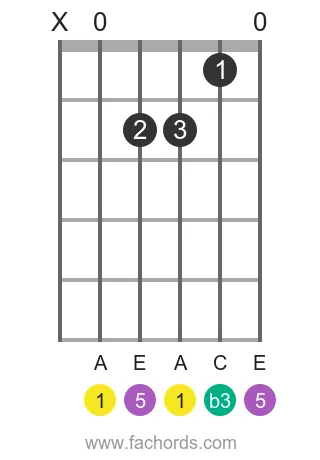
What if the chord stayed put and just one voice moved? That's the minor line cliché, written i-i/7-i7/b7-i6/6. In A minor it reads Am Am/G# Am7/G Am6/F#.
It looks like four chords, but it's one Am with a moving line. The part after the slash is the moving note. In Nashville numbers it's 1m 1m/7 1m(7)/b7 1m(6)/6, and in C minor it's Cm Cm/B Cm7/Bb Cm6/A. That last one has an A natural, which is outside the key, since C minor has Ab. Cm/B steps outside natural minor too, with the B natural of harmonic minor. See it in every key in the chord section.
Root, Major Seventh, Minor Seventh, Sixth
Follow the line against Am: A is the root, G# the major seventh, G the minor seventh, F# the sixth. Each step is a half step down, while C and E stay where they are. So the harmony is static, and the falling voice gives it a gentle, sinking motion.
In the Bass or Inside the Chord
You can put that line in two places, so try both.
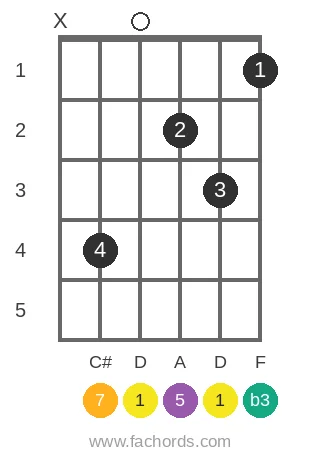
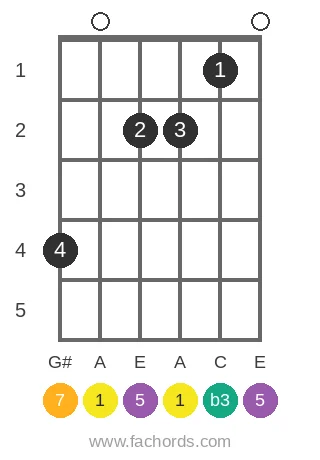
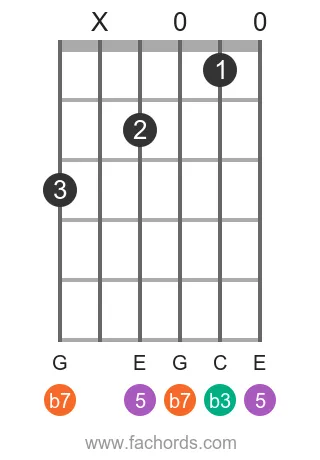
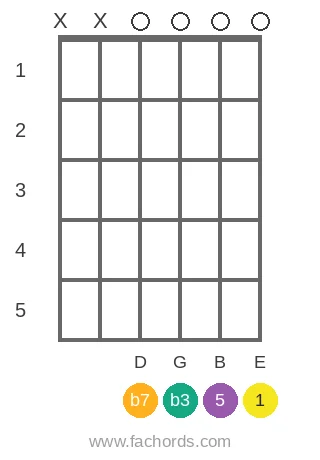
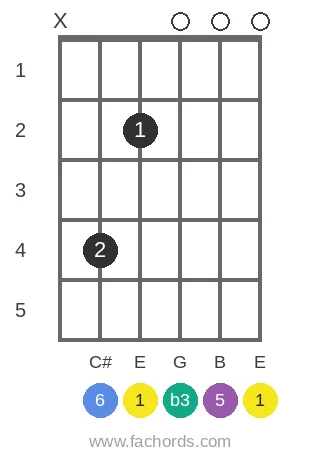
- In the bass: play the open A string, then frets 4, 3 and 2 of string 6, with C and E on top.
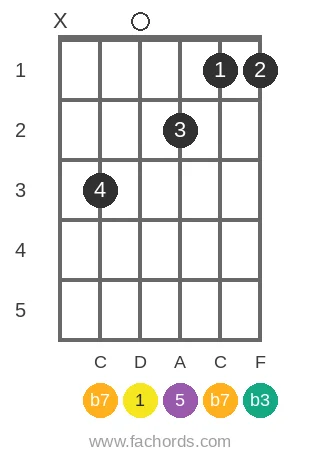
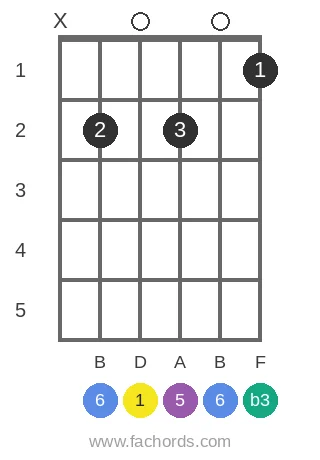
- Inside the chord: hold Am and walk string 3 from fret 2 to fret 1, then open. That gives A, G#, G. The F# sits on fret 4 of string 4.
The inner version has a mouthful of a name. The site jazzguitar.be describes it as CESH, contrapuntal elaboration of static harmony. In plain words: a line that dresses up a chord that isn't going anywhere.
Two A Minor Songs, Two Endings
Both songs sit in A minor, so the same line fits both, and they don't finish it in the same way.
| Song | Artist | Section | Chords | Key |
|---|---|---|---|---|
| My Funny Valentine | Frank Sinatra | opening A section | Am AmMaj7 Am7 Am6 | A minor |
| Stairway to Heaven | Led Zeppelin | intro and verse | Am AmMaj9 Am7 D/F# | A minor |
My Funny Valentine stays on the chord all the way: Am AmMaj7 Am7 Am6. Stairway to Heaven has AmMaj9 on the second step, goes through Am7, then lands on D/F#. The bass is F# as before, but the chord on top has changed. Play Am6 and D/F# back to back and compare.
Keep the line falling to E, with new chords on top, and you're on the chromatic lament bass.
Minor Line Cliché: Chords and Audio in C, G, D, A and E
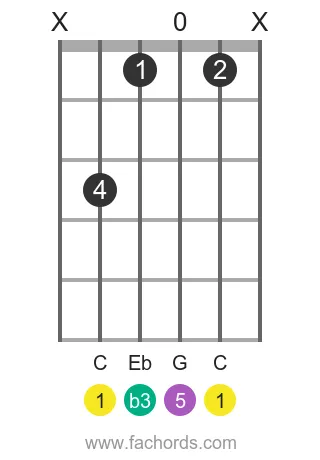
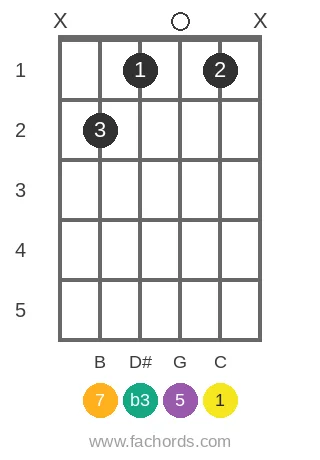
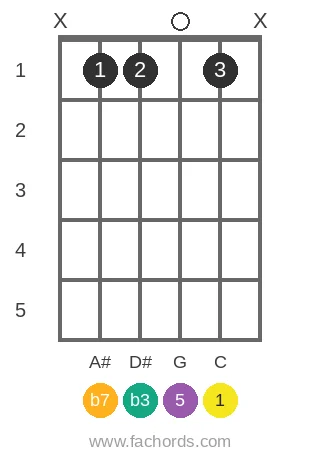
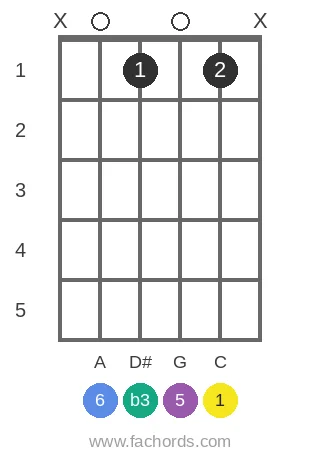
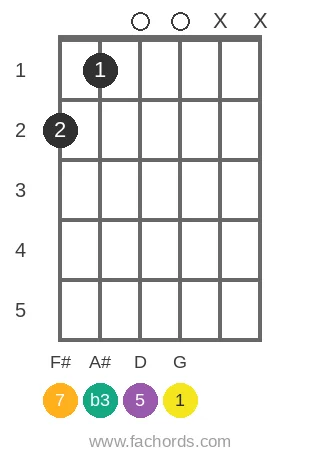
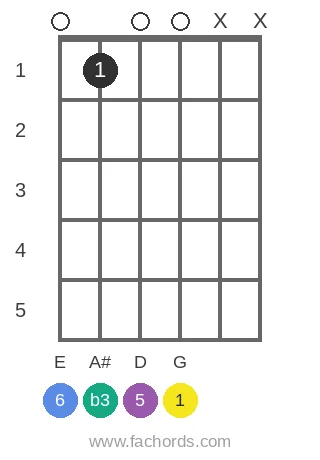
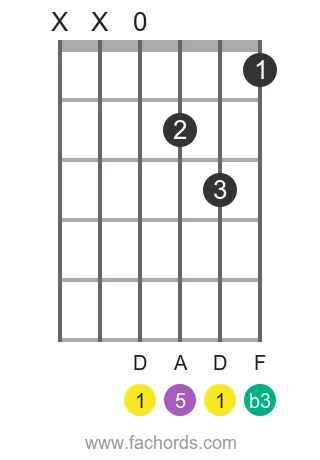
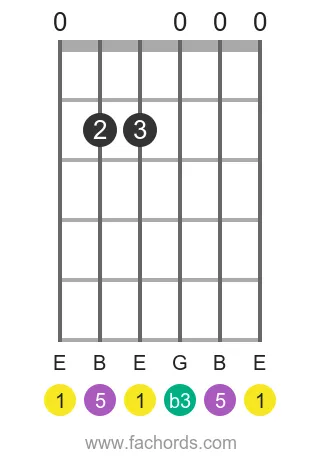
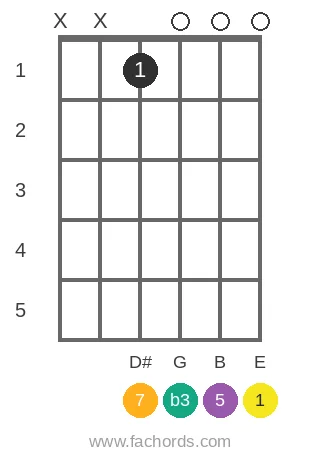
Press play to hear each key. The diagrams show the shapes used in the audio, and every chord links to its full page.



More progressions like this one
- Chromatic lament bass: Cm G/B Cm/Bb F/A Ab G
- Picardy third ending: Cm Fm G C
- Minor circle of fifths: Cm Fm Bb Eb Ab Dm7b5 G Cm
- Minor i-iv-bVII: Cm Fm Bb

Created by
Giancarlo is a musician (teaching guitar since 2000), software engineer, AI consultant and published researcher
FAQ
How is the line cliche spelled in other minor keys?
In C minor: Cm Cm/B Cm7/Bb Cm6/A. In G minor: Gm Gm/F# Gm7/F Gm6/E. In D minor: Dm Dm/C# Dm7/C Dm6/B. In A minor: Am Am/G# Am7/G Am6/F#. In E minor: Em Em/D# Em7/D Em6/C#.
What does CESH mean on guitar?
It stands for contrapuntal elaboration of static harmony. Jazzguitar.be uses it for the inner version of the line cliche, where a voice moves inside one chord that stays put.
Does the moving line go in the bass or inside the chord?
It can go in either place. In A minor the bass plays A, G#, G and F#, or the same notes move inside the chord while the rest of Am holds.
Which songs use a minor line cliche?
My Funny Valentine by Frank Sinatra uses it in the opening A section as Am AmMaj7 Am7 Am6. Stairway to Heaven by Led Zeppelin uses it in the intro and verse, ending on D/F#.