Diminished Guitar Chords
Learn What Diminished Chords Are And How To Use Them
In this tutorial, we are going to learn how to play diminished chords on the guitar.
When we first started learning about chords we started with the easy and simple major triad .
Major triads or chords are all formed with the root (1st), 3rd , and 5th note of the scale.
If we have the key of C with the scale C D E F G A B , our major triad for C are the notes C E G .
Now a minor triad or a C minor chord is made by simply flattening the 3rd note, thus C Eb G .
Today we will take it a step further and deal with diminished chords , which come in three different kinds.
Interactive Fretboard: Explore Diminished Chords
This interactive tool allows you see how diminished chord shapes are found on the fretboard.
All the shapes are with C as root, and are movable, as they don't use open strings.
Diminished Chords Types: Interval Structures
There are three main types of diminished chords:
- Diminished Triads
- Diminished Sevenths
- Half Diminished
Here below you find the interval structure of each of them.
Diminished Triad (C Eb Gb)
Diminished Seventh (C Eb Gb Bbb)
Half Diminished (C Eb Gb Bb)
Diminished Triads
Now that we have reviewed major and minor triads, it isn't too difficult to grasp the diminished triad .
For this we flatten the 3rd and the 5th note.
So a C diminished triad happens to be C Eb Gb .
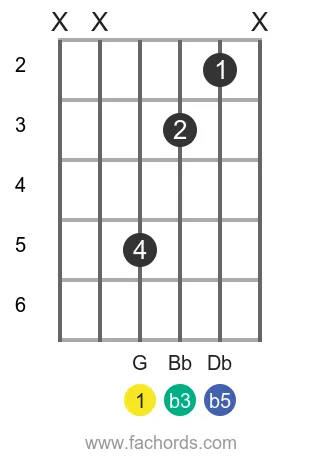
This of course works for every key, with G we have a major triad of G B D , a G minor is G Bb D , and thus a G diminished triad is G Bb Db . Simple right?
Diminished Chords Naming convention
On music sheets, instructional ebooks or other guitar websites you can find the diminished chord denoted with different symbols: Cdim Cb5 Co . All these symbols refer to the diminished triad.
Diminished Triads Fingerings
One of the most common chord shapes for a diminished triad is the shape we use for Gdim which is 3453XX .
That means we have the notes G Db G Bb, so like a regular major barre chord we move this same chord shape up two frets at 5675XX we get an A dim chord.
The root note will be the lowest note on each voicing.
G Dim
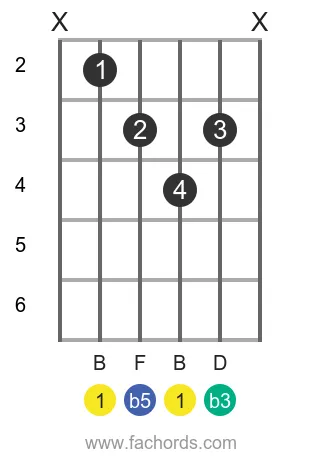
B Dim
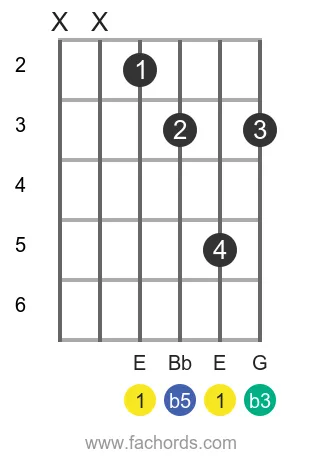
E Dim
Another common diminished shape is X2343X , which is a Bdim .
Again the root is the first note we play the 2nd fret B note.
If we move that shape up one fret we get a Cdim chord .
And even another common shape is the similar XX2353 , which will make the E dim chord. The root note is also the first note we play, the E, and as we move that shape we get different chords.
Of course there are other ways to play diminished triads, but knowing a few basic shapes will give you a good head start.
Diminished Sevenths
In order to understand diminished seventh chords, let's have a look to other chord types:
-
Now in the key of C, a
dominant 7th
chord or C7 is built by taking a
major
triad
and
adding a
minor seventh
.
So the notes of C7 are C, E, G, and Bb
-
The
minor 7th chord
is built by taking a
minor triad
and adding a
minor seventh
.
So a Cmin7 is C Eb G and Bb (notice the third note is flat).
- A diminished 7th is simply a minor 7th chord that has its 5th and 7th notes flatted: C Eb Gb and Bbb
Diminished sevenths chord formula
Now what that means is the diminished 7th chord has a note that is double flat .
If that is all too confusing the simple formula for a diminished seventh is:
- C root note
- Eb flattened third
- Gb flattened fifth
- Bbb double flattened seventh note
Enharmonic equivalent notes
Keep in mind the concept of enharmonic equivalent notes.
The note Db and C# are enharmonic; they are used at different times for different keys but they are essentially the same (same pitch).
As we travel down the path of diminished sevenths we will see notes like Dbb, which is enharmonically the same as the C note.
In our example, the C diminished seventh chord, we have the Bbb , that is enharmonic equivalent to the note A
Try not to let this confuse you, sometimes music theory just seems worse than it is!
Diminished 7th chords naming convention
Diminished seventh chords are denoted with the following symbols: Cdim7 Co7 Cm6b5
Diminished seventh chords are symmetrical
Because a diminished seventh is three stacked minor chords , there are only four inversions of them that represent all diminished seventh chords.
For example, Cdim7 is represented by the notes;
C Eb Gb Bbb
And the same notes for Eb dim7
Eb Gb Bbb (enharmonically same as A) C (enharmonically Dbb). Our article on chord substitution will help you understand how to swap chords with the same notes.
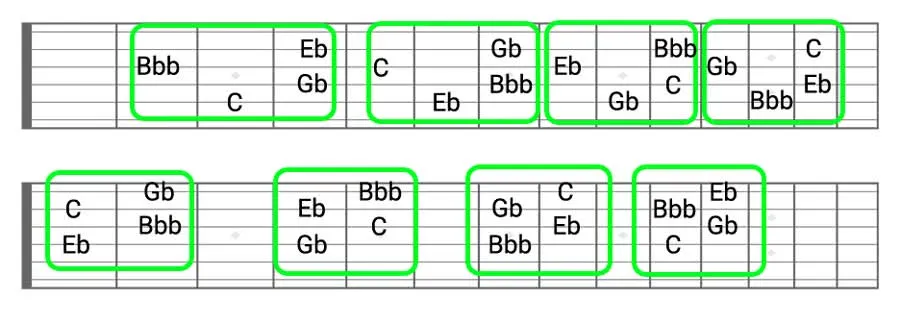
As shown in the picture, diminished seventh chord shapes are symmetrical: you can move the same shape up and down the neck by 3 frets (a minor third) to obtain different inversions of the same chord, keeping the same fingering
And the same notes as Gb dim7 and Bbb dim7 which enharmonically are the same as Adim7.
Because we have twelve musical notes in our scale we only have so many chord voicing's for a dim7.
As you learn these chords you will notice certain repeating chord shapes for this reason.
That is another reason not to let diminished sevenths get to cumbersome, there are only a few of them technically.
Diminished seventh chords guitar shapes
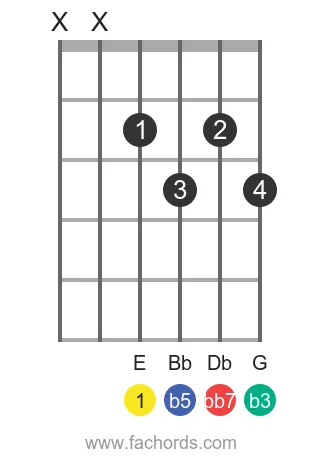
As far as dim7 chord shapes one happens to be XX2323 which is an Edim7 .
The first note we play is the root note E, so if we move this shape up 3 frets we get Gdim7 at XX5656
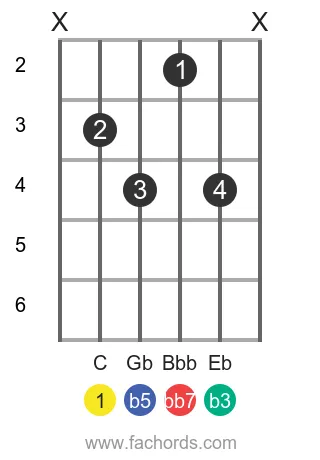
Another dim7 shape is X3424X , which is Cdim7 with the root note C as our first note in the sequence. If we move that chord shape up 2 frets we get Ddim7 .
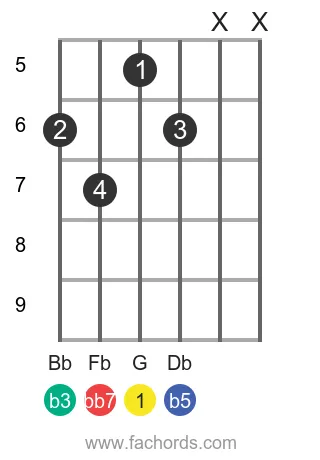
A much harder dim7 shape is 3X232X , which is Gdim7 .
This shape can also be moved up and down the fretboard to make different diminished chords, but it is not easy to always mute the two strings necessary to mute.
E Dim 7th
C Dim 7th
G Dim 7h
Don't forget that many of these chord shapes will stand for different diminished chords .
The X3424X of Cdim7 is also the Ebdim7, as we mentioned above. The root note is not always important so we have a lot of leeway for when we play our diminished sevenths.
Half Diminished Chords
Half diminished chords are also known as minor seventh flat fifth chords and are notated as m7b5 .
Now above for diminished 7ths we flattened the 7th twice, for the half diminished we only do it once, easy right? So a Cm7b5 is C Eb Gb Bb , not complicated at all.
Despite the simple difference between the diminished seventh and the half diminished these two chords sound completely different in a song .
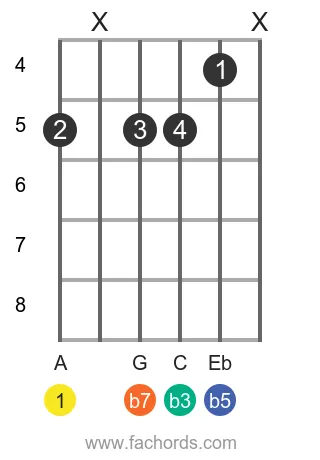
Am7/b5
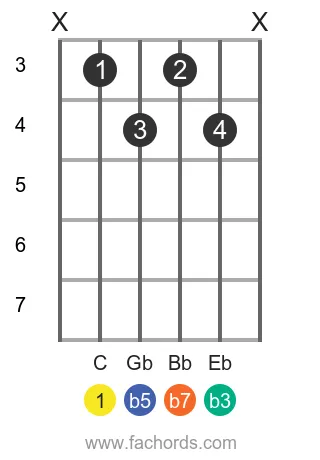
Cm7/b5
Fm7/b5
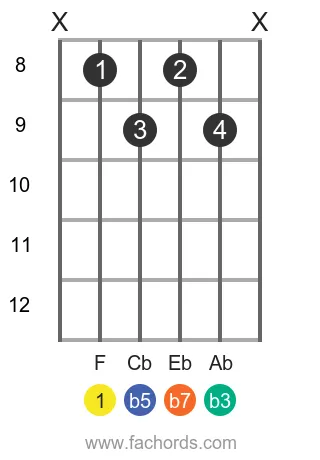
The half diminished chords have a few shapes worth memorizing one is the XX2333 which is a Em7b5 . By moving this up one fret we get an Fm7b5. Another movable barre position is X2323X which is an Bm7b5 .
The half diminished chords unfortunately do not have the same stackable thirds concept as the dim7 above, so there will be a variety of chord shapes to learn.
When to Use Diminished Chords
Diminished chords have a dissonance to them so they cannot just be placed anywhere in your song.
They are often used as a leading tone that require resolution right after playing them.
Often we will not end up using the plain old diminished triads, because they honestly sound better when adding the 7th.
1) Between the root chord and the second chord
There are a couple places that dim7 chords will sound great.
One is in between the root chord and the second chord , in the key of C that is C and Dm. You always use the diminished chord that is a half step below the second chord, so we use a C#dim7 like this;
C C#dim7 Dm (C# is a half step below D)
It is very common for dim7 chords to be half step lower than the chord that comes after them .
It's not a die hard rule but usually when trying to fit a dim7 in, this half step rule will often work great.
2) Between the fourth and fifth chord
Another good place for a dim7 is between the fourth and fifth chord of the key, which in C is the F and G chord.
We use a diminished chord that is a half step higher than the fourth ;
C F F#dim7 G C
And we can use the dim7 to make a parallel chord change like this;
C Cdim7 C
3) Substitution
Now when using half diminished chords, we often replace the third minor chord of the progression.
Instead of the progression C-Dm7-Em-F try:
C Dm7 Em7b5 F (Em7b5 replaces Em)
And we can also replace the second minor chord with a half diminished . Instead of C-Dm-G-C :
C Dm7b5 G C (Dm7b5 replaces Dm)
4) Single notes passing
Diminished chords are not always played as a whole chord of course , it is common with the guitar to use single notes in passing.
Let's say you are playing a F power chord in a rock song 133XXX , with the notes F C F. By lowering the fifth one fret you get the diminished fifth of C (Cb, enharmonic of B).
Now technically this is not a whole diminished triad, but flattening that fifth still gives you the same feel.
Even with dim 7 chords sometimes we just have to add the diminished note in our playing to get the same tension in our music.
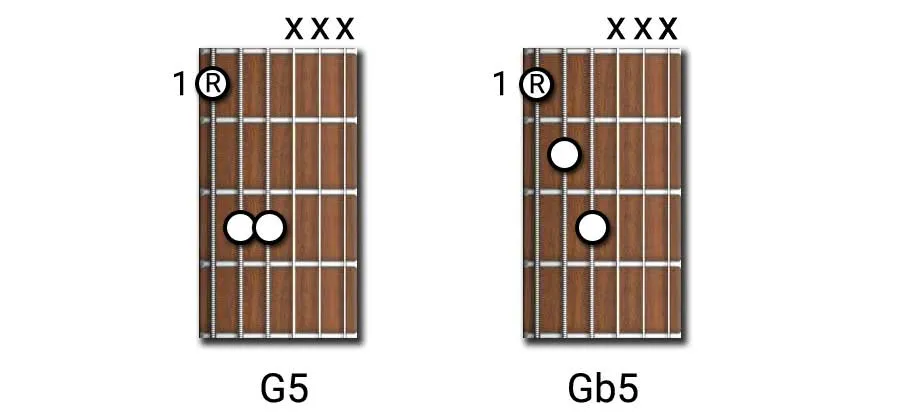
Power chord and diminished fifth
There are many more examples of when to use dim, dim7, and m7b5 chords.
Approach them like food, they are not the main ingredients just extra spice to make the song sound so much better.
Take one of the many common chord progressions out there and start peppering in your diminished chords and see what works and what doesn't!
Some Common Examples of Diminished Chords
One of the best ways to learn your diminished chords will be to practice them in as much music as possible.
Search as many songs as you can and keep an eye out for when dim , dim7 , and m7b5 chords are used.
The more you play these chords in other music, especially your favorite songs the easier they will be to understand.
George Harrisons
In George Harrisons " My Sweet Lord " a diminished triad is used at the end of the chorus when he sings " but it TAKES so long my Lord ". The dim chord appears on the word "takes" and quickly moves to a dominant seventh. George Harrison often uses diminished chords, and his song " Isn't It a Pity " uses both dim7 and m7b5 chords.
When You Wish Upon a Star - Disney
Another great example of just a plain diminished triad is the well known Disney song " When You Wish Upon a Star ". The lyric " makes no difference WHO you are " the who has a Cdim that leads into a C major right after.
God Only Knows - Beach Boys
Another song that happens to have good examples of both diminished sevenths and half diminished chords is the Beach Boys tune " God Only Knows ". The lyrics " you never NEED to doubt, I'll make you so SURE about it " the dim7 appears on NEED and the m7b5 appears on the word SURE .
More songs that use these chords are:
- In the song " This Love " by Maroon 5 each line of the verse ends in a dim7.
- Paul Simons " Still Crazy " has a couple dim and dim7 chords. In fact, that song has a plethora of harder chords like maj7, sus, dim, and dim7.
- In the Red Hot Chili Peppers song " Road Trippin " a diminished is used at the end of the interlude.
- There is a dim7 used in the Garth Brooks song " Friends in Low Places ". In fact, when played in the key of G he uses the standard half step dim7 G-G#dim7-Am.
- The haunting aspect in The Beatles " Blue Jay Way " verse arises from the use of a Cdim chord at the start of each line.
- Of course again The Beatles with " Because " a song that has both half and regular diminished chords. This song makes great study for this topic.
- Again another Beatles song using them was " Till There Was You ", but remember that isn't a song written by them. It is a jazz standard written a decade earlier.
We of course haven't touched on the music genres of black metal and similar styles; they rely heavily on diminished chords.
While those songs aren't as well known to the general public, if you want to play hardcore metal, well you will need to be well versed in diminished chords.
You will not always see diminished chords written in your music or your chord changes because sometimes they are sung by the voice as opposed to being played on the guitar.
Also if you are looking up examples online you will often see these chords left out of tabs, mainly because many guitarists don't want to play anything too difficult.
In regular pop music you will probably see m7b5 chords more often than dim7 chords .
While there are plenty of examples of diminished chords in pop music, when it comes to jazz and old standards...
well nearly every song uses them.
If you are going to study jazz guitar, well you better be familiar with your diminished and half diminished sevenths.
If you happen to have an affinity for early American composers like Hoagy Carmichael or Fats Waller you will see plenty of dim chords.
Diminished Guitar Chords: conclusion
At the end of the day diminished chords can seem complicated because of all their potential uses .
They also can be a little difficult to finger the voicing's for many beginners and even some intermediate students.
But don't let that keep you from learning them. On their own they don't sound the greatest , but added in the right spot they sound wonderful.
As mentioned they are connective chords and notes in arpeggios , that give us more tension in the music which leads to a better resolution .
It's not necessary to get to hung up on when exactly to play diminished chords, the key is to experiment as you play.
Over time your ear will be the guide on when diminished chords sound the best on your guitar! If you like this tutorial, please comment and share!
To stay updated on new tutorials, subscribe to the free newsletter (you'll also get access to the download area with lots of free printable resources)

Created by
Giancarlo is a musician (teaching guitar since 2000), software engineer, AI consultant and published researcher
FAQ
What is the fundamental difference between a Diminished Triad, a Half-Diminished chord, and a Diminished Seventh chord?
The primary distinction lies in their interval structure and the number of notes. A Diminished Triad has three notes (Root, flattened 3rd, flattened 5th). A Half-Diminished chord (also known as m7b5) has four notes (Root, flattened 3rd, flattened 5th, and a flattened 7th). A Diminished Seventh chord also has four notes but features a double-flattened 7th (Root, flattened 3rd, flattened 5th, and a double-flattened 7th), which gives it a distinctly different sound and symmetrical property.
Why are Diminished Seventh chords described as 'symmetrical,' and how does this affect how I play them on guitar?
Diminished Seventh chords are symmetrical because they are built from a stack of three minor third intervals. This means that any inversion of a diminished seventh chord contains the exact same notes as another diminished seventh chord a minor third away. On the guitar, this is highly practical: you can move a single diminished seventh chord shape up or down by three frets (a minor third), and you will effectively be playing an inversion of the same chord, with a new note acting as the apparent root. This symmetry means there are fewer unique-sounding diminished seventh chord voicings to learn.
When is a good time to use diminished chords in a song, and what purpose do they serve?
Diminished chords are often used as 'extra spice' or 'connective chords' due to their inherent dissonance, which creates tension leading to a satisfying resolution. Good times to use them include: 1) As a leading tone a half-step below the next chord (e.g., C - C#dim7 - Dm). 2) As a leading tone a half-step above the previous chord (e.g., F - F#dim7 - G). 3) For parallel motion (e.g., C - Cdim7 - C). 4) Half-diminished chords can substitute for minor chords in progressions (e.g., replacing an Em with an Em7b5).
How do the different naming conventions like 'Cdim,' 'Co,' 'Cdim7,' and 'Cm7b5' relate to the various types of diminished chords?
These notations indicate the specific type of diminished chord: 'Cdim' and 'Co' (C followed by a small circle) both denote a Diminished Triad. 'Cdim7' and 'Co7' (C followed by a small circle and a 7) refer to a Diminished Seventh chord. 'Cm7b5' specifically indicates a Half-Diminished chord, where 'm7' signifies a minor seventh and 'b5' shows a flattened fifth.
Diminished chords are described as having 'dissonance'; does this mean they sound bad on their own?
While diminished chords do possess a strong dissonance or tension, this doesn't mean they 'sound bad.' Their dissonant quality is precisely what makes them effective in music. They create a feeling of instability that naturally pushes towards a resolution, adding drama, interest, and movement to a chord progression. When used strategically, they sound wonderful by providing tension and release, rather than being an end in themselves.
Can I use individual notes from diminished chords, or do I always have to play the full chord shape?
No, you don't always have to play the full chord shape. The tutorial mentions that diminished sounds can be achieved by using single notes in passing. For example, by lowering the fifth of a power chord, you can introduce a diminished fifth, creating a similar 'tension' or 'feel' without playing the entire diminished triad or seventh chord. This highlights their role as connective notes and allows for more nuanced harmonic textures.