Explore B 13#11 Chord Geometry on Guitar
Want a structured chord roadmap instead of jumping between pages?
Go to the full guitar chords tutorial.
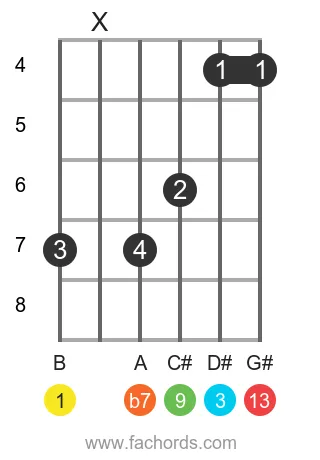
Visualizing complex chords like the B 13(#11) on the guitar fretboard is key to unlocking new sounds. This chord, a vibrant member of the Dominant Chords family, extends across the strings with a distinct geometric pattern. You can immediately see and hear its layout on our interactive virtual fretboard, which also lets you verify your finger placements with real-time mic feedback. The B 13(#11) is built from the notes B, D#, F#, A, C#, E#, and G#, corresponding to the intervals 1, 3, 5, b7, 9, #11, and 13 – that’s the Root, Major Third, Perfect Fifth, Minor Seventh, Major Ninth, Augmented Fourth, and Major Thirteenth.
The B 13(#11) chord is a rich, complex dominant extension, frequently encountered in jazz and fusion music, where its unique augmented eleventh adds a distinctive color. Understanding how these extended intervals are structured is crucial for advanced guitarists looking to expand beyond basic and intermediate chord knowledge. For a deeper dive into how intervals construct chords, explore our guide on Chord Construction. If you're specifically interested in the broader family of dominant chords, including how they function harmonically, our comprehensive Dominant Chord tutorial offers valuable insights into their characteristics and effective use in your playing.
Further down, you'll find an array of B 13(#11) chord diagrams, organized from easiest to most challenging, complete with accompanying theory and practical examples across various keys and songs. Before committing them to memory, we encourage you to use the interactive fretboard above to explore these unique shapes and their sonic possibilities. This hands-on approach will help you truly internalize the chord's geometry rather than just rote memorization.
B 13th with sharp 11th guitar chord is also written as B13(#11), B13#11 or B13+11.
B 13(#11) chord Notes:
Chord Formula:
B 13(#11) Guitar Chord Diagrams
Position 1
Barre
Movable
 Find more shapes in our all guitar chords online library. If you
prefer a printable pdf, download
the Free Guitar Chords Chart Pdf
Find more shapes in our all guitar chords online library. If you
prefer a printable pdf, download
the Free Guitar Chords Chart Pdf
You can also use this accessible B13(#11) chord page, with written diagram instructions and screen-reader support for blind users.

Created by
Giancarlo is a musician (teaching guitar since 2000), software engineer, AI consultant and published researcher
FAQ
What defines the B 13(#11) as a dominant chord?
The B 13(#11) chord is categorized as a dominant chord because it includes a minor seventh interval (b7) relative to its root, B. This characteristic minor seventh is a hallmark of dominant chords, giving them their distinctive tension and function in music.
What specific notes are included in a B 13(#11) chord?
The B 13(#11) chord is composed of seven distinct notes: B (Root), D# (Major Third), F# (Perfect Fifth), A (Minor Seventh), C# (Major Ninth), E# (Augmented Fourth or #11), and G# (Major Thirteenth).
Why is the B 13(#11) chord described as complex for guitarists?
The B 13(#11) chord is considered complex due to its extended nature, incorporating many intervals beyond the basic triad and seventh. This requires precise finger placement across multiple strings and frets, and it is often found in advanced music genres like jazz, signifying a higher level of guitar skill.
What do the intervals 1, 3, 5, b7, 9, #11, and 13 represent in the B 13(#11) chord?
These numbers represent the specific musical intervals relative to the root note, B. They are the Root (1), Major Third (3), Perfect Fifth (5), Minor Seventh (b7), Major Ninth (9), Augmented Fourth (#11), and Major Thirteenth (13). Each interval contributes a unique color and tension to the chord's overall sound.
What is the role of the '#11' in the B 13(#11) chord name?
The '#11' signifies an Augmented Fourth interval, which is an altered extension specific to this chord. In the key of B, a natural 11th would be E, so the #11 refers to E#. This augmented interval adds a distinct, often bright or dissonant, characteristic flavor that distinguishes it from a standard 13th chord.
