Practice the C 13 chord: Master its Dominant Harmony
Want a structured chord roadmap instead of jumping between pages?
Go to the full guitar chords tutorial.
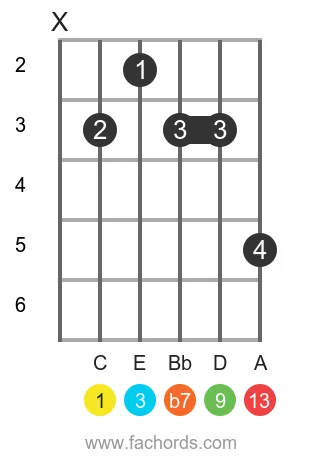
Are you ready to tackle the complex C 13 chord? Our interactive fretboard challenges you to play it, providing immediate, accurate acoustic feedback through your microphone. This sophisticated Dominant Chords family member, comprised of notes C, E, G, Bb, D, F, and A, is constructed with intervals 1, 3, 5, b7, 9, 11, and 13. Use the virtual fretboard to visualize its fingerings and hear its rich sound, then try playing along.
As a sophisticated extension of the Dominant Chord family, the C 13 chord is often heard in jazz and funk, adding a rich, expressive color. Understanding its construction means delving into its complex chord construction, which goes beyond basic triads. This chord involves stacking intervals up to the 13th, making insights into shell chords and even understanding chord inversions beneficial for mastery.
Dive deeper into the C 13 chord by exploring various diagrams, presented from easiest to most challenging, and unlock the theory behind its voicings across different keys. Apply this knowledge to actual songs, but first, challenge your playing by testing yourself with our interactive tool above. Practice makes perfect!
C dominant 13th guitar chord is also written as C13, Cdom13 or C7(13).
Notes of the C 13 chord:
Chord formula for the Dominant Thirteen chord:
C 13 Guitar Chord Diagrams
Position 1
Movable
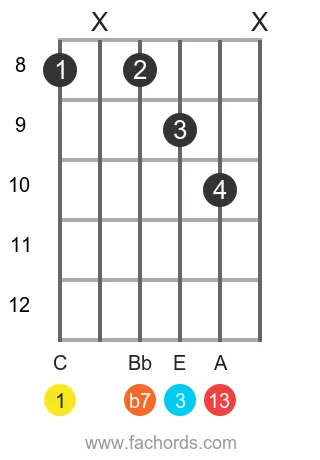
Position 2
Barre
Movable
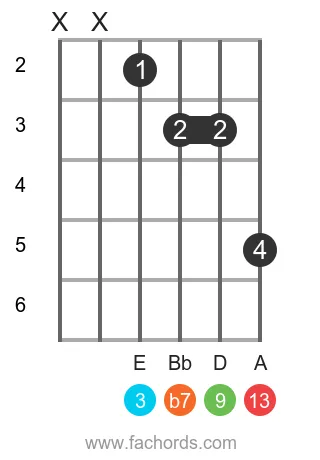
Position 3
Barre
Movable
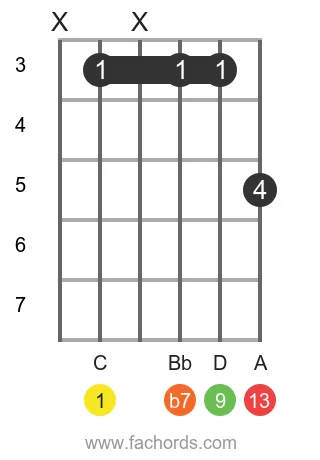
Position 4
Barre
Movable
Position 5
Barre
Movable
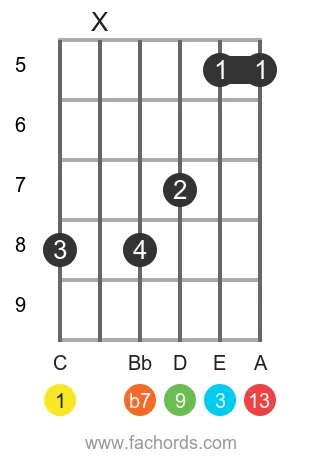
Position 6
Barre
Movable
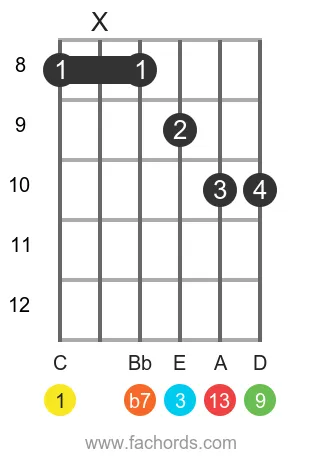
Position 7
Barre
Movable
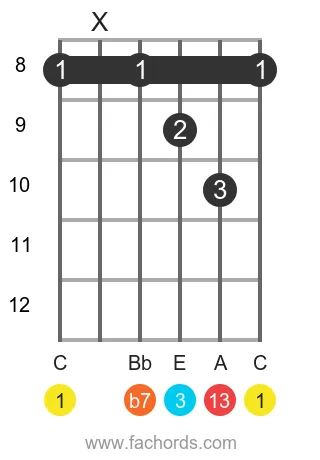
Position 8
Barre
Movable
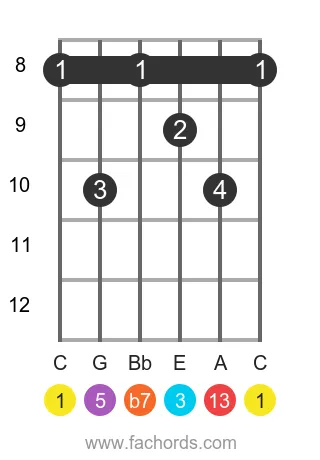
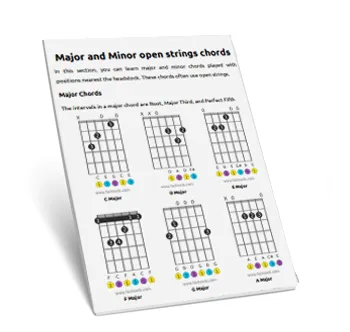
 Find more shapes in our all guitar chords online library. If you
prefer a printable pdf, download
the Free Guitar Chords Chart Pdf
Find more shapes in our all guitar chords online library. If you
prefer a printable pdf, download
the Free Guitar Chords Chart Pdf
You can also use this accessible C13 chord page, with written diagram instructions and screen-reader support for blind users.

Created by
Giancarlo is a musician (teaching guitar since 2000), software engineer, AI consultant and published researcher
FAQ
What notes and intervals form the C 13 chord?
The C 13 chord is built from seven specific notes: C, E, G, Bb, D, F, and A. These notes correspond to the intervals 1 (root), 3 (major third), 5 (perfect fifth), b7 (minor seventh), 9 (major ninth), 11 (perfect eleventh), and 13 (major thirteenth) when stacked from the root C.
Why is the C 13 chord described as complex and rich in sound?
The C 13 chord is considered complex due to its extensive seven-note structure, incorporating intervals up to the 13th. This full voicing creates a rich and sophisticated sound that adds significant harmonic depth, particularly appealing in jazz music.
When is the C 13 chord typically used in music?
The C 13 chord is often used to add depth and sophistication to musical compositions. It's a key player in many jazz chord progressions and is a favorite among jazz musicians looking to enrich their harmonies.
What does it mean to build the C 13 chord by 'stacking intervals'?
Building the C 13 chord by 'stacking intervals' means progressively adding each specific interval on top of the root note C. You start with the root, then add the 3rd, 5th, b7th, 9th, 11th, and finally the 13th, to construct the chord's full seven-note structure.
What foundational guitar knowledge is helpful before learning the C 13 chord?
Before diving into the C 13 chord, it's recommended to have a solid understanding of fretboard intervals and chord notation. These foundational concepts are crucial for visualizing the chord's structure and comprehending how it is built and played on the guitar.
