Explore Cadd9 Guitar Chord Shapes on the Interactive Fretboard
Want a structured chord roadmap instead of jumping between pages?
Go to the full guitar chords tutorial.
The C add nine chord, written Cadd9, stacks root C, major third E, fifth G and ninth D. It differs from a sus2 by one note: sus2 replaces the third with the second, while add9 keeps both.
There are five voicings on this page, four of them with open strings. Cadd9 is a major triad with the ninth added and no seventh. The C major scale holds each of these notes, so it shows you which neighbouring notes fit. For sequences to practise it in, see jazz chord progressions.
Start the drum loop in the player at the top, choose a tempo and play along with Cadd9 until it sits on the beat.
C added 9th guitar chord is also written as Cadd9, C(add9), Cadd2 or Cmaj(add9).
Notes that compose the C add9 chord:
Chord Formula:
Formula: 1 3 5 9
C Add9 Guitar Chord Diagrams
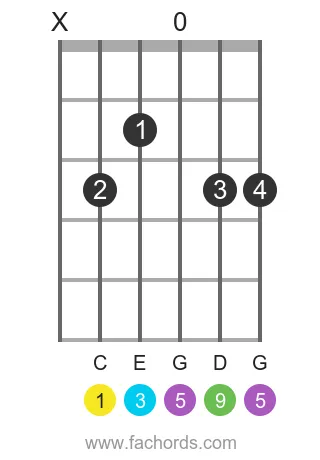
Position 1 Open
Finger Positions
- Mute the low E string
- Let the G string play without pressing any fret
- Place your index finger (1) on the fret 2 of the D string
- Place your middle finger (2) on the fret 3 of the A string
- Place your ring finger (3) on the fret 3 of the B string
- Place your pinky finger (4) on the fret 3 of the high E string
Position 2 Open
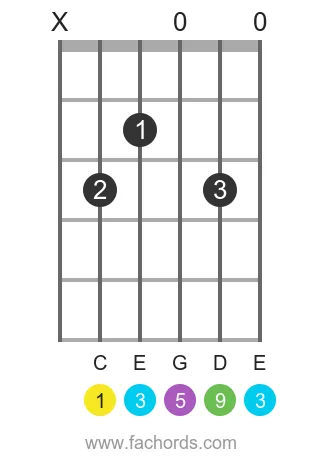
Finger Positions
- Mute the low E string
- Let the G string play without pressing any fret
- Let the high E string play without pressing any fret
- Place your index finger (1) on the fret 2 of the D string
- Place your middle finger (2) on the fret 3 of the A string
- Place your ring finger (3) on the fret 3 of the B string
Position 3 Movable
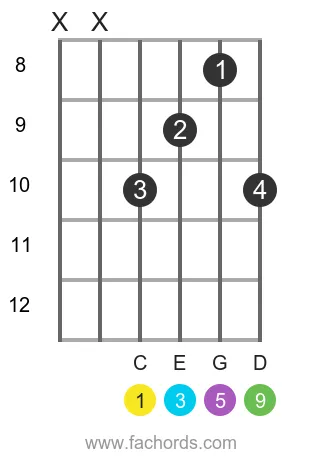
Finger Positions
- Mute the low E string
- Mute the A string
- Place your index finger (1) on the fret 8 of the B string
- Place your middle finger (2) on the fret 9 of the G string
- Place your ring finger (3) on the fret 10 of the D string
- Place your pinky finger (4) on the fret 10 of the high E string
Position 4 Open
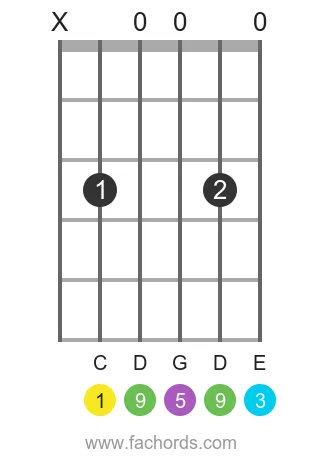
Finger Positions
- Mute the low E string
- Let the D string play without pressing any fret
- Let the G string play without pressing any fret
- Let the high E string play without pressing any fret
- Place your index finger (1) on the fret 3 of the A string
- Place your middle finger (2) on the fret 3 of the B string
Position 5 Open
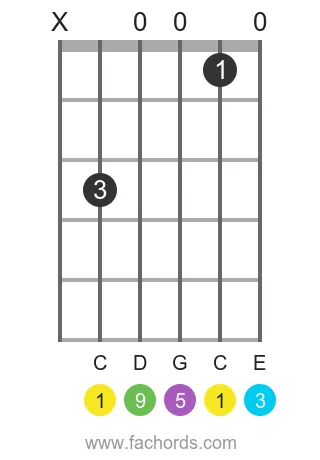
Finger Positions
- Mute the low E string
- Let the D string play without pressing any fret
- Let the G string play without pressing any fret
- Let the high E string play without pressing any fret
- Place your index finger (1) on the fret 1 of the B string
- Place your ring finger (3) on the fret 3 of the A string
 Find more shapes in our all guitar chords online library. If you
prefer a printable pdf, download
the Free Guitar Chords Chart Pdf
Find more shapes in our all guitar chords online library. If you
prefer a printable pdf, download
the Free Guitar Chords Chart Pdf

Created by
Giancarlo is a musician (teaching guitar since 2000), software engineer, AI consultant and published researcher
FAQ
What notes are in Cadd9?
Cadd9 contains C, E, G and D: root, major third, perfect fifth and ninth. D is an octave and a whole step up from C.
How many voicings does C add nine have?
Cadd9 has 5 voicings, 4 with open strings and none using a barre. The highest one reaches the 10th fret.
Which scale suits C add nine?
The C major scale: C, D, E, F, G, A, B. It contains all four chord notes, and D is the ninth.
What is the difference between Cadd9 and Csus2?
Csus2 swaps the third for the second, giving C, D, G. Cadd9 keeps E, the third, so it contains both E and D.