D#+(#11) Guitar Chords Explained | D# Augmented Fifth Sharp Eleventh added

Searching for plain D+(#11), without the sharp? It has its own page: D+(#11).
What is in D#+(#11), the D# augmented sharp eleven chord? The notes are D#, F##, A## and G##. Without a seventh it lacks the pull of a dominant seventh chord, so it works as a colour chord. The sharp eleventh sits a tritone above the root, six semitones up.
D#+(#11) fits inside the D# whole-tone scale: each of its notes is a member of that scale. F##, A## and G## make this spelling a theoretical one, and Eb+(#11) is the spelling charts prefer. The same chord is written Eb+(#11) in the enharmonic spelling, so the two pages share one sound.
D# augmented with sharp 11th guitar chord is also written as D#+(#11), D#aug(#11), D#+#11 or D#aug#11.
D#+(#11) Chord Notes and Formula
Notes in the D# +(#11) chord:
Tones in the Augmented Fifth Sharp Eleventh added chord:
Formula: 1 3 #5 #11
Same chord, different name: D#+(#11) is also written as Eb+(#11) (Eb augmented sharp eleven).
D#+(#11) Chord Interactive Fretboard
Want a structured chord roadmap instead of jumping between pages?
Go to the full guitar chords tutorial.
D#+(#11) Guitar Chord Diagrams
Position 1 Open
D# Augmented Sharp Eleven Finger Positions
- Mute the low E string
- Mute the D string
- Let the G string play without pressing any fret
- Let the B string play without pressing any fret
- Place your index finger (1) on the fret 5 of the high E string
- Place your middle finger (2) on the fret 6 of the A string
Position 2 Movable
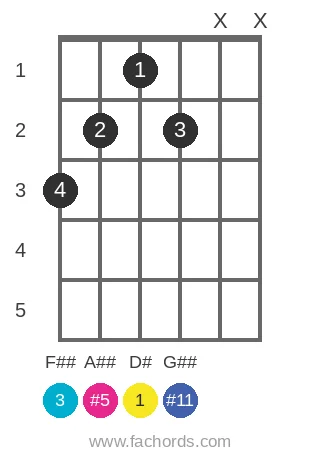
D# Augmented Sharp Eleven Finger Positions
- Mute the B string
- Mute the high E string
- Place your index finger (1) on the fret 1 of the D string
- Place your middle finger (2) on the fret 2 of the A string
- Place your ring finger (3) on the fret 2 of the G string
- Place your pinky finger (4) on the fret 3 of the low E string
Position 3 Barre Movable
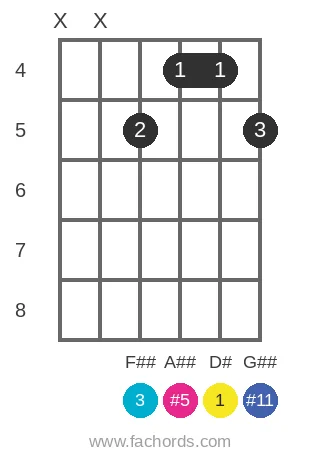
D# Augmented Sharp Eleven Finger Positions
- Mute the low E string
- Mute the A string
- Place your index finger (1) on the fret 4 of the G and B strings at the same time
- Place your middle finger (2) on the fret 5 of the D string
- Place your ring finger (3) on the fret 5 of the high E string
Position 4 Movable
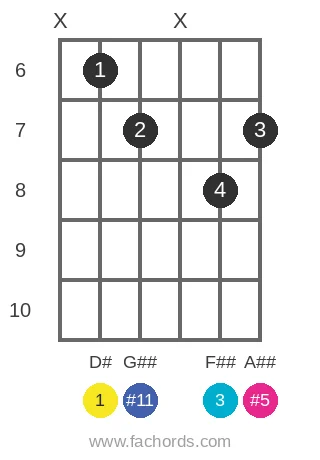
D# Augmented Sharp Eleven Finger Positions
- Mute the low E string
- Mute the G string
- Place your index finger (1) on the fret 6 of the A string
- Place your middle finger (2) on the fret 7 of the D string
- Place your ring finger (3) on the fret 7 of the high E string
- Place your pinky finger (4) on the fret 8 of the B string
Position 5 Movable
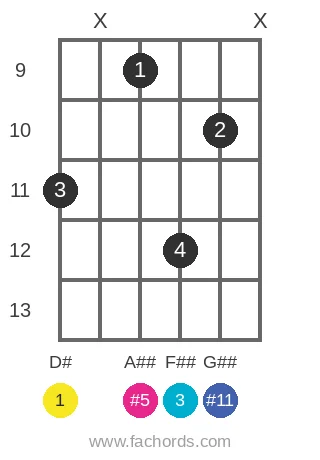
D# Augmented Sharp Eleven Finger Positions
- Mute the A string
- Mute the high E string
- Place your index finger (1) on the fret 9 of the D string
- Place your middle finger (2) on the fret 10 of the B string
- Place your ring finger (3) on the fret 11 of the low E string
- Place your pinky finger (4) on the fret 12 of the G string
Position 6 Barre Movable
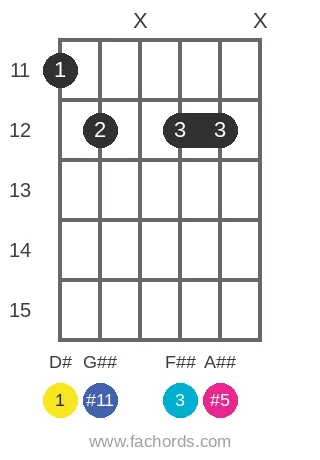
D# Augmented Sharp Eleven Finger Positions
- Mute the D string
- Mute the high E string
- Place your index finger (1) on the fret 11 of the low E string
- Place your middle finger (2) on the fret 12 of the A string
- Place your ring finger (3) on the fret 12 of the G and B strings at the same time
 Find more shapes in our all guitar chords online library. If you
prefer a printable pdf, download
the Free Guitar Chords Chart Pdf
More D# Chords
Want to know how this chord is built? Read chord symbols and intervals, or browse all D# guitar chords.

Created by
Giancarlo is a musician (teaching guitar since 2000), software engineer, AI consultant and published researcher
FAQ
What notes make up D#+(#11)?
D#+(#11) is spelled D#, F##, A## and G##. That is a root, a major third, a raised fifth and a sharp eleventh. Three of the four notes need double sharps.
Is D#+(#11) the same as Eb+(#11)?
Yes. Eb+(#11) contains Eb, G, B and A, the same pitches under simpler names. D#+(#11) is the theoretical spelling of the same sound.
Why does D# augmented sharp eleven use G##?
The perfect fourth of D# is G#, so the sharp eleventh is G##. It sounds like A. The letter G is kept so that the interval stays an eleventh.
Which scale works over D# augmented sharp eleven?
The D# Whole-Tone Scale (D#, E#, F##, G##, A##, C#) contains every note of the chord. The four chord notes are the 1st, 3rd, 4th and 5th degrees of that scale.
