F#7(b13) chord - F# Dominant Seventh Flat Thirteen Added - guitar chord chart

Need F7(b13) rather than F#7(b13)? Jump to F7(b13).
F# seventh flat thirteen is the full name of F#7(b13), a chord of five notes: F#, A#, C#, E and D. The flat thirteenth D is the same pitch as the sharp fifth, C##, though this chord keeps the natural fifth C# as well.
Start from the dominant seventh F#7 (F#, A#, C#, E) and the flat thirteenth D is the note that sets this chord apart. The F# Mixolydian b6 scale, the fifth mode of the melodic minor scale, lines up with F#7(b13), because it contains all five chord tones. It belongs to the dominant family, which is covered in dominant chords.
Like any dominant seventh, it resolves most naturally to a chord a fourth above F#, and a minor chord there is a common target.
F# 7th with flat 13th guitar chord is also written as F#7(b13), F#7b13 or F#7-13.
F#7(b13) Chord Notes and Formula
Notes of the F# 7(b13) chord:
How the Dominant Seventh Flat Thirteen Added chord is built:
Formula: 1 3 5 b7 b13
Same chord, different name: F#7(b13) is also written as Gb7(b13) (Gb seventh flat thirteen).
F#7(b13) Chord Interactive Fretboard
Want a structured chord roadmap instead of jumping between pages?
Go to the full guitar chords tutorial.
F#7(b13) Guitar Chord Diagrams
Position 1 Barre Movable
F# Seventh Flat Thirteen Finger Positions
- Mute the low E string
- Place your index finger (1) on the fret 9 of the A and G strings at the same time
- Place your middle finger (2) on the fret 10 of the high E string
- Place your ring finger (3) on the fret 11 of the D string
- Place your pinky finger (4) on the fret 11 of the B string
Position 2 Barre Movable
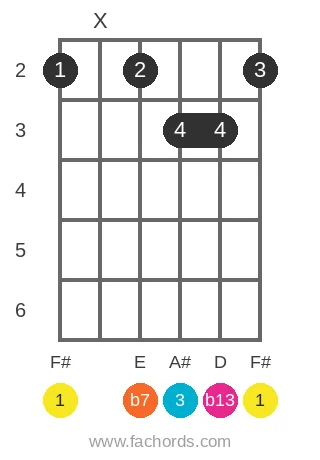
F# Seventh Flat Thirteen Finger Positions
- Mute the A string
- Place your index finger (1) on the fret 2 of the low E string
- Place your middle finger (2) on the fret 2 of the D string
- Place your ring finger (3) on the fret 2 of the high E string
- Place your pinky finger (4) on the fret 3 of the G and B strings at the same time
Position 3 Barre Movable
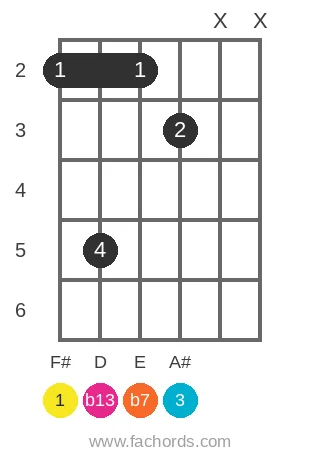
F# Seventh Flat Thirteen Finger Positions
- Mute the B string
- Mute the high E string
- Place your index finger (1) on the fret 2 of the low E and D strings at the same time
- Place your middle finger (2) on the fret 3 of the G string
- Place your pinky finger (4) on the fret 5 of the A string
Position 4 Movable
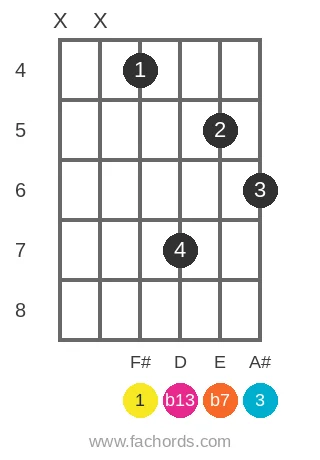
F# Seventh Flat Thirteen Finger Positions
- Mute the low E string
- Mute the A string
- Place your index finger (1) on the fret 4 of the D string
- Place your middle finger (2) on the fret 5 of the B string
- Place your ring finger (3) on the fret 6 of the high E string
- Place your pinky finger (4) on the fret 7 of the G string
Position 5 Barre Movable Slash Chord
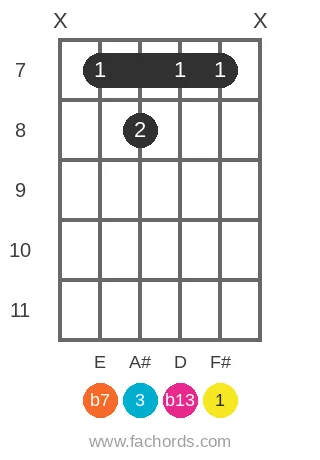
F#/E Seventh Flat Thirteen Finger Positions
- Mute the low E string
- Mute the high E string
- Place your index finger (1) on the fret 7 of the A, G and B strings at the same time
- Place your middle finger (2) on the fret 8 of the D string
The lowest note is E, not the root, so this voicing is the slash chord F#7(b13)/E.
Position 6 Movable
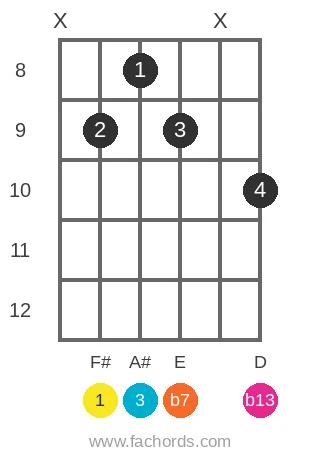
F# Seventh Flat Thirteen Finger Positions
- Mute the low E string
- Mute the B string
- Place your index finger (1) on the fret 8 of the D string
- Place your middle finger (2) on the fret 9 of the A string
- Place your ring finger (3) on the fret 9 of the G string
- Place your pinky finger (4) on the fret 10 of the high E string
 Find more shapes in our all guitar chords online library. If you
prefer a printable pdf, download
the Free Guitar Chords Chart Pdf
Chords That Go With F#7(b13)
One key where F#7(b13) fits is B major, where it works as the V chord, an altered chord whose D is borrowed from outside the key. These are the main chords of that key, the ones you will often hear around it:
See every key in the guitar keys chart, or build a progression with these chords in the chord progression generator.
More F# Chords
Want to know how this chord is built? Read dominant chords explained, or browse all F# guitar chords.

Created by
Giancarlo is a musician (teaching guitar since 2000), software engineer, AI consultant and published researcher
FAQ
What notes are in the F# seventh flat thirteen chord?
F#, A#, C#, E and D. The D is the flat thirteenth. The first four notes make a plain F# seventh chord.
How is F#7(b13) different from a plain F# seventh chord?
A plain F# seventh has F#, A#, C# and E. F#7(b13) adds the note D, a minor sixth from the root one octave up. That note sits only a half step higher than the fifth, C#.
Does Gb7(b13) sound the same as F#7(b13)?
Yes, they are the same pitches. Gb7(b13) is spelled Gb, Bb, Db, Fb and Ebb, so it needs more awkward notes than the F# spelling, which has none.
Which scale fits F#7(b13)?
The F# Mixolydian b6 scale, spelled F#, G#, A#, B, C#, D and E, contains all five chord tones. It is the fifth mode of the melodic minor scale.
What role does the D play in F#7(b13)?
D is the flat thirteenth, the thirteenth degree lowered by a half step. It crowds the fifth, C#, because the two are only a half step apart, and that closeness gives the chord its colour.
