Understand and Play the F#7b9 Guitar Chord Interactively
Want a structured chord roadmap instead of jumping between pages?
Go to the full guitar chords tutorial.
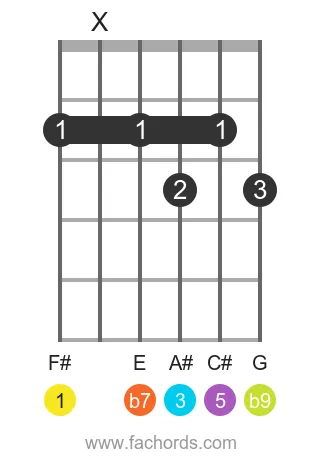
The F#7b9 chord, a distinctive member of the Dominant Chords family, is fundamentally constructed from the notes F#, A#, C#, E, and G. These specific tones represent the intervals of a Root (1), Major Third (3), Perfect Fifth (5), Minor Seventh (b7), and a crucial Minor Ninth (b9). To truly grasp its theoretical structure and sonic character, utilize the interactive fretboard tool at the top of this page. This tool allows you to visualize every possible fingering, hear the chord played as either a strum or arpeggio, and receive instant, real-time verification of your accuracy through its mic feedback feature.
This complex and rich dominant chord introduces an advanced, sophisticated jazz-like color to your playing, moving beyond basic triads and 7ths. To fully appreciate the unique harmonic role of its extended tones, especially the flat nine, explore our comprehensive guide on Ninth Chords. Understanding how these extensions are built and why they function as they do is crucial, so delve into the foundational Chord Construction principles. As a specific type of dominant chord with an alteration, grasping its characteristic tension and resolution is key; review our Dominant Chord tutorial. Once you're comfortable with its shapes, work on your chord changes to seamlessly integrate this chord into your musical vocabulary.
Further down this page, you'll uncover a comprehensive collection of F#7b9 chord diagrams, thoughtfully organized from the most accessible open positions to more intricate movable shapes. This section also provides in-depth music theory explanations, lists of songs that effectively utilize this chord, and details on the key signatures where it commonly appears. Before diving into these static diagrams, commit to a disciplined practice session with the interactive tool above. Actively engage with its drum and BPM tool to establish a steady rhythm, practice playing the chord, and use the mic feedback to meticulously confirm you are hitting every note with precision and clarity. This hands-on, guided approach is essential for truly internalizing and mastering this challenging chord.
F# 7th with flat 9th guitar chord is also written as F#7(b9), F#7b9 or F#7-9.
Notes that compose the F# 7(b9) chord:
Formula of the Dominant Seventh Flat Nine Added chord:
F# 7(B9) Guitar Chord Diagrams
Position 1 Barre Movable
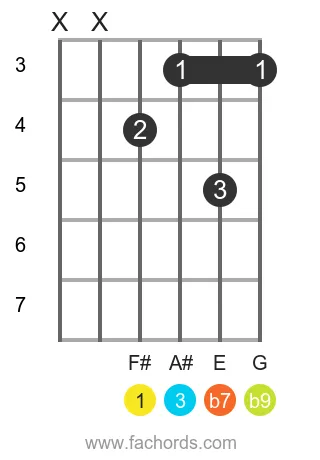
Finger Positions
- Mute the low E string
- Mute the A string
- Place your index finger (1) on the fret 3 of the G and high E strings at the same time
- Place your middle finger (2) on the fret 4 of the D string
- Place your ring finger (3) on the fret 5 of the B string
Position 2 Barre Movable
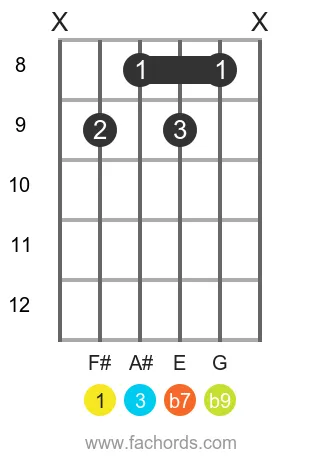
Finger Positions
- Mute the low E string
- Mute the high E string
- Place your index finger (1) on the fret 8 of the D and B strings at the same time
- Place your middle finger (2) on the fret 9 of the A string
- Place your ring finger (3) on the fret 9 of the G string
Position 3 Barre Movable
Finger Positions
- Mute the A string
- Place your index finger (1) on the fret 2 of the low E, D and B strings at the same time
- Place your middle finger (2) on the fret 3 of the G string
- Place your ring finger (3) on the fret 3 of the high E string
 Find more shapes in our all guitar chords online library. If you
prefer a printable pdf, download
the Free Guitar Chords Chart Pdf
Find more shapes in our all guitar chords online library. If you
prefer a printable pdf, download
the Free Guitar Chords Chart Pdf


Created by
Giancarlo is a musician (teaching guitar since 2000), software engineer, AI consultant and published researcher
FAQ
What notes make up an F# 7(b9) chord on the guitar?
The F# 7(b9) chord is composed of the notes F#, A#, C#, E, and G. These correspond to the intervals of Root, Major Third, Perfect Fifth, Minor Seventh, and Minor Ninth, respectively.
Why is the F# 7(b9) categorized as a 'dominant chord'?
It is considered a dominant chord because it includes a minor seventh (b7) interval (E in this case), which creates a characteristic tension. This tension typically leads to a strong resolution in chord progressions.
What does the 'b9' notation signify in the F# 7(b9) chord name?
The 'b9' signifies a Minor Ninth interval. This means the ninth note of the scale is lowered by a half step from a major ninth, adding a distinctive complex and rich quality to the chord.
How do you build the F# 7(b9) chord using intervals?
You build the F# 7(b9) chord by stacking specific intervals from the root note (F#): a Major Third (A#), a Perfect Fifth (C#), a Minor Seventh (E), and finally a Minor Ninth (G). Understanding these intervals on the fretboard is crucial.
When should I use an F# 7(b9) chord in my guitar playing?
The F# 7(b9) chord can be incorporated into various common chord progressions for added sophistication. It is especially prevalent in jazz chord progressions, where its complex sound and tension are often utilized for harmonic interest.
How does an F# 7(b9) chord differ from a standard F# dominant 7th chord?
The key difference is the addition of the Minor Ninth (b9) interval. A standard F# dominant 7th chord contains the Root, Major Third, Perfect Fifth, and Minor Seventh. The F# 7(b9) adds the Minor Ninth (G), creating a richer, more complex, and often more dissonant sound compared to a simple dominant 7th.
