Explore F#7#5 Guitar Chord: Interactive Fretboard & Real-time Mic
Want a structured chord roadmap instead of jumping between pages?
Go to the full guitar chords tutorial.
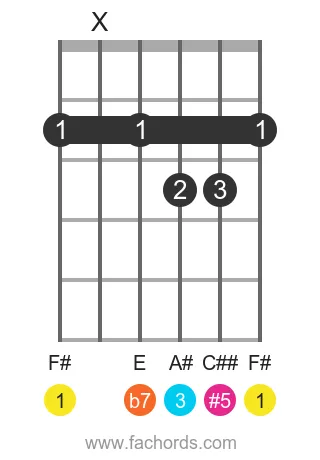
The F# 7(#5) chord is a truly compelling voice, perfect for jazz and other advanced musical contexts where unique tension and color are desired. As an augmented dominant seventh, often termed an altered dominant, its structure is built from the notes F#, A#, C##, and E, which correspond to the intervals Root (1), Major Third (3), Augmented Fifth (#5), and Minor Seventh (b7), placing it firmly within the Augmented Chords family. To fully explore its sound and fingerings, utilize the interactive virtual fretboard tool above, allowing you to instantly play it as a strum or arpeggio and receive real-time microphone feedback to confirm your accuracy.
As an augmented dominant seventh, this chord's unique intervallic structure – particularly the raised fifth – creates a distinctive tension, making it an ideal candidate for pushing harmonic boundaries. To fully understand its theoretical underpinnings, delve into our comprehensive guide on Chord Construction. Given its dominant function, exploring the wider Dominant Chord family will provide crucial context for its application. For many players, mastering its voicings will involve Guitar Bar Chords, so those resources are highly recommended. Finally, to ensure seamless integration into your playing, our tips for Improve Chords Change will prove invaluable.
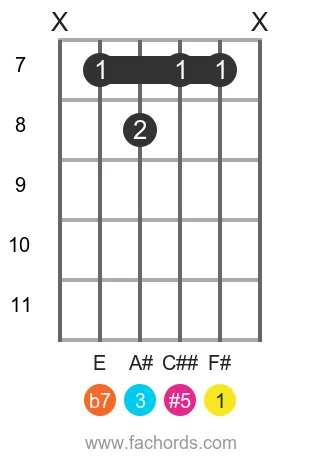
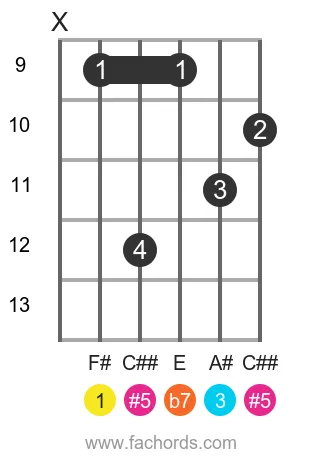
Below, you'll discover a wealth of F#7#5 chord diagrams, organized from the most accessible open positions to more demanding barre shapes. We also provide in-depth music theory explanations, lists of songs featuring this intriguing chord, and its typical key contexts. However, before immersing yourself in these static visual aids, we strongly recommend you spend quality time with the interactive virtual fretboard. Experiment with the drum and BPM features to find your rhythm, articulate the chord, and let the microphone feedback refine your technique. Play, listen, and refine before analyzing further.
F# dominant 7th with sharp 5th guitar chord is also written as F#7(#5), F#7#5, F#7+5 or F#aug7.
Notes of the F# 7(#5) chord:
How to create the Dominant Seventh Sharp Fifth chord:
F# 7(#5) Guitar Chord Diagrams
Position 1
Barre
Movable
Position 2
Barre
Movable
Position 3
Barre
Movable
 Find more shapes in our all guitar chords online library. If you
prefer a printable pdf, download
the Free Guitar Chords Chart Pdf
Find more shapes in our all guitar chords online library. If you
prefer a printable pdf, download
the Free Guitar Chords Chart Pdf
You can also use this accessible F#7(#5) chord page, with written diagram instructions and screen-reader support for blind users.

Created by
Giancarlo is a musician (teaching guitar since 2000), software engineer, AI consultant and published researcher
FAQ
What does the '#5' in the F# 7(#5) chord name mean?
The '#5' signifies an 'Augmented Fifth' interval. This means the natural fifth note of the F# major scale has been raised by a semitone (half step), creating a unique, altered sound that is characteristic of this specific chord.
Why is C## (C double sharp) used in the F# 7(#5) chord instead of D natural?
The C## is the theoretically correct spelling for the augmented fifth interval in an F# chord. When you build a fifth from F#, the natural fifth is C#. To 'augment' it, you raise it another semitone, resulting in C##. While C## sounds the same as D natural on a guitar, C## maintains the proper intervallic relationship and theoretical naming convention for the chord.
What are the specific intervals that make up the F# 7(#5) chord?
The F# 7(#5) chord is constructed from the following intervals: the Root (1), the Major Third (3), the Augmented Fifth (#5), and the Minor Seventh (b7). These intervals correspond to the notes F#, A#, C##, and E, respectively.
Why is the F# 7(#5) considered a member of the 'Augmented Chord family'?
The F# 7(#5) is part of the Augmented Chord family primarily because of the 'Augmented Fifth' interval (C##) within its structure. Chords containing this specific interval are generally classified within this family due to the distinct harmonic quality it imparts.
When would I typically use an F# 7(#5) chord in music?
The F# 7(#5) chord is frequently found in jazz chord progressions. Its altered nature and tension-building qualities make it a popular choice for adding color, harmonic interest, and leading to other chords in a jazz context.
Why is the F# 7(#5) chord categorized as 'intermediate'?
It is considered an intermediate chord because it moves beyond the basic major, minor, and dominant 7th chord types. Its inclusion of an altered interval (the augmented fifth) and specific theoretical construction requires a deeper understanding of music theory and potentially more complex fingerings, making it a step up from beginner chords.