Explore F maj9 Guitar Chord Shapes & Sounds
Want a structured chord roadmap instead of jumping between pages?
Go to the full guitar chords tutorial.
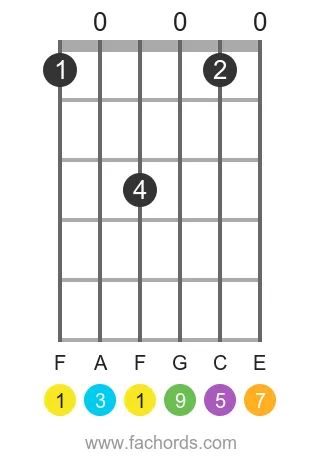
Unravel the visual layout of the F maj9 guitar chord across the fretboard. Our interactive tool lets you directly manipulate the virtual fretboard, listen to chord playback, and verify your accuracy in real-time with mic feedback. This extended chord, a member of the Major Chords family, is comprised of the notes F, A, C, E, and G, built upon the intervals 1, 3, 5, 7, and 9.
Understanding how these extended intervals create rich harmonies is crucial for navigating chords like F maj9. For those unfamiliar with these terms, the complete names of the music intervals are as follows: 1: Root, b2: Minor Second, 2: Major Second, b3: Minor Third, 3: Major Third, 4: Perfect Fourth, b5: Diminished Fifth, #4: Augmented Fourth, 5: Perfect Fifth, b6: Minor Sixth, 6: Major Sixth, bb7: Diminished Seventh, b7: Minor Seventh, 7: Major Seventh, b9: Minor Ninth, 9: Major Ninth, 11: Perfect eleventh, and 13: Major thirteenth. You can deepen your knowledge of how chords are structured by stacking intervals with our guitar music theory tutorial. For a broader exploration of similar extended voicings, delve into our ninth chords tutorial.
Below, you'll find various chord diagrams, ranging from simpler voicings to more complex shapes. Each diagram helps visualize the tones that compose the F maj9 chord across different keys. Before committing them to memory, we encourage you to use the interactive fretboard to explore the shapes and sounds, integrating this rich chord into your musical vocabulary.
F major 9th guitar chord is also written as Fmaj9, FM9, FΔ9 or Fma9.
Notes that compose the F maj9 chord:
Formula of the Major Ninth chord:
F Maj9 Guitar Chord Diagrams
Position 1 Movable
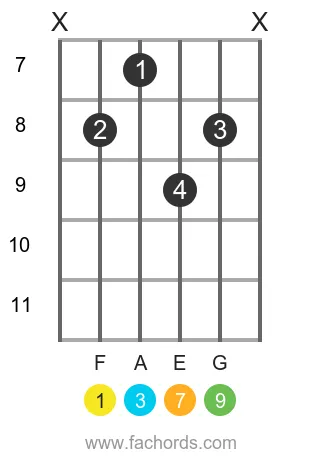
Finger Positions
- Mute the low E string
- Mute the high E string
- Place your index finger (1) on the fret 7 of the D string
- Place your middle finger (2) on the fret 8 of the A string
- Place your ring finger (3) on the fret 8 of the B string
- Place your pinky finger (4) on the fret 9 of the G string
Position 2 Open
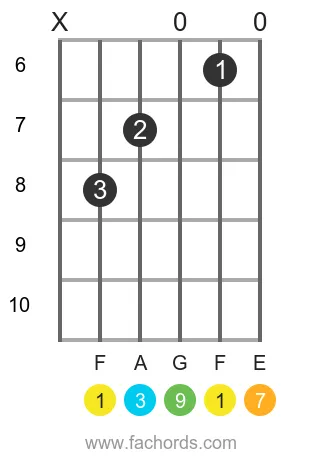
Finger Positions
- Mute the low E string
- Let the G string play without pressing any fret
- Let the high E string play without pressing any fret
- Place your index finger (1) on the fret 6 of the B string
- Place your middle finger (2) on the fret 7 of the D string
- Place your ring finger (3) on the fret 8 of the A string
Position 3 Open
Finger Positions
- Let the A string play without pressing any fret
- Let the G string play without pressing any fret
- Let the high E string play without pressing any fret
- Place your index finger (1) on the fret 1 of the low E string
- Place your middle finger (2) on the fret 1 of the B string
- Place your pinky finger (4) on the fret 3 of the D string
Position 4 Barre Open
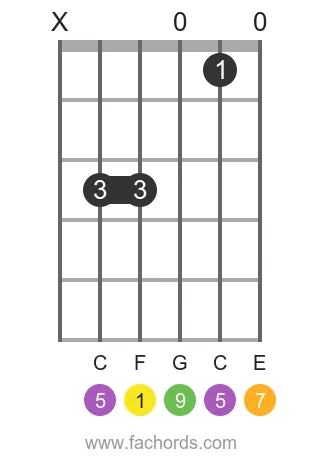
Finger Positions
- Mute the low E string
- Let the G string play without pressing any fret
- Let the high E string play without pressing any fret
- Place your index finger (1) on the fret 1 of the B string
- Place your ring finger (3) on the fret 3 of the A and D strings at the same time
Position 5 Barre Movable
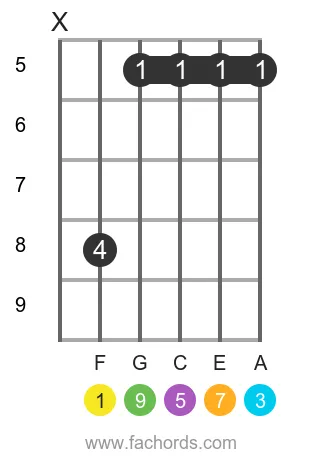
Finger Positions
- Mute the low E string
- Place your index finger (1) on the fret 5 of the D, G, B and high E strings at the same time
- Place your pinky finger (4) on the fret 8 of the A string
 Find more shapes in our all guitar chords online library. If you
prefer a printable pdf, download
the Free Guitar Chords Chart Pdf
Find more shapes in our all guitar chords online library. If you
prefer a printable pdf, download
the Free Guitar Chords Chart Pdf


Created by
Giancarlo is a musician (teaching guitar since 2000), software engineer, AI consultant and published researcher
FAQ
What do the numbers 1, 3, 5, 7, and 9 represent in the F maj9 chord?
In music theory, these numbers represent specific musical intervals measured from the root note (F). For the F maj9 chord, '1' is the Root (F), '3' is the Major Third (A), '5' is the Perfect Fifth (C), '7' is the Major Seventh (E), and '9' is the Major Ninth (G).
Why does the F maj9 chord consist of five notes?
The F maj9 chord is defined by five distinct intervals: the 1st (Root), 3rd, 5th, 7th, and 9th. Each of these intervals corresponds to a unique note (F, A, C, E, G) relative to the root F, resulting in a five-note chord.
What do 'maj' and '9' signify in the chord name 'F maj9'?
In 'F maj9,' 'F' is the root note. 'maj' indicates that the chord includes a Major Seventh interval (E in this case), distinguishing it from a dominant 7th chord which uses a minor seventh. The '9' indicates the addition of a Major Ninth interval (G), which gives the chord its characteristic rich sound beyond a Major Seventh chord.
How are the notes F, A, C, E, and G specifically chosen to form an F maj9 chord?
These notes are derived directly from the fundamental intervals that define a maj9 chord, applied to the root note F. F is the 1st (Root), A is the Major 3rd, C is the Perfect 5th, E is the Major 7th, and G is the Major 9th. These are the specific pitches that create the F maj9 sound.
The tutorial lists many intervals like 'b2' and 'b3'. Are these part of the F maj9 chord?
No, while the tutorial provides a comprehensive list of all common intervals for general understanding, the F maj9 chord specifically uses only the 1 (Root), 3 (Major Third), 5 (Perfect Fifth), 7 (Major Seventh), and 9 (Major Ninth) intervals. Other intervals like 'b2' or 'b3' are not present in a standard F maj9 chord.
What does it mean to construct chords by 'stacking intervals'?
"Stacking intervals" refers to the process of building a chord by successively adding specific musical intervals on top of a root note. For the F maj9, you start with the root (F), then add the 3rd (A) on top, then the 5th (C), then the 7th (E), and finally the 9th (G). This method explains how the unique sound and structure of complex chords are created.
