Advanced Chord Construction
Sus, 6th, Dim7, 9th, 11th, 13th, Drop 2 and Altered Chords
In Part 1: chord construction we built chords one note at a time: the root, the 3rd, the 5th and the 7th. We ended with five seventh chords, shell voicings and inversions.
Now we keep climbing. We'll replace notes, add colors above the octave and alter the dominant chord, and you'll see that even a scary name like C7#9 or Cmaj13 is just a few more instructions on top of a shape you already know.
Same rules as Part 1: root C, every chord with the root on the 6th string (fret 8) and on the 5th string (fret 3), only movable shapes, a diagram and an audio example for every step.
The path in Part 2:
- Replace the 3rd: sus4 and sus2
- Add the 6th
- The last two seventh chords: dim7 and minor-major 7
- 9th chords
- 11th chords
- 13th chords
- Drop 2 and drop 3 voicings
- Altered dominants
- Slash chords
- Recap
Quick Recap of Part 1
| Chord | Formula | Notes in C |
|---|---|---|
| Major / minor | 1 3 5 / 1 b3 5 | C E G / C Eb G |
| Augmented / diminished | 1 3 #5 / 1 b3 b5 | C E G# / C Eb Gb |
| maj7 / 7 / m7 | 1 3 5 7 / 1 3 5 b7 / 1 b3 5 b7 | C E G B / C E G Bb / C Eb G Bb |
| m7b5 / 7#5 | 1 b3 b5 b7 / 1 3 #5 b7 | C Eb Gb Bb / C E G# Bb |
And two rules we'll use all the time: the perfect 5th is the first note to drop when a chord gets crowded, and any chord tone can go in any octave.
Step 1. Replace the 3rd: Sus Chords
In Part 1 we saw that the 3rd decides major or minor. What happens if we take it away and put a neighbor in its place?
- sus4: the 3rd moves up to the 4th. Formula 1 4 5 (C F G).
- sus2: the 3rd moves down to the 2nd. Formula 1 2 5 (C D G).
Csus4

8 x 10 10 8 x
Csus2

8 x 10 7 8 x
Csus4

x 3 5 5 6 x
Csus2

x 3 5 5 3 x
"Sus" means suspended: with no 3rd, the chord is neither major nor minor and sounds open, waiting. Play the sus chord and then the plain major chord: the 4th falls to the 3rd, or the 2nd rises to it, and you hear the tension resolve. More shapes and songs in the suspended chords guide.
Step 2. Add the 6th
Go back to the major triad and add the 6th (9 half steps, A). The formula is 1 3 5 6, and the chord is C6:
C6
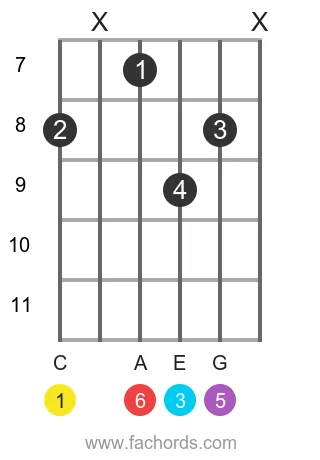
8 x 7 9 8 x
C6

x 3 5 2 5 x
The 6th adds a sweet, vintage color, think of the last chord of a swing tune. Look at the notes: C E G A. These are the same four notes as Am7 (A C E G)! The bass note decides the name: with C at the bottom it's C6, with A at the bottom it's Am7. This is a great example of why naming a chord starts from the bass. More in the sixth chords guide.
Step 3. The Last Two Seventh Chords
In Part 1 we built five seventh chords from four triads and two kinds of 7th. Two more seventh chords complete the family: one uses a third kind of 7th, the other a combination we skipped.
Diminished 7th: 1 b3 b5 bb7
Take the diminished triad (C Eb Gb) and add a diminished 7th, the minor 7th lowered once more: Bb becomes Bbb ("B double flat"), which sounds like A.
Cdim7
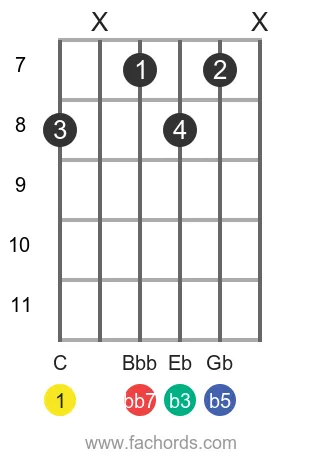
8 x 7 8 7 x
Cdim7
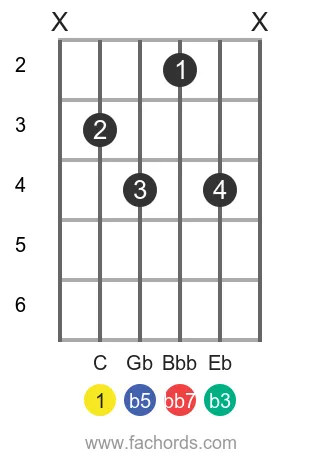
x 3 4 2 4 x
Why "Bbb" and not "A"? Because it's the 7th of the chord, not the 6th: the name follows the job. On the fretboard, just play an A.
The diminished 7th is built only from minor 3rds: C-Eb, Eb-Gb, Gb-Bbb, and one more minor 3rd brings you back to C. The chord divides the octave into four equal parts, so any of its notes can be the root: Cdim7, Ebdim7, Gbdim7 and Adim7 contain the same four sounds (spelled differently in each chord), and the same shape repeats every 3 frets. More in the diminished chords guide.
Minor-Major 7th: 1 b3 5 7
Now take the minor triad and add the major 7th: C Eb G B. It's a minor chord with a bright, tense B on top:
CmMaj7
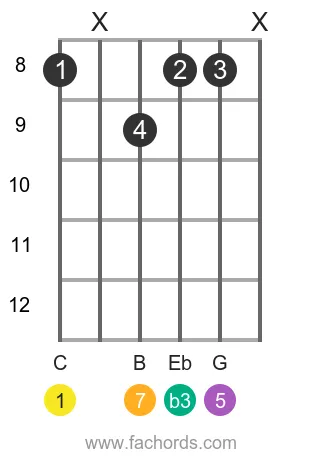
8 x 9 8 8 x
CmMaj7
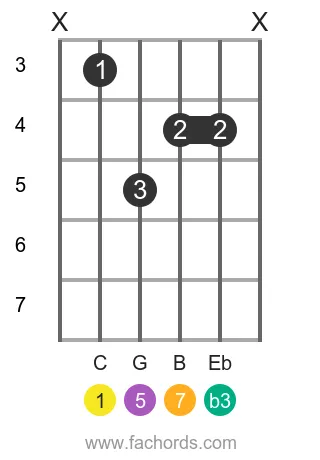
x 3 5 4 4 x
Mysterious and cinematic: the final chord of the James Bond theme is a minor-major 7th with a 9th on top. In practice it often appears as a passing chord in a descending line: Cm, CmMaj7, Cm7, Cm6.
That completes the seven seventh chords:
| Triad | + major 7th (7) | + minor 7th (b7) | + diminished 7th (bb7) |
|---|---|---|---|
| Major | Cmaj7 | C7 | |
| Minor | CmMaj7 | Cm7 | |
| Diminished | Cm7b5 | Cdim7 | |
| Augmented | (Cmaj7#5) | C7#5 |
(The augmented triad with a major 7th, Cmaj7#5, exists too, but it's rare enough to stay in brackets.)
Step 4. 9th Chords
We've used every note inside the octave. To add more color, we keep stacking 3rds above the 7th: C, E, G, B(b), then D, F, A. Those three notes above the octave are called extensions: the 9th, the 11th and the 13th.
The 9th is the same note as the 2nd (D), an octave higher. Count C-D-E-F-G-A-B-C-D: the second D is the 9th note. The name tells you two things: the D sits above the chord, and the chord is a seventh chord with something on top.
add9: no 7th
If you add the D to a plain triad, without a 7th, the chord is an add9 (1 3 5 9). It is different from sus2 because the 3rd is still there:
Cadd9

8 x 10 9 x 10
Cadd9

x 3 2 x 3 x
In both shapes we dropped the 5th: as usual, it's the note we can spare.
C9, Cmaj9, Cm9
Add the 9th to a seventh chord and the 9th takes the name of the whole chord:
- C9 (dominant 9th): 1 3 5 b7 9, C E G Bb D
- Cmaj9: 1 3 5 7 9, C E G B D
- Cm9: 1 b3 5 b7 9, C Eb G Bb D
C9
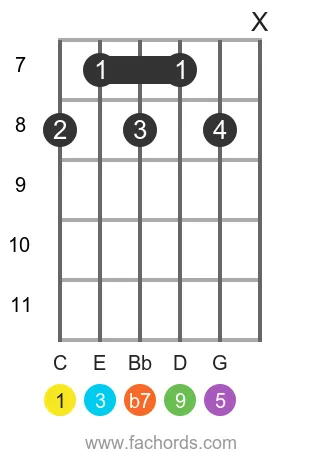
8 7 8 7 8 x
Cmaj9
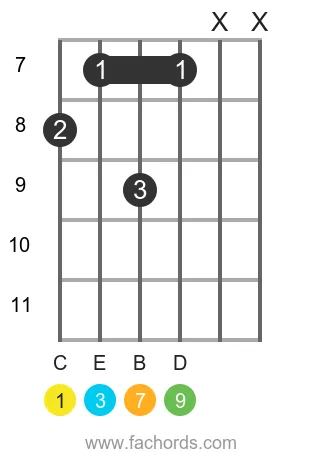
8 7 9 7 x x
Cm9
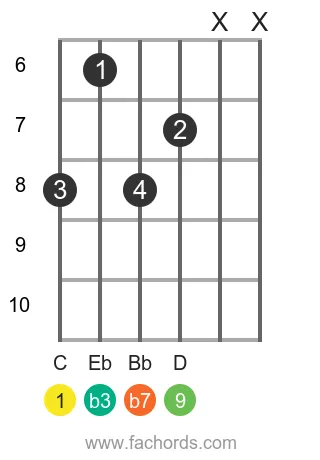
8 6 8 7 x x
C9
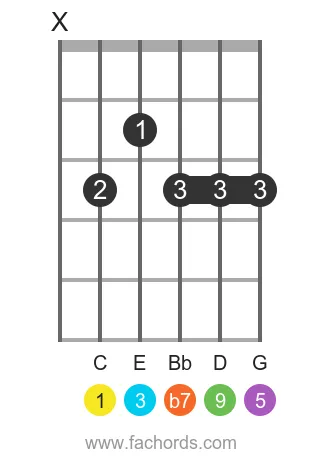
x 3 2 3 3 3
Cmaj9
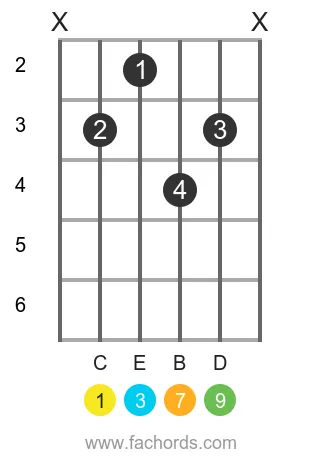
x 3 2 4 3 x
Cm9
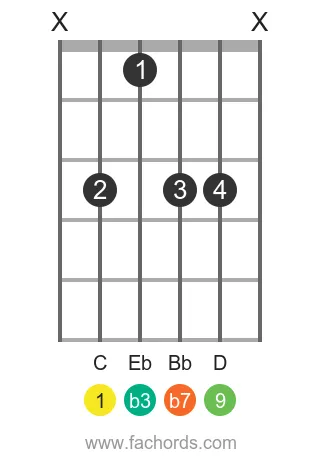
x 3 1 3 3 x
Five notes and only four fingers: in most 9th shapes the 5th is gone. The two C9 shapes are the exception: with the root on the 6th string the G is on the B string, and with the root on the 5th string a small barre catches it on the high E string. The C9 shape on the 5th string is the funk chord par excellence: try it with short, muted strums. More shapes in guitar ninth chords.
Step 5. 11th Chords
The next 3rd up is the 11th: F, the 4th an octave higher. Here we hit the first real problem of chord construction. In a C major or C7 chord, the F sits one half step above the E (the 3rd), and the two notes clash.
Players solve it in two ways:
- Drop the 3rd. C7 + 9 + 11 without the E (and, as usual, without the G) gives C Bb D F: the chord is usually called C9sus4 (and often written C11 on lead sheets).
- Raise the 11th to #11 (F#): that's the bright Lydian color of Cmaj7#11 and C7#11.
On a minor chord there's no clash, because the F is a whole step above the Eb. That's why Cm11 (1 b3 5 b7 9 11) is a very common, very beautiful chord:
C9sus4

8 8 8 7 x x
C9sus4

x 3 3 3 3 x
Cm11
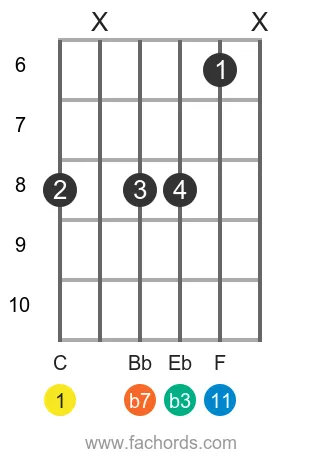
8 x 8 8 6 x
Cm11

x 3 x 3 4 1
Notice the Cm11 shapes: root, b7, b3 and 11, no 5th and no 9th. Four notes are enough to say "minor 11".
Step 6. 13th Chords
One more 3rd and we reach the 13th: A, the 6th an octave higher. Stack everything and a C13 would have seven notes: C E G Bb D F A. The guitar has six strings and you have four fingers, so we choose:
- Keep: root, 3rd, b7 (the dominant sound) and 13th (the color).
- Drop: the 5th (as always) and the 11th (it clashes with the 3rd).
- Optional: the 9th.
C13
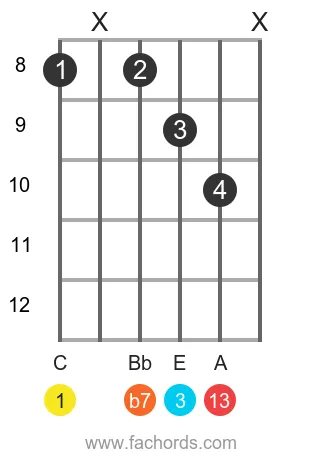
8 x 8 9 10 x
C13
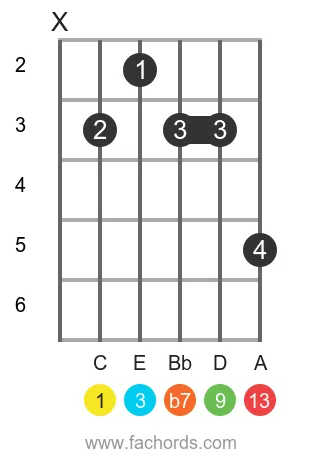
x 3 2 3 3 5
Cmaj13

8 x 9 9 10 x
Compare C7 and C13 with the root on the 6th string: the only difference is the 5th (G, on the B string) moving up two frets to the 13th (A). One finger, a whole new color. This shape is everywhere in blues, swing and soul.
13th or 6th? Both are an A. If the chord has a 7th, the A is the 13th (C13, Cmaj13). If there's no 7th, it's a 6th (C6).
Step 7. Drop 2 and Drop 3 Voicings
In Part 1, the seventh chords with the root on the 5th string had the notes in this order: 1 5 7 3. With the root on the 6th string: 1 7 3 5. These orders are no accident: they have a name.
Start from a close position chord, with the four notes as near as possible. C7 in close position is C E G Bb, all within one octave:
C7, close position
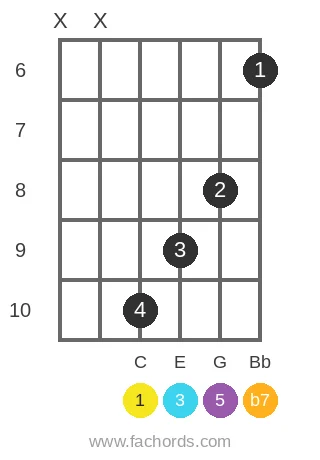
x x 10 9 8 6
C7, drop 2
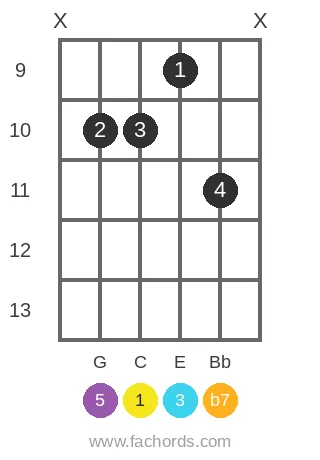
x 10 10 9 11 x
The close shape needs a big stretch (frets 6 to 10) and sounds a bit cluttered. Now take the second note from the top (G) and drop it one octave: the order becomes G C E Bb, and the shape fits under four fingers. This is a drop 2 voicing.
- Drop 2: move the 2nd-highest note of a close chord down an octave. Our 5th-string family (1 5 7 3) is a drop 2: it comes from the close voicing G B C E.
- Drop 3: move the 3rd-highest note down an octave. Our 6th-string family (1 7 3 5) is a drop 3: it comes from the close voicing B C E G.
Since a four-note chord has four close positions (root position and three inversions), each one gives a drop 2 and a drop 3 shape. That's how jazz guitarists get a full set of voicings for any seventh chord on every string set. Drop 2 voicings on the middle and top strings are also the secret of smooth voice leading.
Step 8. Altered Dominants
The dominant 7th chord is restless by nature: it wants to resolve, usually down a fifth (C7 to F). Jazz and blues players make it even more restless by altering the 5th and the 9th, moving them a half step:
| Chord | Formula | Notes in C | Altered note |
|---|---|---|---|
| C7b9 | 1 3 5 b7 b9 | C E G Bb Db | 9th lowered |
| C7#9 | 1 3 5 b7 #9 | C E G Bb D# | 9th raised |
| C7b5 (or C7#11) | 1 3 b5 b7 | C E Gb Bb | 5th lowered |
| C7b13 (or C7#5) | 1 3 b7 b13 | C E Bb Ab | 5th raised / 13th lowered |
C7b9
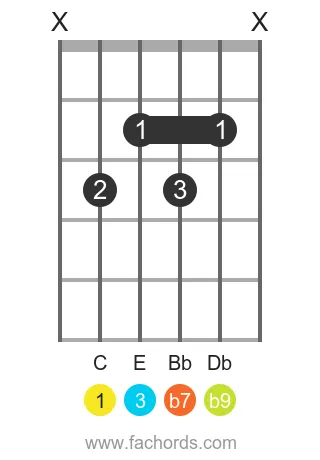
x 3 2 3 2 x
C7#9

x 3 2 3 4 x
C7b5
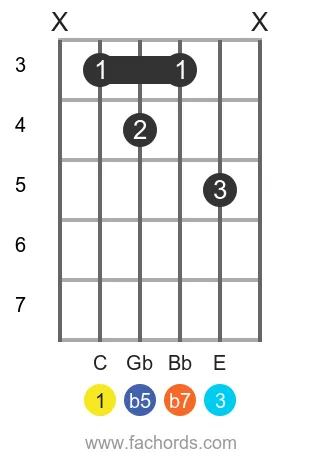
x 3 4 3 5 x
C7b13

x 3 2 3 x 4
C7b9
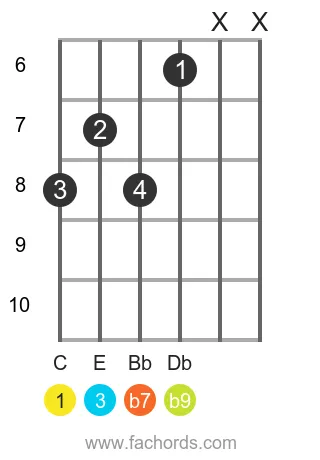
8 7 8 6 x x
C7#9

8 7 8 8 x x
A few things to notice:
- All these shapes keep the 3rd and the b7: they're the dominant core. Only the colors around them change.
- C7#9 is the "Hendrix chord", made famous by Purple Haze (in E). The D# sounds like a minor 3rd on top of the major 3rd, so the chord sounds major and minor at once. Perfect for blues rock.
- C7b5 vs C7#11, C7#5 vs C7b13: same sounds, different names. If the chord also has a perfect 5th, the altered note is called an extension (#11, b13); if it replaces the 5th, it's an altered 5th (b5, #5). In practice the names mix: a b13 on the top string is often still called b13 even with no 5th in the shape, like our C7b13.
Altered notes sit a half step or a whole step away from the notes of the next chord, so they pull hard towards it: in C7b9 to F, the Db falls to C, the 5th of F. Another way to get altered sounds is the tritone substitution: Gb7 played over a C bass gives a C7 with b5 and b9.
Step 9. Slash Chords and Upper Structures
In Part 1 we wrote inversions as slash chords: C/E is a C chord with E in the bass. But a slash chord can also put a triad over a bass note that isn't in the triad. Then the slash is a shortcut to write a complex chord in a simple way.
Bb/C
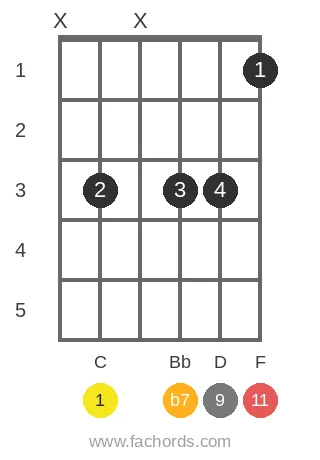
x 3 x 3 3 1
C9sus4
x 3 3 3 3 x
D/C
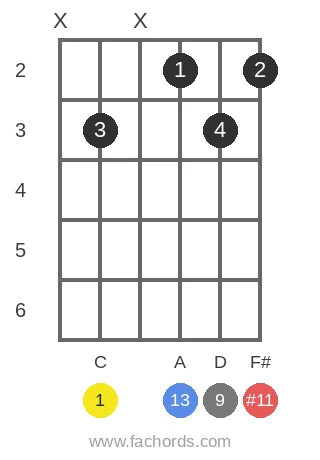
x 3 x 2 3 2
- Bb/C: a Bb triad (Bb D F) over C. Measured from C: b7, 9 and 11. That's exactly C9sus4 from Step 5, compare the two diagrams. Pianists and songwriters love writing it as Bb/C because it's easier to read.
- D/C: a D triad (D F# A) over C. From C: 9, #11 and 13. A bright, floating Lydian color, the sound of countless film scores.
Triads placed over a different root like this are called upper structures, and they're a fast way to play extensions: think "which triad gives me the colors I want?" and play it over the root. This is the same idea as superimposing arpeggios, applied to chords.
Step 10. Recap: All the Formulas
| Chord | Formula | Notes in C | Built from |
|---|---|---|---|
| Csus4 / Csus2 | 1 4 5 / 1 2 5 | C F G / C D G | 3rd replaced |
| C6 | 1 3 5 6 | C E G A | major triad + 6th |
| Cdim7 | 1 b3 b5 bb7 | C Eb Gb Bbb (A) | diminished triad + diminished 7th |
| CmMaj7 | 1 b3 5 7 | C Eb G B | minor triad + major 7th |
| Cadd9 | 1 3 5 9 | C E G D | major triad + 9th, no 7th |
| C9 / Cmaj9 / Cm9 | 1 3 5 b7 9 / 1 3 5 7 9 / 1 b3 5 b7 9 | C E G Bb D / C E G B D / C Eb G Bb D | seventh chord + 9th |
| C9sus4 / Cm11 | 1 4 5 b7 9 / 1 b3 5 b7 9 11 | C F G Bb D / C Eb G Bb D F | 3rd replaced by 11 / minor + 11th |
| C13 / Cmaj13 | 1 3 5 b7 9 13 / 1 3 5 7 9 13 | C E G Bb D A / C E G B D A | seventh chord + 13th (5, 9 optional) |
| C7b9 / C7#9 | 1 3 5 b7 b9 / 1 3 5 b7 #9 | C E G Bb Db / C E G Bb D# | dominant + altered 9th |
| C7b5 / C7b13 | 1 3 b5 b7 / 1 3 b7 b13 | C E Gb Bb / C E Bb Ab | dominant + altered 5th / 13th |
| Bb/C / D/C | 1 b7 9 11 / 1 9 #11 13 | C Bb D F / C D F# A | triad over a C bass |
Build Your Own Chord
Now you have all the pieces. To build any chord on the fly:
- Pick the root (6th or 5th string).
- Pick the 3rd: major, minor, or replace it (sus2, sus4).
- Pick the 5th: perfect (and probably drop it), augmented or diminished.
- Pick the 7th: major, minor, diminished, or none (6 or add9).
- Add one color: 9, 11 or 13, natural or altered.
- Fit it on four or five strings, keeping root, 3rd and 7th.
Then check the name with how to name a chord and compare your shape with the voicings in the chord library. For the full list of chord formulas, see chord intervals and symbols, and for hundreds of shapes across the neck my ebook Chords Domination. Want to hear these chords at work? Try them in a chord substitution.
That's all for today. Remember that you can subscribe here to stay updated on new tutorials and get the free chords and scales PDFs.

Created by
Giancarlo is a musician (teaching guitar since 2000), software engineer, AI consultant and published researcher
FAQ
What is the difference between sus2 and add9?
Csus2 (C D G) replaces the 3rd with the 2nd, so it is neither major nor minor. Cadd9 (C E G D) keeps the 3rd and adds the D on top, usually an octave higher, so it is still a major chord.
What is the difference between a 9 chord and an add9 chord?
A 9 chord contains a 7th: C9 is C E G Bb D. An add9 chord has no 7th: Cadd9 is C E G D. Cmaj9 (C E G B D) and Cm9 (C Eb G Bb D) also include their 7th.
Why is the diminished 7th chord symmetric?
Cdim7 (C Eb Gb Bbb) is made of minor 3rds only, and four minor 3rds make an octave. So every note can be the root: Cdim7, Ebdim7, Gbdim7 and Adim7 contain the same four sounds (only the spelling changes), and on the guitar the same shape repeats every three frets.
Why do guitarists skip the 11th on major and dominant chords?
The natural 11th (F in C) sits a half step above the major 3rd (E) and clashes with it. Players either drop the 3rd (C9sus4, often written C11) or raise the 11th to #11 (F#). On minor chords the 11th sits a whole step above the b3, so Cm11 sounds fine.
Which notes do you leave out in a 13th chord?
A full C13 has seven notes (C E G Bb D F A) and the guitar has six strings, so you keep what defines the chord: root, 3rd, b7 and 13th (C E Bb A). The 5th and the 11th go first, the 9th is optional.
What is a drop 2 voicing?
Take a four-note chord in close position (all notes within one octave) and move the second-highest note down an octave. C7 close (C E G Bb) becomes G C E Bb, a shape that is easy to finger on four adjacent strings. Drop 3 moves the third-highest note instead, which gives the classic seventh chord shapes with the root on the 6th string.
What does a slash in a chord name mean?
The note after the slash is the bass note. C/E is a C chord with E in the bass (an inversion). Bb/C is a Bb triad over a C bass: the notes C Bb D F give a C9sus4 sound. D/C puts a D triad over C and gives the bright C Lydian color (C D F# A).
What is the Hendrix chord?
It is the dominant 7#9 chord, made famous by Jimi Hendrix in Purple Haze (E7#9). C7#9 is C E Bb D#: the D# sounds like a minor 3rd against the major 3rd E, so the chord sounds major and minor at the same time.