What Is This Chord Called? How to Name Any Guitar Chord
A Step-by-Step Method to Get From the Frets to the Chord Symbol
It happens to every guitarist sooner or later: you're noodling around, your fingers land on a shape that sounds amazing, and you have no idea what it's called. You want to write it down, use it in a song, or just understand why it sounds that way.
Guitar forums are full of "what is this chord called?" threads, and they all get the same kind of answer: a name, often two or three different names, and a lot of arguing. In this tutorial I want to give you something better than a name: the method to work it out yourself.
It takes four steps, a bit of interval knowledge, and some practice. We'll go through each step, then name real shapes taken from those forum threads, including the tricky ones, with a chord diagram for every example.
How to name a chord in one sentence: turn the frets into note names, pick a root (usually the lowest note), measure every other note from the root to get its interval, then match those intervals to a chord formula.
Example: the shape x32010 gives the notes C, E, G, C, E. From C, E is a major 3rd and G a perfect 5th: 1 3 5, so it's a C major chord.
The 4-Step Method at a Glance
Here is the whole process. Keep this table in mind, then we'll go through each step in detail.
| Step | Question to ask | Example (x32010) |
|---|---|---|
| 1. Frets to notes | Which notes am I playing? | C, E, G, C, E: so C, E, G |
| 2. Pick a root | Which note is the chord built on? | The bass note: C |
| 3. Measure the intervals | How far is each note from the root? | E = 3 (major 3rd), G = 5 (perfect 5th) |
| 4. Match the formula | Which chord type has these intervals? | 1 3 5 = major triad: C |
Step 1: Turn the Frets Into Note Names
You can't name a chord until you know its notes. Start from the open strings, low to high: E A D G B E. Every fret raises the note by one half step, so you just count up the fretboard notes.
Take the open C chord. Look at the diagram: the low E string is muted, then we have the 3rd fret of the A string, the 2nd fret of the D string, the open G, the 1st fret of the B string and the open high E. It is only one of many ways to play a C chord, but it is the easiest to analyze.
C (x32010)
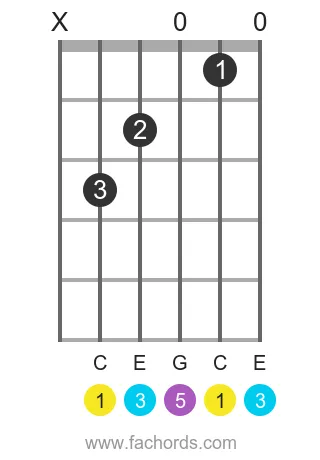
- A string, 3rd fret: C
- D string, 2nd fret: E
- G string, open: G
- B string, 1st fret: C
- High E string, open: E
Five strings, but only three different notes: C, E and G. Repeated notes don't change the name, so cross out the doubles.
Two habits will save you a lot of headaches:
- Open strings count. If a string rings, its note is part of the chord, even if you didn't press anything. This is the most common reason a shape gets the wrong name.
- Write the lowest note first. You'll need it in step 2, because the bass note is your best clue to the root.
If you're not fast with note names yet, that's fine: this step gets quicker every time you do it. Our guide on how to read chord diagrams covers the symbols (x, o, finger numbers) if any of them look unfamiliar.
Step 2: Pick a Candidate Root
The root is the note the chord is built on, the "C" in "C major". Finding it is the real detective work, and here's the strategy I use:
- Try the bass note first. In most chords you'll meet, the lowest note is the root.
- Measure the other notes from it (step 3) and see if you get a known formula (step 4).
- If the result looks odd (a b3 and a 3 together, a b3 next to a 4, a lot of "add" notes), try the next note as the root, and the next one. Keep the root that gives the simplest formula.
"Simplest" usually means the notes stack up in 3rds: root, 3rd, 5th, 7th. Chords are built that way (see our tutorial on chord construction), so when a root makes the notes line up in 3rds, you're probably on the right track.
Tip: if the bass note is not the root, don't throw it away. You'll need it at the end to write a slash chord, like C/E.
Step 3: Measure Every Note From the Root
Now count the half steps from the root to each note. On a single string it's easy: every fret is one half step. Then convert the count into an interval with this table.
| Half steps from the root | Interval | Written in chord names as | Example from C |
|---|---|---|---|
| 0 | Root | 1 | C |
| 1 | Minor 2nd | b9 | Db |
| 2 | Major 2nd | 2 or 9 | D |
| 3 | Minor 3rd | b3 (or #9 in a dominant chord) | Eb |
| 4 | Major 3rd | 3 | E |
| 5 | Perfect 4th | 4 or 11 | F |
| 6 | Tritone | b5 or #11 | Gb / F# |
| 7 | Perfect 5th | 5 | G |
| 8 | Minor 6th | #5 or b13 | G# / Ab |
| 9 | Major 6th | 6 or 13 | A |
| 10 | Minor 7th | b7 | Bb |
| 11 | Major 7th | 7 (maj7) | B |
Why do some intervals have two names (2 or 9, 4 or 11, 6 or 13)? It depends on the rest of the chord:
- No 3rd in the chord: the 2nd or 4th replaces it. That's a sus chord (sus2, sus4).
- 3rd present, no 7th: the note is an add-on: add9, add11, or a 6 chord.
- 3rd and 7th present: the notes above the 7th are extensions: 9, 11, 13.
Need a refresher on how intervals look on the neck? Our fretboard intervals tutorial shows every shape across strings.
Step 4: Match the Formula
You now have a list like "1, 3, 5" or "1, b3, 5, b7". The last step is to find the chord type with the same formula. Here are the ones you'll meet most often (the full list is in our chord intervals and symbols chart).
| Formula | Chord type | Symbol (root C) |
|---|---|---|
| 1 3 5 | Major | C |
| 1 b3 5 | Minor | Cm |
| 1 b3 b5 | Diminished | Cdim |
| 1 3 #5 | Augmented | Caug |
| 1 5 | Power chord | C5 |
| 1 2 5 | Suspended 2nd | Csus2 |
| 1 4 5 | Suspended 4th | Csus4 |
| 1 3 5 9 | Add 9 | Cadd9 |
| 1 3 5 6 | Major 6th | C6 |
| 1 3 5 b7 | Dominant 7th | C7 |
| 1 3 5 7 | Major 7th | Cmaj7 |
| 1 b3 5 b7 | Minor 7th | Cm7 |
| 1 b3 b5 b7 | Half diminished | Cm7b5 |
| 1 4 5 b7 | Dominant 7th sus4 | C7sus4 |
Back to our open C: C, E, G measured from C give 1 3 5, the major triad.
Major Triad Formula
Formula: 1 3 5
When the formula is longer, build the name in this order: root + quality (m, dim) + 7th type + sus + extras + /bass. For example Cm7b5, Gadd9, C7sus4/G.
And remember: the 3rd decides major or minor, the 7th decides the chord family, and a missing 5th almost never changes the name. Guitarists drop it all the time.
Example 1: Is This Really an F Chord?
A classic forum question: a video lesson calls a shape "F", but it doesn't look like the F you learned, and the open high E string rings. Let's compare the small F with the same shape plus the open E.
F (xx3211)

Fmaj7 (xx3210)

F (xx3211), then Fmaj7 (xx3210)
So if the open high E rings, you're playing Fmaj7, not F. Is that "wrong"? Not at all: Fmaj7 contains the whole F major triad, so it can stand in for F in most songs, with a softer, dreamier colour. Whether you mute that string or let it ring is a choice of sound. Just call it by its real name when you write it down.
Example 2: Add9 or Sus2? Look for the 3rd
Here's a shape many people play as a "fancy G": 3x020x.
Gadd9 (3x020x)

- Notes: G (low E, 3rd fret), D (open D), A (G string, 2nd fret), B (open B).
- Root: the bass note, G.
- Intervals from G: D = 7 half steps (5), A = 2 half steps (9), B = 4 half steps (3).
- Formula: 1 3 5 9. The 3rd is there, there's no 7th, so the 9 is an add-on: Gadd9.
If the B were missing, the A would take the place of the 3rd and the chord would be Gsus2. That's the whole difference between sus and add: a sus chord has no 3rd, an add chord keeps it. More on this in our suspended chords and ninth chords tutorials.
Example 3: When the Bass Isn't the Root (Slash Chords)
Look closely at this open C diagram, the one with the open low E string ringing.
C/E (032010)

D/F# (200232)
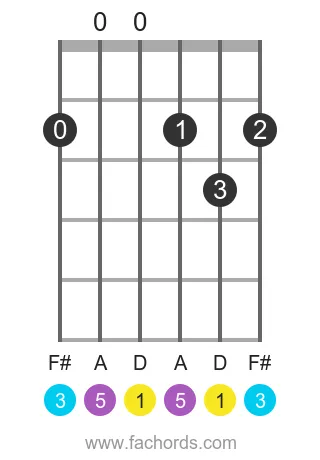
032010: E, C, E, G, C, E. The notes are still C, E, G, a C major chord, but the lowest note is E.
200232: F#, A, D, A, D, F#. A D major chord with F# in the bass.
When the bass note is not the root, write the chord, a slash, and the bass note: C/E ("C over E") and D/F#. When the bass is the 3rd or the 5th of the chord, as here, the slash chord is also called an inversion: C/E is a C major in first inversion.
So to answer the question Google keeps showing ("how do you name inverted chords?"): name the chord from its root as usual, then add "/" and the bass note.
Same Notes, Two Names
This is where most forum arguments start. Some sets of notes give a perfectly clean formula from two different roots. Both names are correct; the bass note and the song decide which one to use.
Am7 or C6?
Am7 (x02010)
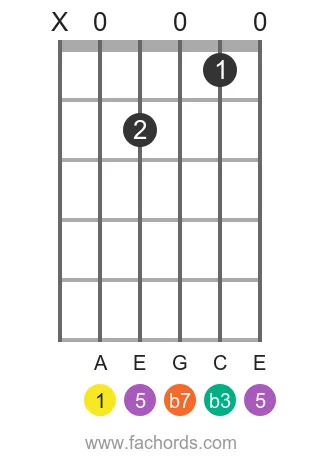
C6 (x35555)
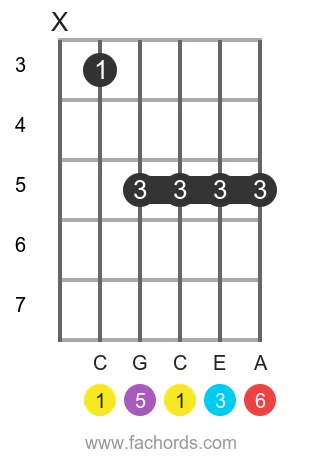
Am7 (x02010), then C6 (x35555)
With A in the bass, call it Am7. With C in the bass, call it C6. (Some chord apps show the second shape as Am7/C: same notes, same idea, just measured from A.)
Csus2 or Gsus4?
Csus2 (x3x033)

Gsus4 (xx5533)

Csus2 (x3x033), then Gsus4 (xx5533)
Sus chords have no 3rd, so they're neither major nor minor. That's why shapes like these sound good almost anywhere you slide them on the neck: there's no 3rd to clash with the key.
The Hard Cases: Real Shapes From Forum Questions
Let's put the method to work on three chords people actually asked about. They're harder because the bass note is not the root, or because the notes don't stack neatly in 3rds. Listen to all three first:
3x331x, x0341x, 3x321x
"What chord is G, A#, C, F?"
First, the spelling. A# and Bb are the same sound (they're enharmonic), and next to C and F the letter name Bb will make the intervals much easier to read. So our notes are G, Bb, C, F. Here they are in a playable shape, 3x331x, measured from two different roots:
Root G: Gm7(add11)

Root C: C7sus4/G

From G: Bb = b3, C = 4 (11), F = b7. A minor 7th with an added 11th and no 5th: Gm7(add11). It's add11 and not m11 because there's no 9th in the chord.
From C: F = 4, G = 5, Bb = b7. That's exactly 1 4 5 b7, a C7sus4, with G in the bass.
Same frets, same sound, two labels. The C root gives a textbook formula with nothing missing, so C7sus4/G is the cleanest name. But if the song is in G minor and this chord sits on the "home" spot, Gm7(add11) tells the reader more. That's the rule for every borderline case: simplest formula first, then let the song decide.
C7sus4 Formula
Formula: 1 4 5 b7
"What do you call A, C, F, B?"
Here's a shape with A in the bass: x0341x (open A, F on the D string, B on the G string, C on the B string). Let's test the roots:
- From A (the bass): C = b3, F = b6, B = 9. A minor sound with a b6 and a 9 and no 5th. Possible, but messy.
- From C: F = 4, A = 6, B = 7. Even stranger.
- From F: A = 3, B = #11 (6 half steps), C = 5. That's an F major triad plus a #11. Clean!
F(#11)/A (x0341x)
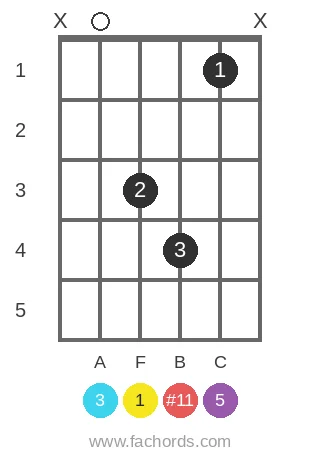
The root is F, the bass is A, so the name is F(#11)/A, also written Fadd#11/A.
The #11 (B over F) is the note that gives the Lydian mode its bright, floating sound, which is probably why the shape sounded so good to the person who found it.
F with #11 Formula
Formula: 1 3 #11 5
"Is this really a Gsus chord?"
Another reader found a chord called "Gsus" in a book and noticed it looked more like a G7 with no 3rd, no 5th, and both a 2nd and a 4th. They were on to something. A shape with that sound is 3x321x: G, F, A, C.
F/G (3x321x)

From G: F = b7, A = 9, C = 11 (the 4th). No 3rd, so it's a sus chord, and with the b7 and the 9 the full name is G9sus4 (with no 5th).
From F: F, A, C is an F major triad, and G sits underneath: F/G.
In pop and jazz charts you'll find this exact sound written as G9sus4, G11 or F/G, and some books shorten it to just Gsus. All of them point to the same idea: a G bass with the F major triad on top. It's a great chord to hang on before resolving to G, where the missing 3rd (B) finally lands.
Shortcuts That Make Chord Naming Faster
After you've named a few dozen chords, you'll stop doing every step by hand. These are the patterns to look for:
- Find the 3rd first. A major 3rd (4 half steps) or a minor 3rd (3 half steps) above a note is a strong hint that the note is the root. No 3rd anywhere? Think sus chord or power chord.
- The bass note is the root most of the time. When it isn't, you'll usually spot it in step 4: the formula from the bass looks odd, the formula from another note looks clean.
- Ignore doubled notes and a missing 5th. Neither changes the name.
- Check the open strings twice. One ringing open string can turn F into Fmaj7 or C into C/E.
- Spell with letters that fit. A chord with C and F is easier to read with Bb than with A#. If your intervals look weird (a "#2" with no 3 in the chord), try the other spelling.
- When two names fit, take the simpler one, then check it against the bass and the key of the song.
- Learn the triads on the top strings. Many "mystery" chords are a simple triad over a different bass note, like F/G above. Once you see the triad, the name follows.
Check Your Answer With the Chord Identifier
Once you've worked out a name by hand, check it. Our free Chord Identifier lets you click the same frets on a virtual fretboard and shows the chord names that match those notes.
Use it as an answer key, not a shortcut. If it lists two or three names for your shape, you now know why: the same notes measured from different roots, or a slash chord. Pick the one that fits your bass note and your song.
And if you want to hear the difference between chord types instead of only reading it, try our chord recognition game: being able to tell major, minor, 7th and sus chords apart by ear makes naming them a lot faster. When the chord comes from a recording rather than your fingers, our guide on figuring out chords by ear picks up where this one stops.
Conclusion
Naming a chord isn't about memorising thousands of shapes. It's four questions you ask every time:
| Step | What you do | Watch out for |
|---|---|---|
| 1. Notes | Turn every played string into a note name | Open strings, doubled notes |
| 2. Root | Start from the bass, try the others if the result looks odd | Slash chords (bass is not the root) |
| 3. Intervals | Count half steps from the root | 2/9, 4/11 and 6/13 depend on the 3rd and 7th |
| 4. Formula | Match to a chord type, add extras and /bass | Two clean names: let the bass and the song decide |
Your next step: grab the last song you learned, pick the one chord that looked a bit unusual in the diagram, and name it by hand before you look it up. Do that with a few chords a week and the method will become second nature.
That's all for today.
Remember that you can subscribe here to stay updated on new tutorials and gain access to the free download area, where you'll find some free chords and scales PDFs.

Created by
Giancarlo is a musician (teaching guitar since 2000), software engineer, AI consultant and published researcher
FAQ
How do you name a chord on guitar?
Work it out in four steps. Turn every fretted or open string into a note name, pick a root (start with the bass note), measure each note's distance from the root in half steps to get its interval (3, b3, 5, b7 and so on), then match those intervals to a chord formula. C, E and G give 1, 3, 5: a C major chord.
How do I find the root of a chord?
Start with the lowest note, because most of the time it is the root. Measure the other notes from it: if they form a known formula (1 3 5, 1 b3 5, 1 3 5 b7...), you found it. If you get an odd mix, such as a b3 and a 4 together, try each of the other notes as the root and keep the one that gives the simplest formula.
What is the difference between sus2 and add9?
Both contain the 2nd (or 9th) of the root. A sus2 chord has no 3rd: the 2nd replaces it, so C D G is Csus2. An add9 chord keeps the 3rd and adds the 9th on top, so G B D A is Gadd9. Look for the 3rd: if it is there, it is an add chord, if it is missing, it is a sus chord.
Why can the same chord have two names?
Because a set of notes can be measured from more than one root. A, C, E and G are Am7 measured from A and C6 measured from C. C, D and G are Csus2 from C and Gsus4 from G. The bass note usually decides which name to use, and the key of the song can tip the balance.
What does a slash chord like D/F# mean?
The letter before the slash is the chord, the letter after it is the bass note. D/F# is a D major chord (D, F#, A) with F# as its lowest note. When the bass is the 3rd or 5th of the chord, the slash chord is an inversion. When the bass is a note outside the chord, as in F/G, it adds a new sound.
Is a chord still the same chord if the 5th is missing?
Yes. The perfect 5th adds weight but no colour, so guitarists leave it out all the time, especially in 7th and extended chords. A chord with 1, 3 and b7 is still a dominant 7th. The 3rd and the 7th are the notes that define the name; the root, the 3rd and the 7th are the ones to keep.
What chord is G, A#, C, F?
Spell A# as Bb, then try different roots. From G the notes give 1, b3, 4, b7, a Gm7 with an added 11th and no 5th. From C they give 1, 4, 5, b7: a C7sus4. With G in the bass, the cleanest name is C7sus4/G, but in a G minor song Gm7(add11) can read better.