Voice Leading on Guitar
How to Play Chord Progressions Without Jumping Around the Neck
You know the chords, you know the progression, and still every change feels like a small earthquake: the hand flies from the 8th fret to the 3rd, then up to the 5th, then down to the 1st. The chords are right, but the song sounds like a list of separate chords instead of music.
The fix has a name: voice leading. Instead of thinking of chords as shapes, you think of them as three or four notes (the "voices"), and you move each voice to the closest note of the next chord. The result is a progression you can play in one spot of the neck, with the fingers moving a fret or two at a time.
In this lesson we'll start from the pop progression everybody knows, C - G - Am - F, then play I-IV-V, a 12-bar blues, a minor progression and a jazz ii-V-I the same way, with a chord diagram and an audio clip for every example.
Voice leading in one sentence: keep the notes two chords share on the same string and fret, and move every other note by the smallest step (a half step or a whole step) to a note of the next chord.
Example: from C (C E G) to Am (A C E), C and E stay where they are and only G moves up a whole step to A. One finger moves, the progression sounds smooth.
Why Your Chord Changes Sound Choppy
Let's start with the way most of us learn barre chords: root on the 6th string, find the root, slap the shape on it. Here is C - G - Am - F played like that.
C

G

Am

F
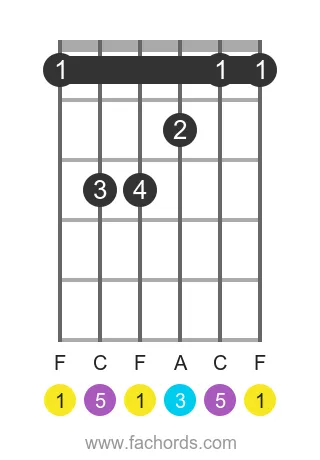
C - G - Am - F, every chord with the root on the 6th string
Follow the index finger: 8th fret, 3rd, 5th, 1st. That's 11 frets of travel for four chords, and then a 7-fret jump to go back to C. Listen to the top note too: it leaps up and down with the hand.
Now the same four chords, chosen so they all live between the 3rd and the 8th fret.
C

G
Am
F

C - G - Am - F in one region of the neck
The index finger now stays at the 3rd fret for C and G and moves to the 5th for Am and F. Two frets, that's all. Mixing barre chords with the root on the 6th and on the 5th string is already a first step towards voice leading, and it's the idea behind the CAGED system: every chord has a shape near the one you are playing.
But full six-string chords are heavy and they still move a lot of notes. To really see (and hear) the voices, we need smaller chords.
The Two Rules of Voice Leading
Every chord is a group of notes, and every note is a "voice", like the singers of a choir. When the chord changes, each singer moves to a note of the new chord. A good choir director keeps the singers from jumping around, and you want the same for your fingers. Two rules cover almost everything:
- Keep the common tones. If two chords share a note, hold it on the same string and fret.
- Move the other notes by the smallest step. Go to the closest note of the next chord, ideally a half step (1 fret) or a whole step (2 frets) away.
Here is what that means for C - G - Am - F. The notes of each chord come from our C, G, Am and F chord pages.
| Change | Notes | Stays | Moves |
|---|---|---|---|
| C to G | C E G to G B D | G | C down a half step to B, E down a whole step to D |
| G to Am | G B D to A C E | none | B up a half step to C, D up a whole step to E, G up a whole step to A |
| Am to F | A C E to F A C | A, C | E up a half step to F |
| F to C | F A C to C E G | C | F down a half step to E, A down a whole step to G |
Look at the Am to F row: one note out of three moves, by one fret. That's the kind of change you can play half asleep, and it's exactly the idea behind neo-Riemannian chord transformations. And when two chords share nothing, like G and Am, every voice still moves by a step, all in the same direction.
To play the table exactly as written, the chords can't all be in root position. Sometimes the 3rd or the 5th ends up at the bottom: these are chord inversions, and they are the secret ingredient of voice leading.
I-V-vi-IV on the Top Three Strings
The easiest place to try it is on the G, B and high E strings with three-note triads. The shapes are small, they sit above the bass player, and you can clearly hear the top note.
Position 1: frets 3 to 6
C

G

Am

F

C - G - Am - F, triads between the 3rd and 6th fret
Go back to the table and check it on the diagrams:
- C to G: the G on the high E string (3rd fret) stays. The other two notes drop: C to B on the G string (5th to 4th fret), E to D on the B string (5th to 3rd fret).
- G to Am: all three notes go up by one or two frets.
- Am to F: only the B string moves, from the 5th to the 6th fret (E to F).
- F to C: C on the G string stays, F drops to E, A drops to G.
Now listen only to the top note: G, G, A, A. The progression has turned into a tiny melody. This is why voice leading sounds "musical": the top voice moves like a singer would sing it.
Tip: say the moving note out loud as you change ("C goes to B, E goes to D"). It feels silly for a day, then the fretboard starts to make sense.
Position 2: frets 7 to 10
The same rules give you a second complete set, higher up. This time C starts in first inversion, with E at the bottom.
C

G

Am

F

C - G - Am - F, triads between the 7th and 10th fret
The top note now sings C, B, C, C, a different melody over the same chords. Two positions, two colors: you can play the verse low and the chorus high, or have a second guitarist take the other one.
The same four chords appear (in other orders) in hundreds of songs: see our common chord progressions and the sensitive progression (Am - F - C - G). The voicings above work for all of them.
I-IV-V and the 12-Bar Blues in One Spot
The three-chord progression I-IV-V is the backbone of rock, country and blues. In the key of A that's A, D and E, and on the top three strings it fits between the 4th and 7th fret.
A

D

E
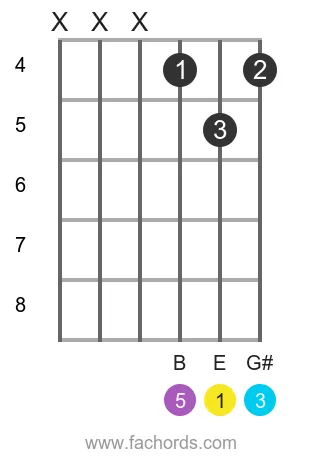
A - D - E - A on the top three strings
- A to D: A on the high E string (5th fret) stays, C# goes up a half step to D, E goes up a whole step to F#.
- D to E: F# drops to E and A drops to G#, both by step. D drops to B, a minor 3rd: sometimes the closest note is not a step away, and that's fine as long as the hand stays put.
- E to A: E on the B string stays, B goes up to C#, G# goes up to A.
Now put the three triads in a 12-bar blues: four bars of A, two of D, two of A, then E, D, A and E, with A - E as the turnaround. Same three shapes, same four frets.
| A | A | A | A |
| D | D | A | A |
| E | D | A | E |
12-bar blues in A with the three triads above, strummed D - D U - U D U
A Minor Progression: Am - F - G
Here is a sound every rock player knows: Am - F - G, the i - VI - VII in A minor (or vi - IV - V in C major, same chords). Good news: you already know the shapes, they come from Position 1.
Am
F
G
Am - F - G - Am on the top three strings
From F to G, C drops a half step to B and A drops a whole step to G, while F drops to D (a minor 3rd). Then G climbs back to Am with all three notes moving up by step. That's the point of learning a few good voicings: the same shapes keep coming back in different progressions.
Voice Leading With Seventh Chords: the ii-V-I
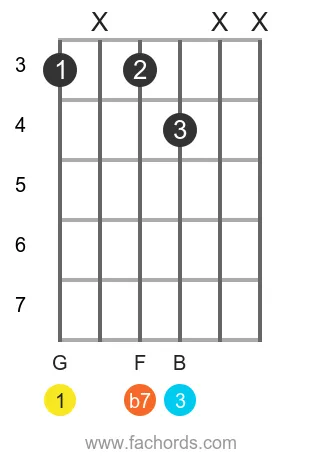
In jazz, voice leading is not a trick, it's the whole game. The chords have four notes, but the two that matter most are the 3rd and the 7th, called guide tones. Watch them in a ii-V-I in C (Dm7 - G7 - Cmaj7) played with three-note shell chords:
Dm7
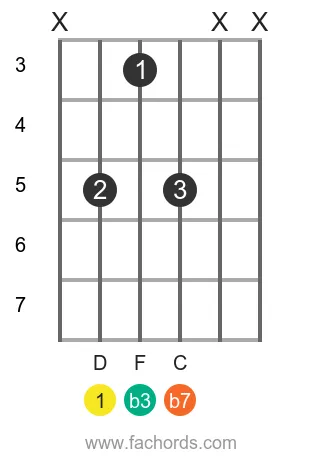
G7
Cmaj7

Dm7 - G7 - Cmaj7 shell chords
| String | Dm7 | G7 | Cmaj7 |
|---|---|---|---|
| G string | C (b7), 5th fret | B (3), 4th fret | B (7), 4th fret |
| D string | F (b3), 3rd fret | F (b7), 3rd fret | E (3), 2nd fret |
At every change, one guide tone stays and the other falls a half step: the 7th of one chord becomes the 3rd of the next. Only the bass moves more. If you want to go further, the jazz progression workout takes the ii-V-I through the whole neck, and the tritone substitution shows another chord that shares the same guide tones as G7.
How to Voice Lead Any Progression
You don't need a book of voicings for every song. With a progression in front of you, follow these steps:
- Write the notes of every chord (C E G, G B D...). The chord tone map helps if you don't know them by heart.
- Pick a string set: start with G-B-E, then try D-G-B and A-D-G.
- Play the first chord in any inversion around the fret you want to stay in.
- For each next chord, hold the common tones and move every other note to the nearest note of the new chord.
- Check the hand: if you are moving more than three or four frets, look for a closer inversion.
You need to know where the notes are, so if the fretboard is still a mystery, spend some time with our fretboard notes lesson. And if you want the triad shapes on every string set, they are all in our guitar triads guide and on the move chords up the neck map.
Thinking left or right? With a chord in your hand, the next one can be just below or just above. Our article on fretboard navigation explains how to choose the direction.
Practice Routine
Five minutes a day is plenty. Pick one progression from this lesson and:
- One strum per chord, slow. Name the moving note at every change.
- Top voice only. Play just the note on the high E string through the progression, then add the other two strings.
- Two positions back to back. Play Position 1, then Position 2, then go back and forth every four bars.
- Add a rhythm. Once the changes are automatic, use a strumming pattern or arpeggiate the triads.
- Play with a band. Put on a backing track and play the triads over it.
For the backing, use our free chord progression generator: it gives you drums and chords to play over. Choose a preset or build your own progression (for example C, G, Am, F, or the 12-bar blues in A), set a slow BPM and play the triads from this lesson on top. Try one strum per bar first, then two.
If chord changes are still a struggle even with nearby shapes, read our chord transition tips: air changes and the one-minute changes drill work very well with these triads too.
Conclusion
Voice leading turns chord changes from jumps into small steps: keep what the chords share, move the rest as little as possible.
| Progression | Where | What to listen for |
|---|---|---|
| C - G - Am - F (Position 1) | Top 3 strings, frets 3 to 6 | Top note G, G, A, A |
| C - G - Am - F (Position 2) | Top 3 strings, frets 7 to 10 | Top note C, B, C, C |
| A - D - E, 12-bar blues | Top 3 strings, frets 4 to 7 | A on top stays from A to D |
| Am - F - G | Top 3 strings, frets 3 to 6 | Am to F: one note moves |
| Dm7 - G7 - Cmaj7 | Shell chords, frets 2 to 5 | 7th falls to the 3rd |
Your next step: take a song you already play, write down its chords, and voice lead it on the top three strings. The first time it takes a while. By the third song you'll start seeing the next chord before you need it.
That's all for today.
Remember that you can subscribe here to stay updated on new tutorials and gain access to the free download area, where you'll find some free chords and scales PDFs.

Created by
Giancarlo is a musician (teaching guitar since 2000), software engineer, AI consultant and published researcher
FAQ
What is voice leading on guitar?
Voice leading is the way each note of a chord moves to a note of the next chord. Good voice leading keeps the notes the two chords share on the same string and fret, and moves the other notes by the smallest possible step. On guitar it means playing a whole progression in one small area of the neck, for example C - G - Am - F between the 3rd and 6th fret of the top three strings.
What are the rules of voice leading?
For guitar players two rules cover most of it. First, keep the common tones: if two chords share a note, hold it on the same string and fret. Second, move every other note to the closest note of the next chord, ideally a half step or a whole step away. When a chord has no note in common with the previous one, all the voices move by step.
Why should I play chord progressions in one position of the neck?
Because your fretting hand travels a couple of frets instead of jumping across the neck, so the changes are faster and cleaner. It also sounds smoother: the top note of each chord moves like a small melody instead of leaping, and the progression sounds connected rather than like a list of separate chords.
Do I need chord inversions for voice leading?
Yes. If you only play root-position chords, the bass note jumps with every root and so does your hand. Inversions put the 3rd or the 5th at the bottom, so you can always find a shape of the next chord a fret or two away. Small three-note triads on the top three strings are the easiest place to start.
Which strings are best for voice leading triads?
The top three strings (G, B and high E) are the most common choice: the shapes are small, they sit above the bass and the drums, and the top note is easy to hear as a melody. Once they feel natural, use the same method on the B-G-D and G-D-A string sets.
Does voice leading work with seventh chords?
Yes, and it's the foundation of jazz comping. In a ii-V-I in C (Dm7 - G7 - Cmaj7), F stays put from Dm7 to G7, C falls a half step to B, then F falls a half step to E while B stays. Those 3rds and 7ths are called guide tones.
How do I practice voice leading on guitar?
Take a progression you know, pick a string set, and play the first chord in any shape. For every next chord, keep the shared notes and move the others to the nearest chord tone. Play it slowly with one strum per chord, then play only the top notes as a melody, then repeat the progression in a second area of the neck.