Tritone Substitution for Guitar Players
How to Swap a Dominant Chord and Make Your Cadences Sound Jazzy
If you have ever listened to a jazz guitarist play a simple ii-V-I and wondered why it sounds so much smoother than yours, there is a good chance the answer is the tritone substitution.
It's one of the most famous tricks in jazz harmony, and the good news is that it's much easier than it sounds: you replace one dominant chord with another dominant chord, and that's it.
In this tutorial, we're going to see why it works, how to find the substitute chord on the fretboard in a split second, and how to use it in real progressions, with chord diagrams for every example.
Tritone substitution in one sentence: any dominant 7th chord can be replaced by the dominant 7th chord whose root is a tritone (six semitones) away.
Example in C: instead of Dm7 - G7 - Cmaj7, play Dm7 - Db7 - Cmaj7. The bass walks down D, Db, C.
A Quick Refresher: the Tritone Inside the Dominant Chord
Before we start swapping chords, we need one piece of theory. If you have read our tutorial on tritone resolution, you already know it: the tritone is the interval of three whole steps (six semitones), the one that splits the octave exactly in half.
Notes: 1 T 8
Every dominant 7th chord contains a tritone, formed by its 3rd and its b7. These two notes are often called guide tones, because they define the sound of the chord and guide it towards the next one.
Dominant Chord Formula
Formula: 1 3 5 b7
In G7 (G, B, D, F), the tritone is B - F. When G7 resolves to C, B rises to C and F drops to E: that's the engine of the most common cadence in Western music.
Why the Tritone Substitution Works
Here comes the magic. Since the tritone divides the octave in two equal halves, if you flip it upside down you get... another tritone!
B - F is a tritone, and so is F - B (or F - Cb, if we spell it correctly). This means that two different dominant chords share the same guide tones: G7 and Db7.
The 3rd of G7 becomes the b7 of Db7, and the b7 of G7 becomes the 3rd of Db7. The two notes that do the heavy lifting are the same, they just swap roles. Change the root, keep the engine.
You can actually see it on the fretboard. Look at the D and G strings in these two shapes: same frets, same notes. Only the bass and the top notes move.
G7
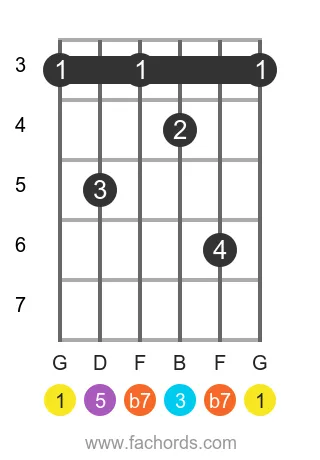
Db7
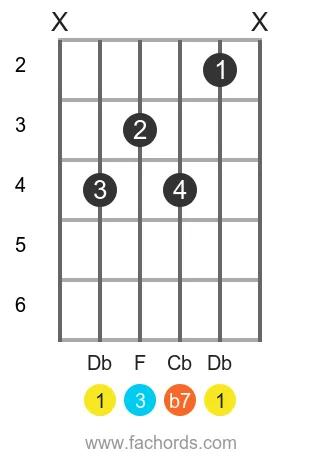
G7 vs Db7
F on the 3rd fret of the D string, B (Cb) on the 4th fret of the G string.
Both chords contain the same tritone, so both want to resolve to C.
Cmaj7
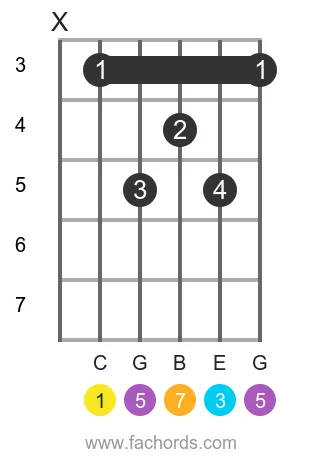
G7 - Cmaj7, then Db7 - Cmaj7
And what about the other notes of Db7? Measured from G, the Db is a b5 and the Ab is a b9. So, if a bass player keeps playing G while you play Db7, the result is a G7(b5 b9): an altered dominant, one of the most tense and colorful sounds in jazz. We'll come back to this when we talk about scales.
How to Find the Tritone Substitute on the Guitar
You don't need to count six semitones every time. There are three quick ways:
- On the fretboard: the tritone sits one string up and one fret up from the root (for roots on the 6th, 5th and 4th strings; from the G to the B string it is two frets up). If your G7 has its root on the 3rd fret of the low E string, the Db root is on the 4th fret of the A string. Shapes with the root on the 6th string become shapes with the root on the 5th string, and vice versa.
- On the circle of fifths: the substitute is the chord directly opposite on the circle of fifths. G is at 1 o'clock, Db is at 7 o'clock. Each chord type also forms its own circle of fifths chord shape.
- In the key: the substitute of the V7 is always the bII7, the dominant chord a half step above the tonic. In C it's Db7, in F it's Gb7, in A it's Bb7.
Since the relation works both ways, there are only six pairs of tritone substitutes. Learn this table and you'll never have to think about it again:
| Dominant chord | Tritone substitute | Shared guide tones |
|---|---|---|
| C7 | Gb7 (F#7) | E - Bb |
| Db7 | G7 | F - B |
| D7 | Ab7 | F# - C |
| Eb7 | A7 | G - C# |
| E7 | Bb7 | G# - D |
| F7 | B7 | A - Eb |
Tritone Substitution in the ii-V-I Progression
The natural habitat of the tritone substitution is the ii-V-I progression, the backbone of jazz. Let's start with the standard version in C.
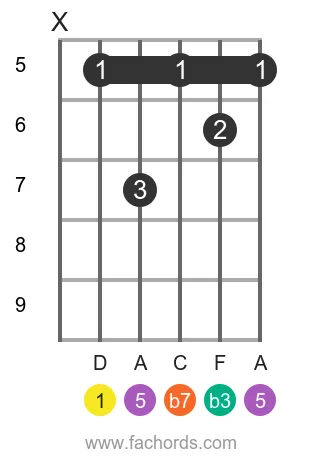
The Original: Dm7 - G7 - Cmaj7
Dm7
G7
Cmaj7
Dm7 - G7 - Cmaj7
The root movement goes D, G, C: down a fifth, then down a fifth again. Strong and classic, but also a bit predictable.
With the Tritone Sub: Dm7 - Db7 - Cmaj7
Dm7
Db7
Cmaj7
Dm7 - Db7 - Cmaj7
Now look at the bass on the A string: 5th fret, 4th fret, 3rd fret. D, Db, C. Instead of jumping around, the bass slides down chromatically, and your left hand barely moves.
That's the real secret of the tritone sub: it turns the root movement of a fifth into a half step, while keeping the same resolution of the guide tones. Smooth voice leading, more color, same harmonic function.
Tip: jazz players love to play the substitute as a 9th chord. Try Db9 (x-4-3-4-4-x) and simply slide the whole shape down one fret: you get C9, or resolve to Cmaj7 for a classic ending.
Dm7
Db9

Cmaj7
Dm7 - Db9 - Cmaj7
Substituting the Whole ii-V: Abm7 - Db7 - Cmaj7
Once Db7 is in place, you can go one step further and precede it with its own ii chord, Abm7. Now the entire ii-V has been moved a tritone away, and it still lands perfectly on C.
Abm7

Db7
Cmaj7
Abm7 - Db7 - Cmaj7
This one sounds more "outside" because Abm7 has little in common with the key of C. Use it when you want a bit of surprise right before the resolution. You can hear this kind of move at the end of the A section of Duke Ellington's Satin Doll.
Tritone Substitution of Secondary Dominants
The trick isn't limited to the V7 chord. It works on any dominant chord that resolves down a fifth, and that includes secondary dominants.
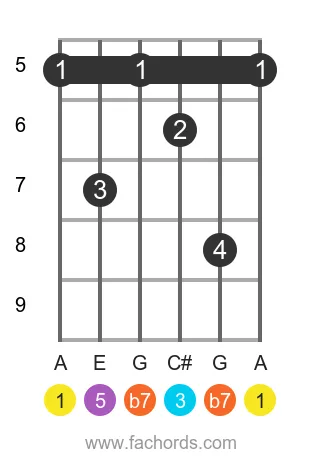
Take this progression in C, with A7 acting as the secondary dominant of Dm7:
Original: C - A7 - Dm7 - G7 - C
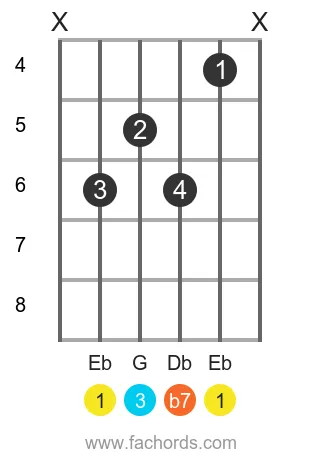
With two tritone subs: C - Eb7 - Dm7 - Db7 - C
Listen to the bass now: C, Eb, D, Db, C. A tiny chromatic melody that gives the whole turnaround a sophisticated, almost cinematic flavor. Eb7 shares G and C# (Db) with A7, so it pulls towards Dm7 just as well.
A7
Eb7
A7 vs Eb7
Same tritone: C# (Db) and G.
Both resolve to Dm7, but Eb7 gets there by a half step.
C

A7
Dm7
G7
Original: C - A7 - Dm7 - G7 - C
C
Eb7
Dm7
Db7
With two tritone subs: C - Eb7 - Dm7 - Db7 - C
Tritone Substitution in the Blues
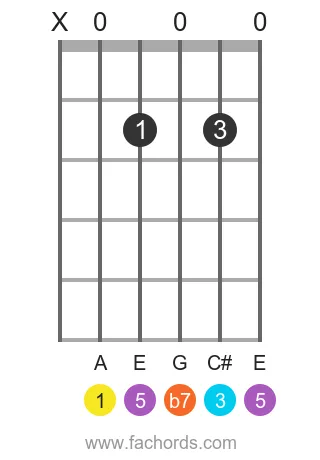
Blues players have been using this trick for decades, often without calling it by name. In a 12-bar blues in A, the V chord in the turnaround is E7. Replace it with its tritone sub, Bb7, and you get the classic Bb7 to A7 half-step ending you've heard in countless blues and jump tunes.
Bb7

A7
Bb7 to A7
Same shape, one fret lower.
Bb7 shares D and Ab (G#) with E7, the V chord of A.
Bb7 - A7
A Curious Fact: G7b5 and Db7b5 Are the Same Chord
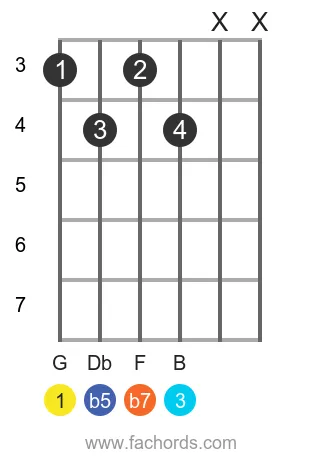
If you lower the 5th of a dominant chord, something funny happens. G7b5 is spelled G, B, Db, F. Db7b5 is spelled Db, F, Abb, Cb, and Abb and Cb are just enharmonic names for G and B (read more about enharmonics).
Same four notes, two names. The 7b5 chord is its own tritone substitute: the same shape works for both, and you decide which one it is by what the bass plays (the G7b5 shape below is also a Db7b5 with G in the bass).
G7b5
Db7b5

Which Scale to Play Over a Tritone Sub?
If you solo over Db7 in a ii-V-I in C, the go-to choice is the Db Lydian Dominant scale (1 2 3 #4 5 6 b7). It contains all the chord tones of Db7, plus the #11 (G), which is the root of the original V chord.
Formula: 1 2 3 #4 5 6 b7

Db Lydian Dominant: Db, Eb, F, G, Ab, Bb, Cb
Now here is the beautiful part. Write down the notes of the G Super Locrian scale, also known as the altered scale: G, Ab, Bb, Cb (= B), Db, Eb, F.
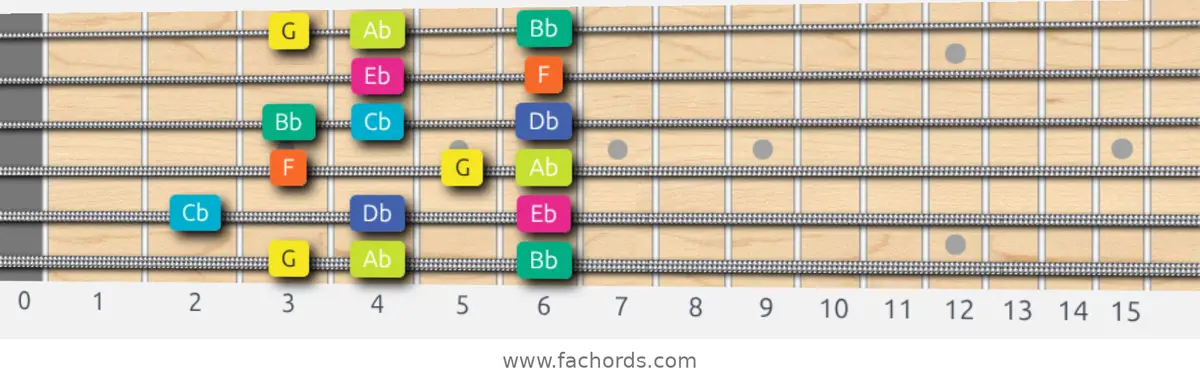
G Super Locrian (Altered): G, Ab, Bb, Cb (= B), Db, Eb, F
They are exactly the same seven notes. Both scales are modes of Ab melodic minor: Lydian Dominant is the 4th mode, the Super Locrian is the 7th.
So the tritone substitution works for soloists too. When you play the altered scale over G7, you are really "thinking Db7" over a G bass. Chords and scales are two sides of the same coin, as we explain in our scale chord application guide.
Song Examples
The tritone substitution is everywhere in jazz and bossa nova, and it pops up in pop songs too:
- The Girl from Ipanema (Antonio Carlos Jobim): in the key of F (as in most fake books), the A section uses Gb7 to return to Fmaj7. Gb7 is the tritone sub of C7, the V chord of F.
- Satin Doll (Duke Ellington and Billy Strayhorn): the Abm7 - Db7 move resolving to C is a tritone substituted ii-V.
- Blues turnarounds: the Bb7 to A7 ending in a blues in A (or Gb7 to F7 in a blues in F) is the same idea applied to the V chord.
When to Use the Tritone Substitution
A few practical tips before you start sprinkling Db7 chords everywhere:
- Start with cadences to the tonic. V7 to I is where the substitution is foolproof. It's also one of our favorite songwriting tricks for song endings.
- Use it on dominant chords that resolve. Static dominants, like the IV7 in a blues (or the I7 when it just sits there instead of moving to the IV), don't benefit as much.
- Watch the melody. If the melody sits on the 5th of the original V chord (D over G7), it becomes a b9 over Db7 (a half step above the root), which can clash. Your ear is the judge.
- Talk to your bass player. The effect is strongest when the bass plays the new root. If the bass stays on G, you get the altered sound instead, which is fine too, but different.
- Use shell voicings. Three-note shell chords (root, 3rd, b7) make the guide tone movement crystal clear and are very easy to move around.
The tritone substitution is just one member of a bigger family. If you want to explore more ways to reharmonize a progression, check out our guide to chord substitution, the borrowed chords tutorial (which also covers the backdoor progression), and practice everything in all keys with our jazz chord progressions.
Tritone Substitution - Conclusion
Let's recap the key points:
| Concept | Example in C |
|---|---|
| Replace V7 with bII7 | G7 → Db7 |
| Tritone substituted ii-V-I | Dm7 - Db7 - Cmaj7 |
| Substitute the whole ii-V | Abm7 - Db7 - Cmaj7 |
| Substitute a secondary dominant | A7 → Eb7 (to Dm7) |
| Scale over the substitute | Db Lydian Dominant = G Altered |
Pick a ii-V-I you already know, swap the V for its tritone sub, and play the two versions back to back. Once your ear catches that chromatic bass line, you'll start hearing it in every jazz record.
That's all for today.
Remember that you can subscribe here to stay updated on new tutorials and gain access to the free download area, where you'll find some free chords and scales PDFs.

Created by
Giancarlo is a musician (teaching guitar since 2000), software engineer, AI consultant and published researcher
FAQ
What is a tritone substitution?
A tritone substitution replaces a dominant 7th chord with the dominant 7th chord whose root is a tritone (six semitones) away. In the key of C, for example, you play Db7 instead of G7, so Dm7 - G7 - Cmaj7 becomes Dm7 - Db7 - Cmaj7.
Why does the tritone substitution work?
Every dominant 7th chord contains a tritone between its 3rd and its b7, the guide tones that pull the chord towards its resolution. G7 has B and F, Db7 has F and Cb (B): the same two notes with the roles swapped. Since the guide tones are the same, both chords resolve to C.
How do I find the tritone substitute of a chord on the guitar?
For roots on the 6th, 5th and 4th strings, the tritone is one string up and one fret up from the root (from the G to the B string it is two frets up). You can also pick the chord directly opposite on the circle of fifths, or simply remember that the substitute of the V7 chord is always the bII7, a half step above the tonic.
What is the tritone substitute of G7?
The tritone substitute of G7 is Db7. It works both ways, so G7 is also the tritone sub of Db7. There are only six pairs: C7/Gb7, Db7/G7, D7/Ab7, Eb7/A7, E7/Bb7 and F7/B7.
How do you use a tritone substitution in a ii-V-I progression?
Replace the V7 with the bII7: in C, Dm7 - G7 - Cmaj7 becomes Dm7 - Db7 - Cmaj7, and the bass walks down chromatically D, Db, C. You can go further and substitute the whole ii-V with Abm7 - Db7 - Cmaj7, a more outside sound heard in Satin Doll.
Can you use the tritone substitution on secondary dominants?
Yes, it works on any dominant chord that resolves down a fifth. In C - A7 - Dm7 - G7 - C, replace A7 with Eb7 and G7 with Db7 to get C - Eb7 - Dm7 - Db7 - C, with a chromatic bass line C, Eb, D, Db, C.
What scale should I play over a tritone substitution?
Over Db7 in a ii-V-I in C, use the Db Lydian Dominant scale (1 2 3 #4 5 6 b7). It has exactly the same notes as the G Super Locrian (altered) scale, because both are modes of Ab melodic minor. Playing the altered scale over G7 is like thinking Db7 over a G bass.
How is the tritone substitution used in the blues?
In a 12-bar blues in A, the V chord E7 in the turnaround can be replaced by its tritone sub Bb7, giving the classic Bb7 to A7 half-step ending. In a blues in F, the same idea gives Gb7 to F7.