Chromatic Mediant I-III: Why C to E Sounds So Bright
C to E. Both open shapes, and you can hear the jump the moment the E lands. That's the chromatic mediant I-III, a major chord a major third above the tonic, written 1 3 in the Nashville Number System.
The E chord is the one from outside the key of C, because C major has no G#. It's the same move as the verse of Creep, where the pair is G B. Listen in five keys and pick the one that suits your hands.
One Note Holds, Two Notes Slide
C is C E G. E is E G# B. So the two chords share one note, E, and it changes job: third of C, root of E. The other two notes each move a half step, in opposite directions:
- G rises to G#. That's the raised note, and the source of the brightness.
- C falls to B.
Those two half steps make the change smooth for such an unexpected chord. Play the three notes of each chord slowly and follow them. Keep those moves in your voice leading and the jump in the bass is the only big one.
Colour Shift or V of vi?
Wikipedia points out that this III can also be heard as V of vi, so context decides what it is. Try both readings:
- Play C E C E. The E comes back to the tonic, and it works as a colour shift.
- Now play C E and go to A minor. The E acts as a secondary dominant, leading to the vi.
Same two chords, and the next chord tells you which one you played. There's a third ending too: the puff schema with a major III moves up to IV instead.
Want a sense of how much that one raised note matters? Put this next to the plain I-iii, with a minor chord in the same spot. And for a flat version, a minor third up, there's I-bIII.
Radiohead and Bowie
Two verses, two versions of the III.
| Song | Artist | Section | Chords | Key |
|---|---|---|---|---|
| Creep | Radiohead | verse | G B | G major |
| Space Oddity | David Bowie | verse | C E7 | C major |
Creep by Radiohead plays G B, plain triads, and that B is a barre shape. Space Oddity by David Bowie plays C E7, with a seventh on the III. E7 is an open shape, and that added D makes it a dominant seventh, so it leans further toward the V of vi reading.
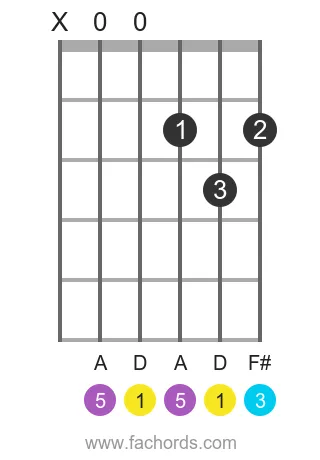
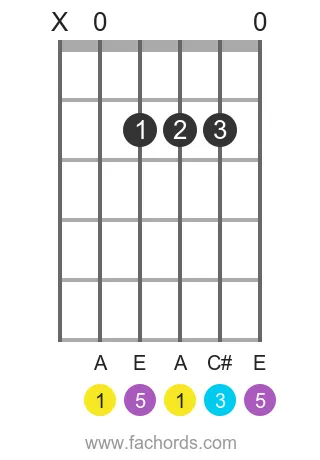
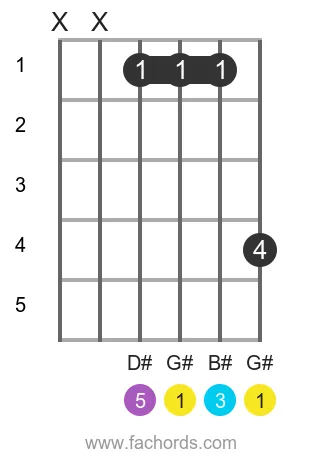
Chromatic Mediant I-III Chord Progression: Chords and Audio in C, G, D, A and E
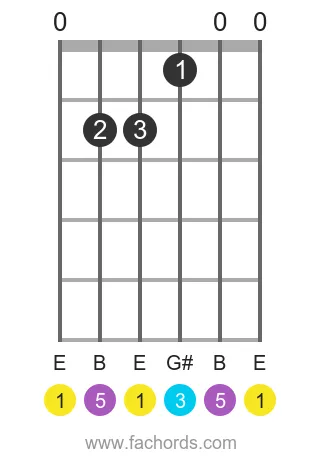
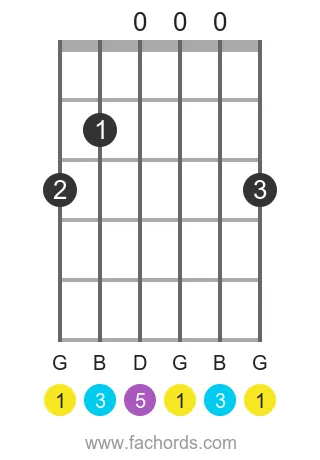
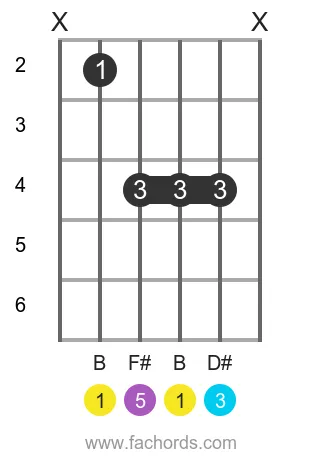
Press play to hear each key. The diagrams show the shapes used in the audio, and every chord links to its full page.



More progressions like this one
- Major line cliche: C Cmaj7 C7 F
- bIII-V7 cadence: Eb G7 C
- Mixolydian I-v-IV: C Gm F
- I-bVII-IV: C Bb F

Created by
Giancarlo is a musician (teaching guitar since 2000), software engineer, AI consultant and published researcher
FAQ
What does I-III look like in each key?
In C major: C E. In G major: G B. In D major: D F#. In A major: A C#. In E major: E G#.
Why is the E chord outside the key of C?
Its third is G#, a note that is not in C major. That raised note is what makes the chord sound bright and slightly unexpected after the C.
Is the III chord a secondary dominant?
It can be. Wikipedia points out that III can also be heard as V of vi, so context decides. If it leads to the vi it works as a secondary dominant, and if it returns to I it is a colour shift.
Which songs move from I to a major III in the verse?
Creep by Radiohead plays G B in the verse, and Space Oddity by David Bowie plays C E7 in the verse.