D Standard Tuning for Guitar
How to Tune to D G C F A D, What Your Chord Shapes Sound Like Now and the Songs That Use It
Take a guitar in standard tuning and lower every string by two frets. Nothing else changes: the same chord shapes, the same scale patterns, the same riffs under your fingers. But the guitar sounds darker, heavier and a whole step lower.
That's D standard tuning, also called "one step down" or "whole step down" tuning, or simply DGCFAD. Metal bands use it for weight, singers use it to bring a song down to their range, and blues and rock players like it because looser strings are easier to bend.
Most pages about D standard stop at the tuner. Here you'll tune each string with a reference tone, and then we'll see the one thing that confuses everybody: what your chord shapes are called now. Diagrams, riffs in tab, and audio for every example.
D standard tuning in one sentence: every string of standard tuning goes down a whole step, so the strings are D G C F A D (low to high).
What it means for you: you play the same shapes as always, and each one sounds a whole step lower. A G shape sounds F, a C shape sounds Bb, an E shape sounds D.
D Standard Tuning Notes
The open strings are D2, G2, C3, F3, A3 and D4. The distance between neighbouring strings is the same as in standard tuning (a 4th everywhere, a major 3rd between the 3rd and 2nd strings), so the whole fretboard layout simply slides down two frets.
Here are the notes of the first 12 frets. Compare any row with standard tuning: the note you used to find on fret 5 now sits on fret 7, the note of the 3rd fret is now on the 5th.
| String | 0 | 1 | 2 | 3 | 4 | 5 | 6 | 7 | 8 | 9 | 10 | 11 | 12 |
|---|---|---|---|---|---|---|---|---|---|---|---|---|---|
| 1st | D | Eb | E | F | Gb | G | Ab | A | Bb | B | C | Db | D |
| 2nd | A | Bb | B | C | Db | D | Eb | E | F | Gb | G | Ab | A |
| 3rd | F | Gb | G | Ab | A | Bb | B | C | Db | D | Eb | E | F |
| 4th | C | Db | D | Eb | E | F | Gb | G | Ab | A | Bb | B | C |
| 5th | G | Ab | A | Bb | B | C | Db | D | Eb | E | F | Gb | G |
| 6th | D | Eb | E | F | Gb | G | Ab | A | Bb | B | C | Db | D |
(The notes between the natural ones are written as flats: Gb is F#, Db is C#.) If you want to compare with the layout you know, our guide to the guitar fretboard notes shows standard tuning.
The six open strings in D standard, low to high, then an E chord shape (it sounds D major)
Before and after: the open strings in standard tuning, then the same strings a whole step down
How to Tune to D Standard
All six strings go down by the same amount: a whole step, two semitones. Play each reference tone and match your string to it, or use a tuner and check the note names in the table.
| String | Standard | D standard | What to do | Check without a tuner | Reference tone |
|---|---|---|---|---|---|
| 6th | E | D (D2, 73.42 Hz) | Down a whole step | Tune it to the reference tone: every other string follows from it | |
| 5th | A | G (G2, 98 Hz) | Down a whole step | Same note as the 5th fret of the 6th string | |
| 4th | D | C (C3, 130.81 Hz) | Down a whole step | Same note as the 5th fret of the 5th string | |
| 3rd | G | F (F3, 174.61 Hz) | Down a whole step | Same note as the 5th fret of the 4th string | |
| 2nd | B | A (A3, 220 Hz) | Down a whole step | Same note as the 4th fret of the 3rd string | |
| 1st | E | D (D4, 293.66 Hz) | Down a whole step | Same note as the 5th fret of the 2nd string, two octaves above the open 6th string |
The checks are the same "5th fret, 5th fret, 5th fret, 4th fret, 5th fret" you may already use in standard tuning, because the intervals between the strings didn't change. Only the starting note did.
Check 1: 6th string at the 5th fret, open 5th string, together. Check 2: 3rd string at the 4th fret, open 2nd string, together
A few practical tips:
- Go around twice. Six strings losing tension at once means the neck relaxes a little while you tune, and the first strings drift flat. Check all six again at the end.
- Tune up to the note. If you overshoot, go below the target and come back up: the string holds its pitch better.
- Is it safe for the guitar? Yes. Every string goes down, so there is less tension on the neck than in standard tuning, not more.
The frequencies in the table come from our note frequencies chart (A4 = 440 Hz).
Why Play in D Standard?
If the shapes are the same, why bother? Three reasons come up again and again:
- A heavier sound. The low string is a D instead of an E, and the whole guitar has more low end. That's why so many rock and metal records are tuned this way: riffs you already know hit harder.
- The singer's range. A song that is too high to sing in G drops to F without learning a single new chord. Same fingers, a key that fits the voice better.
- Easier bends and a softer feel. Looser strings bend further with less effort, and chords feel a bit lighter under the fingers.
String gauge for D standard
The price of that softer feel: with a light set, the low strings can get floppy and buzz, especially if you pick hard. Many players who stay in D standard move up one gauge (for example 11s instead of 10s on electric) to bring the tension back. Our guide to guitar strings explains how gauges work. After a change of tuning and gauge, a quick setup check (neck relief and intonation) keeps the guitar playing in tune up the neck.
D Standard Chords: Same Shapes, New Names
Here's the part that confuses everybody, so let's keep it simple:
The D standard chord rule: you play the shapes you know, and every shape sounds a whole step lower than its name. The shape is the same, the chord you hear is two frets below.
So when a tab for a D standard song says "G", it usually means the G shape, and what comes out of the speakers is an F chord. Here are the open chords you know and what they sound like in D standard:
| Shape you play | Frets (6th to 1st string) | Chord you hear | Notes in D standard (low to high) |
|---|---|---|---|
| C | x-3-2-0-1-0 | Bb | Bb D F Bb D |
| A | x-0-2-2-2-0 | G | G D G B D |
| G | 3-2-0-0-0-3 | F | F A C F A F |
| E | 0-2-2-1-0-0 | D | D A D F# A D |
| D | x-x-0-2-3-2 | C | C G C E |
| Am | x-0-2-2-1-0 | Gm | G D G Bb D |
| Em | 0-2-2-0-0-0 | Dm | D A D F A D |
| Dm | x-x-0-2-3-1 | Cm | C G C Eb |
| E7 | 0-2-0-1-0-0 | D7 | D A C F# A D |
| A7 | x-0-2-0-2-0 | G7 | G D F B D |
| B7 | x-2-1-2-0-2 | A7 | A C# G A E |
| F (barre) | 1-3-3-2-1-1 | Eb | Eb Bb Eb G Bb Eb |
The diagrams below are drawn for D standard: the fingering is the shape you know, the note names and degrees under the grid are what really sounds.
G shape = F

C shape = Bb

D shape = C

Em shape = Dm

E shape = D
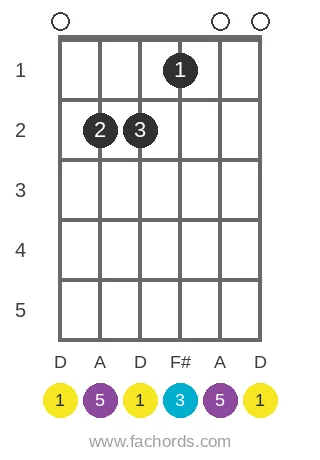
A shape = G

Play the four most common open chords of the key of G (G, C, D, Em shapes) and you're in the key of F: F, Bb, C and Dm, the I, IV, V and vi of the chords in the key of F.
G - C - D - Em shapes, sounding F - Bb - C - Dm
And the E, A and B7 shapes, the classic blues and rock trio in E, now give you D, G and A7: the key of D, with a low D under the I chord.
E - A - B7 - E shapes, sounding D - G - A7 - D
Playing with other musicians: transpose or capo
If you're the only one in D standard, tell the others the chords you hear, not the shapes you play. Transposing is mechanical: every chord name goes down a whole step (G to F, C to Bb, D to C), and our guide on how to transpose guitar chords shows how to do it for any song.
And when you want standard pitch back without retuning, put a capo on the 2nd fret. The open strings become E A D G B E again, and your shapes sound like their names. It works the other way too: to play along with a D standard record on a guitar in standard tuning, play the chords you hear (an F chord where the tab says G shape).
D Standard Power Chords and a Riff in Tab
Power chords keep the same shape as in standard tuning: root on the 6th string, two fingers two frets higher on the 5th and 4th strings. The shape doesn't change, so the only thing to learn is which fret gives which chord. Our lesson on power chords covers the shape itself.
D5 (open)

G5 (5th fret)

Two frets lower
The open E5 shape of standard tuning (0-2-2) is now D5. Every power chord with its root on the 6th string sounds two frets lower than in standard tuning.
| Fret of the 6th string | 0 | 1 | 3 | 5 | 7 | 8 | 10 | 12 |
|---|---|---|---|---|---|---|---|---|
| Power chord in D standard | D5 | Eb5 | F5 | G5 | A5 | Bb5 | C5 | D5 |
| Same fret in standard | E5 | F5 | G5 | A5 | B5 | C5 | D5 | E5 |
Here is a heavy riff with D5, F5 and G5. Four downstrokes per chord, and keep it tight:
D|------------------|------------------|
A|------------------|------------------|
F|------------------|------------------|
C|--2-2-2-2-5-5-5-5-|--7-7-7-7-5-5-5-5-|
G|--2-2-2-2-5-5-5-5-|--7-7-7-7-5-5-5-5-|
D|--0-0-0-0-3-3-3-3-|--5-5-5-5-3-3-3-3-|
D5 - F5 - G5 - F5, played twice, ending on D5
Now a single-note riff in the open position. It uses the shape of the open E minor pentatonic box, which in D standard gives you the notes of the D minor pentatonic scale: D, F, G, A and C.
D|------------------|-----------------|
A|------------------|-----------------|
F|------------------|-----------------|
C|------------------|-----------0-2---|
G|----------0-2-0---|---------0-------|
D|--0-0-3-0-------3-|--0-0-3-0--------|
D|------------------|------------|
A|------------------|------------|
F|------------------|------------|
C|------------------|------------|
G|----------0-2-0---|------0-----|
D|--0-0-3-0-------3-|--0-3---3-0-|
The four bars of the riff, D minor pentatonic in the open position
Notice that you're playing the fingering of an E minor pentatonic riff. That's D standard in a nutshell: your hands do the same thing, your ears get something new. For more riffs to try in this tuning, here is our list of famous guitar riffs.
Songs in D Standard Tuning
D standard is not only a metal tuning. These songs were recorded with the guitars a whole step down:
| Song | Artist | What to listen for |
|---|---|---|
| Yesterday | The Beatles | Paul McCartney plays chord shapes in G with the guitar a whole step down, so the song sounds in F |
| Dogs | Pink Floyd | Acoustic and electric guitars tuned down a step, under David Gilmour's long solos |
| Sad But True | Metallica | The riff that sounds like a wall: producer Bob Rock suggested tuning down to D for it |
| Dr. Feelgood | Motley Crue | The title track of an album recorded a whole step down |
| Kickstart My Heart | Motley Crue | Fast hard rock riffing from the same album, same tuning |
| Come As You Are | Nirvana | The famous single-note riff, a whole step down on the studio recording |
Two of these show the two reasons to tune down. On "Yesterday" the tuning moves the song to a key for the voice with the same chord shapes. On "Sad But True" it makes the riff heavier.
Drop C: the Drop Version of D Standard
Drop D lowers the 6th string of standard tuning by a whole step. Do the same thing to D standard and you get drop C: C G C F A D. Only the 6th string moves, from D down to C.
| String | D standard | Drop C | What to do |
|---|---|---|---|
| 6th | D (D2, 73.42 Hz) | C (C2, 65.41 Hz) | Down a whole step: its 7th fret must match the open 5th string (G) |
| 5th to 1st | G C F A D | G C F A D | Leave them |
Reference tone: the 6th string in drop C (low C)
The three lowest strings are now C, G and C: root, 5th and root. Just like in drop D, one finger across them is a power chord at any fret: open = C5, 3rd fret = Eb5, 5th fret = F5, 7th fret = G5, 10th fret = Bb5.
C5 (open)

F5 (5th fret)

Drop D, two frets lower
Every drop D riff works in drop C with the same frets. It just sounds a whole step lower.
D|------------------------------|
A|------------------------------|
F|------------------------------|
C|--0-0-3-3-0-0-5-5-3-3-0-0-0-0-|
G|--0-0-3-3-0-0-5-5-3-3-0-0-0-0-|
C|--0-0-3-3-0-0-5-5-3-3-0-0-0-0-|
Drop C riff: C5 - Eb5 - C5 - F5 - Eb5 - C5, one finger, played twice
Drop C is the home of a lot of nu metal and metalcore: System of a Down, for one, tuned to drop C on most of their songs. If you're going that low, the string gauge advice above counts double: a heavier 6th string keeps that low C from flapping.
D Standard vs Drop D, Drop C, Half Step Down and Open D
Lots of tunings have a low D. Here is how they relate:
| Tuning | Strings (6th to 1st) | What changes from standard |
|---|---|---|
| D standard | D G C F A D | All six strings down a whole step: same shapes, everything a whole step lower |
| Half step down | Eb Ab Db Gb Bb Eb | All six strings down a half step: the halfway point between standard and D standard |
| Drop D | D A D G B E | Only the 6th string down a whole step |
| Drop C | C G C F A D | D standard with the 6th string one more whole step down |
| Open D | D A D F# A D | Four strings down: the open strings are a D major chord |
Don't confuse D standard with drop D: the names are close, but drop D changes one string and leaves your chord shapes on the other five untouched, while D standard changes all six and leaves every shape untouched. If you like the idea of tuning down but a whole step is too much, half step down tuning is the gentler option (and the one Jimi Hendrix used most). For a tuning that changes the shapes, try open D tuning, and the full tour is in our list of alternate guitar tunings.
Conclusion
D standard is the easiest way to change the sound of a guitar without learning anything new: six strings down, same fingers. Here is the recap:
| Notes | D G C F A D (D2 G2 C3 F3 A3 D4) |
| From standard | Every string down a whole step (two frets) |
| Tune by ear | 6th string to D, then 5th fret, 5th fret, 5th fret, 4th fret, 5th fret, like standard tuning |
| Chord rule | Same shapes, each sounds a whole step lower: G shape = F, C shape = Bb, E shape = D |
| Back to standard pitch | Capo on the 2nd fret |
| Drop variant | Drop C (C G C F A D): one-finger power chords |
| Best for | Heavy riffs, lower vocal keys, easier bends |
Your next step: tune down, play the G - C - D - Em shapes and listen to them come out as F - Bb - C - Dm, then crank up the power chord riff.
That's all for today.
Remember that you can subscribe here to stay updated on new tutorials and gain access to the free download area, where you'll find some free chords and scales PDFs.

Created by
Giancarlo is a musician (teaching guitar since 2000), software engineer, AI consultant and published researcher
FAQ
What tuning is DGCFAD?
DGCFAD is D standard tuning, also called one step down or whole step down tuning. Every string of a guitar in standard tuning (E A D G B E) is lowered a whole step, two frets: the strings become D G C F A D, low to high (D2 G2 C3 F3 A3 D4). The intervals between the strings do not change, so every chord and scale shape is the same, and everything sounds a whole step lower.
What tuning did Jimi Hendrix use?
Not D standard. Hendrix usually tuned his guitar down a half step, to Eb Ab Db Gb Bb Eb (half step down or Eb tuning), on songs like Little Wing and Voodoo Child (Slight Return). D standard goes one more half step lower: a whole step down from standard.
What is the difference between D standard, drop D and drop C?
Drop D (D A D G B E) lowers only the 6th string a whole step. D standard (D G C F A D) lowers all six strings a whole step. Drop C (C G C F A D) is D standard with the 6th string lowered one more whole step, to C: the drop D idea applied to D standard, so one finger across the three low strings plays a power chord.
Do chords change in D standard tuning?
The shapes do not change, only the sound. Every shape sounds a whole step lower than its name: a G shape sounds F, a C shape sounds Bb, a D shape sounds C, an E shape sounds D, an A shape sounds G, an Em shape sounds D minor and an Am shape sounds G minor.
What string gauge should I use for D standard?
Lowering all six strings a whole step makes them looser, so many players move to a slightly heavier set than they use in standard tuning, for example 11s instead of 10s on an electric guitar. Heavier strings bring the tension back up, which keeps the low notes from buzzing and the tuning stable. A setup check (neck relief, intonation) helps after the change.
How do I play a song in D standard without retuning?
Play the chords you hear, not the shapes the guitarist plays: transpose every chord down a whole step (a G shape becomes an F chord, a C shape a Bb chord). To go the other way, put a capo on the 2nd fret of a guitar in D standard: the open strings become E A D G B E again, the pitch of standard tuning.
Is D standard tuning bad for the guitar?
No. All six strings go down, so the total tension on the neck is lower than in standard tuning, not higher. The strings feel looser and can buzz with a very light set; heavier strings or a small setup adjustment fix that.