Half Step Down Tuning for Guitar
How to Tune to Eb Ab Db Gb Bb Eb, Which Chord Each Shape Plays and Why So Many Players Use It
Half step down tuning is the alternate tuning that doesn't feel like one. Every string goes down one fret, and that's it: your chords, your scales and your riffs stay exactly where they were.
So why bother? Because the guitar comes out a little darker and a little looser, bends get easier, and a song moves down to where many singers are more comfortable. That's why half step down tuning, also called Eb tuning or E flat standard, is all over blues and rock records.
Here you'll tune each string with a reference tone, see which chord every familiar shape plays now, use a capo to jump back to standard pitch, and play a blues shuffle and a lick, all with audio.
Half step down tuning in one sentence: it is standard tuning with all six strings lowered a half step, so the strings are Eb Ab Db Gb Bb Eb (low to high).
What it gives you: the same shapes as standard tuning, sounding one half step lower, with a bit less string tension.
Half Step Down Tuning Notes
Here is the fretboard in Eb tuning. Every note sits one fret higher than you're used to: the G that lived on the 3rd fret of the 6th string is now on the 4th fret, the A that lived on the 5th fret is now on the 6th.

(The caption on the map uses sharp names: D# G# C# F# A# D# are the same six notes. On this page we write them as flats, the usual spelling for this tuning.)
The pattern of the fretboard doesn't change at all, only the names. If you know where the notes are in standard tuning, take one half step off each name and you're done. Our guide to the guitar fretboard notes has the standard layout to compare with.
The six open strings in half step down tuning, low to high, then an E chord shape (it sounds Eb)
How to Tune Half Step Down
All six strings move, and all six go down by one half step. Play each reference tone and match your string to it, or use a tuner and check the note names in the table.
| String | Standard | Half step down | What to do | Check without a tuner | Reference tone |
|---|---|---|---|---|---|
| 6th | E | Eb (Eb2, 77.78 Hz) | Down a half step | Tune it to a reference (tone or tuner): the others follow from it | |
| 5th | A | Ab (Ab2, 103.83 Hz) | Down a half step | Same note as the 5th fret of the 6th string | |
| 4th | D | Db (Db3, 138.59 Hz) | Down a half step | Same note as the 5th fret of the 5th string | |
| 3rd | G | Gb (Gb3, 185 Hz) | Down a half step | Same note as the 5th fret of the 4th string | |
| 2nd | B | Bb (Bb3, 233.08 Hz) | Down a half step | Same note as the 4th fret of the 3rd string | |
| 1st | E | Eb (Eb4, 311.13 Hz) | Down a half step | Same note as the 5th fret of the 2nd string, two octaves above the open 6th string |
The checks are the same frets you already use in standard tuning, because the distance between each pair of strings hasn't changed. Only the starting note has.
Check 1: 6th string at the 5th fret, open 5th string, together. Check 2: 3rd string at the 4th fret, open 2nd string, together
Before and after: the low E of standard tuning, then the low Eb. An E chord at standard pitch, then the same E shape in Eb tuning
A few practical tips:
- The 6th string is the one that matters. Get it right with the reference tone or a tuner, then tune the other five from it with the frets in the table, exactly as you would in standard.
- Tune down past the note, then come up to it. Strings settle better when you finish tuning upward, and the tuning holds longer.
- Go around twice. Lowering six strings takes tension off the neck, and the strings you tuned first drift a little flat. Check all six again when you're done.
- Is it safe for the guitar? Yes. Everything goes down, so there is less tension than in standard tuning, not more. With very light strings the guitar can feel slack and buzz a bit more; a slightly heavier set gives back the usual feel.
If you want the numbers behind those pitches, they're in our note frequencies chart.
Half Step Down Chords: Same Shapes, Lower Names
Here's the good news: there is nothing to relearn. One rule covers every chord:
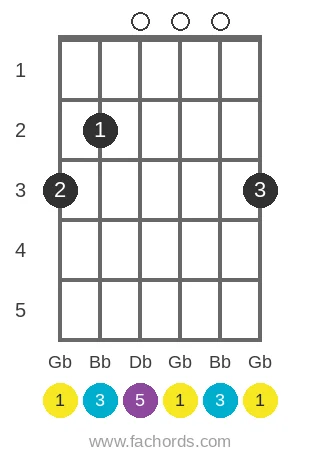
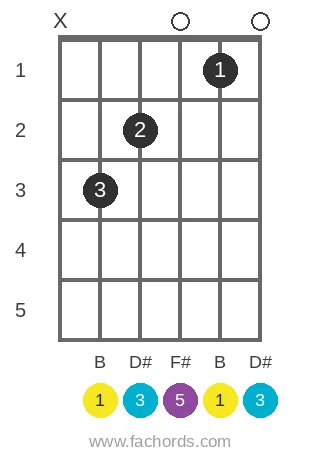
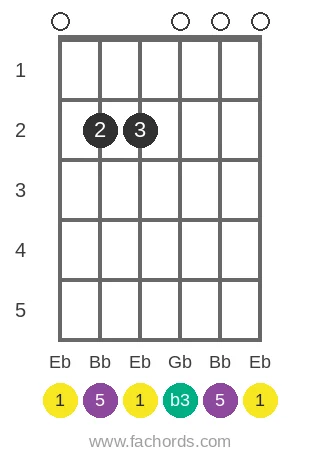
The half step down rule: play any shape you know, and it sounds one half step lower than its usual name. An E shape is an Eb chord, a G shape is a Gb chord, a C shape is a B chord.
The fingers are the same as always. Look at the note names under each diagram: those are the notes you actually hear in Eb tuning.
E shape = Eb
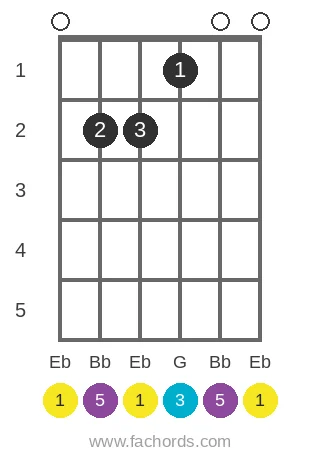
A shape = Ab
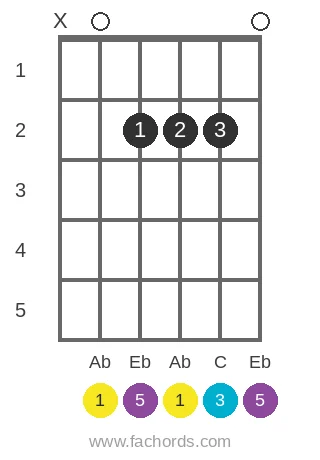
D shape = Db
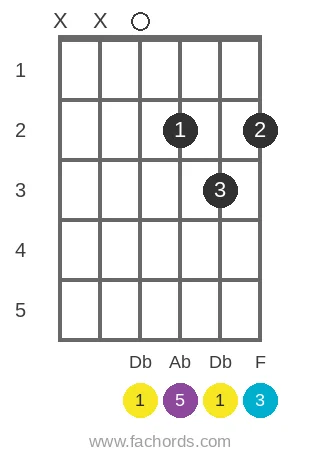
G shape = Gb
C shape = B
Em shape = Ebm
G - C - D - G shapes. You hear Gb - B - Db - Gb
Em - C - G - D shapes. You hear Ebm - B - Gb - Db
Shape to chord chart
Use this when you read a chord chart for a song recorded in Eb tuning, or when you jam with someone in standard and need to tell them what you're really playing.
| Shape you play | Frets (6th to 1st) | Chord you hear in Eb tuning |
|---|---|---|
| E | 0-2-2-1-0-0 | Eb |
| A | x-0-2-2-2-0 | Ab |
| D | x-x-0-2-3-2 | Db |
| G | 3-2-0-0-0-3 | Gb |
| C | x-3-2-0-1-0 | B |
| F (barre) | 1-3-3-2-1-1 | E |
| B (barre) | x-2-4-4-4-2 | Bb |
| Em | 0-2-2-0-0-0 | Ebm |
| Am | x-0-2-2-1-0 | Abm (also written G#m) |
| Dm | x-x-0-2-3-1 | Dbm (also written C#m) |
| Bm (barre) | x-2-4-4-3-2 | Bbm |
| E7 | 0-2-0-1-0-0 | Eb7 |
| A7 | x-0-2-0-2-0 | Ab7 |
| D7 | x-x-0-2-1-2 | Db7 |
| G7 | 3-2-0-0-0-1 | Gb7 |
| C7 | x-3-2-3-1-0 | B7 |
| B7 | x-2-1-2-0-2 | Bb7 |
The same goes for keys: a song you play "in E" comes out in Eb, "in A" comes out in Ab, "in G" comes out in Gb. Scales too: the E minor pentatonic box you know is now the Eb minor pentatonic scale. For any other chord, the chord library has the shape: look it up under its standard name and take a half step off.
Capo on the 1st Fret: Back to Standard Pitch
Put a capo on the 1st fret and every open string goes back up one half step: E A D G B E again. Your shapes sound with their usual names, so you can play with a guitarist in standard tuning without retuning.
A G shape without capo (Gb), then the same G shape with the capo on the 1st fret (G)
It doesn't work the other way: a capo can only raise the strings. If your guitar is in standard and the record is in Eb tuning, either tune down or play every chord a half step lower (a song with E shapes becomes Eb chords, with barre shapes). Our chord transposer moves a whole chord chart down a half step for you.
Why Guitarists Tune Down a Half Step
- Easier bends. Each string has a little less tension at the same gauge, so a full bend takes less effort. Many players use that to go up a string gauge and keep the same feel with a fatter tone.
- The singer's range. Moving the whole song down a half step takes the top notes a little lower. For a singer at the edge of their range, that can be the difference between a comfortable note and a strained one.
- A darker sound. The open strings ring lower and a bit looser, and the same riff sounds heavier. A lot of blues and hard rock is built on that sound.
- Playing along with the records. If a song was recorded in Eb tuning, tuning down lets you play it with the original fingerings and open strings, instead of barre chords everywhere.
Learning a solo off one of those records? Load it in our slow downer, slow it down without changing the pitch and loop the hard part, with your guitar already tuned down.
A Blues Shuffle in Half Step Down Tuning
This is the sound that made Eb tuning famous in blues. It's the classic boogie shuffle on the low strings, played with E, A and B shapes, so it sounds as a 12-bar blues in Eb: Eb, Ab and Bb. On the Eb and Ab bars the open string is the root, and the 2nd and 4th frets on the next string alternate the 5th and the 6th; on the Bb bars the root is the 2nd fret of the 5th string, with the 4th and 6th frets of the 4th string.
Eb shape (E):          Ab shape (A):          Bb shape (B):
E|------------------|  E|------------------|  E|------------------|
B|------------------|  B|------------------|  B|------------------|
G|------------------|  G|------------------|  G|------------------|
D|------------------|  D|-2-2-4-4-2-2-4-4--|  D|-4-4-6-6-4-4-6-6--|
A|-2-2-4-4-2-2-4-4--|  A|-0-0-0-0-0-0-0-0--|  A|-2-2-2-2-2-2-2-2--|
E|-0-0-0-0-0-0-0-0--|  E|------------------|  E|------------------|
(The tab uses the usual standard string names: in Eb tuning each string sounds a half step lower.)
| Eb | Eb | Eb | Eb |
| Ab | Ab | Eb | Eb |
| Bb | Ab | Eb | Bb |
The 12-bar shuffle, straight eighths, ending on an E7 shape (Eb7)
The audio plays straight eighths. To make it swing, play each pair long-short, like "dah-da dah-da".
A blues lick in Eb
Now a fill to drop between the shuffle bars. It runs down the open position E minor pentatonic box, which in this tuning sounds as Eb minor pentatonic (Eb Gb Ab Bb Db), and lands on the open low Eb.
E|---0-------------------------|
B|-3---3-0---------------------|
G|---------2-0-----------------|
D|-------------2-0-------------|
A|-----------------2-0---0-----|
E|---------------------3---0---|
The lick, down the Eb minor pentatonic box to the open 6th string
Once it feels easy, try bending the 3rd fret of the 2nd string up a whole step, to the pitch of the open 1st string: you'll notice how much less push it needs than in standard tuning.
Songs in Half Step Down Tuning
Jimi Hendrix often tuned down a half step, and so did Stevie Ray Vaughan, who counted Hendrix among his biggest influences. Eddie Van Halen and Slash used it on some of the best known hard rock records. Put on these records and play along:
| Song | Artist | What to listen for |
|---|---|---|
| Hey Joe | Jimi Hendrix | Open-position chord shapes that ring a half step low |
| Voodoo Child (Slight Return) | Jimi Hendrix | An E blues played with E shapes, heard in Eb |
| Pride and Joy | Stevie Ray Vaughan | A shuffle in E shapes, sounding in Eb, with heavy strings |
| Texas Flood | Stevie Ray Vaughan | A slow blues in G shapes, sounding in Gb |
| Eruption | Van Halen | The famous solo guitar piece, Frankenstrat tuned down a half step |
| Sweet Child o' Mine | Guns N' Roses | The intro riff: written around D, it sounds in Db |
| Welcome to the Jungle | Guns N' Roses | Hard rock riffing on the lowered strings |
Half Step Down vs D Standard, Drop D and Other Tunings
Tuning down comes in steps. Here is how Eb tuning relates to its neighbours:
| Tuning | Strings (6th to 1st) | What changes from standard |
|---|---|---|
| Standard | E A D G B E | |
| Half step down | Eb Ab Db Gb Bb Eb | All six strings down a half step: same shapes, everything a half step lower |
| D standard | D G C F A D | All six strings down a whole step: same shapes, everything a whole step lower |
| Drop D | D A D G B E | Only the 6th string, down a whole step |
| Drop Db | Db Ab Db Gb Bb Eb | Half step down, plus the 6th string one more whole step down |
| Open D | D A D F# A D | Four strings down: the open strings are a D major chord |
If you want to go one more step down, D standard tuning works the same way with everything a whole step lower. For a tuning that changes the shapes, try drop D or open D, and see the full tour in our list of alternate guitar tunings, from open G and open E to open C and DADGAD.
Conclusion
Half step down is the easiest alternate tuning to live with: six strings down one fret, and every shape you know still works. Here is the recap:
| Notes | Eb Ab Db Gb Bb Eb (Eb2 Ab2 Db3 Gb3 Bb3 Eb4), with sharps D# G# C# F# A# D# |
| From standard | Every string down a half step |
| Tune by ear | 6th string from a reference, then the usual 5th fret checks (4th fret on the 3rd string) |
| Chord rule | Same shapes, one half step lower: E shape = Eb, G shape = Gb, C shape = B |
| Back to standard pitch | Capo on the 1st fret |
| Best for | Blues and rock, easier bends, heavier strings, singers who need the song a little lower |
Your next step: tune down, play the shuffle until it grooves, then put on one of the songs above and play along with the record.
That's all for today.
Remember that you can subscribe here to stay updated on new tutorials and gain access to the free download area, where you'll find some free chords and scales PDFs.

Created by
Giancarlo is a musician (teaching guitar since 2000), software engineer, AI consultant and published researcher
FAQ
What is half step down tuning?
Half step down tuning is standard tuning with all six strings lowered one half step (one fret). The strings become Eb Ab Db Gb Bb Eb, low to high (Eb2 Ab2 Db3 Gb3 Bb3 Eb4). It is also called Eb tuning, E flat standard or Eb standard. With sharp names the same notes are D# G# C# F# A# D#.
Do chord shapes change in half step down tuning?
No. Every string moves by the same amount, so the distances between the strings are the same as in standard tuning and every chord shape, scale pattern and riff is played exactly as before. Everything simply sounds one half step lower: an E shape sounds Eb, an A shape sounds Ab, a G shape sounds Gb, a C shape sounds B.
How do you tune a guitar a half step down?
Lower each string by one half step: E to Eb, A to Ab, D to Db, G to Gb, B to Bb and the high E to Eb. Use a tuner or the reference tones on this page for the 6th string, then tune the others from it with the usual relative checks: 5th fret of the 6th string = open 5th string, and so on, with the 4th fret of the 3rd string for the open 2nd string.
Why do guitarists tune down a half step?
The most common reasons are: the strings have less tension, so bends are easier and players can use heavier strings with the same feel; the song moves a half step lower, which can suit a singer's range; and the guitar sounds a little darker and heavier. Many players also tune down to play along with records that were made in Eb tuning.
How do you get back to standard pitch from half step down tuning?
Put a capo on the 1st fret. With the capo every open string goes back up one half step, so the guitar sounds at standard pitch and every chord shape sounds with its usual name (a G shape is a G again). Without a capo, retune each string up one half step.
Is half step down tuning the same as Eb tuning and D# tuning?
Yes. Half step down, Eb tuning, E flat standard and D# standard are names for the same six notes: Eb Ab Db Gb Bb Eb, or D# G# C# F# A# D# written with sharps. Flats are the usual spelling because the tuning sits in a flat key family.
What songs are in half step down tuning?
Well known examples include Hey Joe and Voodoo Child (Slight Return) by Jimi Hendrix, Pride and Joy and Texas Flood by Stevie Ray Vaughan, Eruption by Van Halen, and Sweet Child o' Mine and Welcome to the Jungle by Guns N' Roses.
Is half step down tuning bad for the guitar?
No. All six strings go down, so the total tension on the neck drops a little. With light strings the guitar can feel slack and buzz more, which is why many players who stay in Eb tuning use a slightly heavier set. If you switch for good, a setup check (neck relief and intonation) keeps it playing well.