DADGAD Tuning for Guitar
How to Tune to D A D G A D, Why It Sounds Neither Major Nor Minor, and What to Play With It
Some tunings give you a chord. DADGAD gives you a mood. Strum the open strings and you don't hear D major or D minor, you hear something in between: open, a bit mysterious, a sound that seems to wait for a melody.
That's why Celtic guitarists, folk players and Jimmy Page all fell for it. The open strings ring like a harp, and almost anything you play in D sounds good over them.
Here you'll tune up with a reference tone for each string, find out why DADGAD is not a major chord, and then play the shapes you need: D, Dm, G and A, with diagrams drawn for this tuning and audio for every example.
DADGAD tuning in one sentence: the six strings are tuned to D A D G A D (low to high), the notes D, G and A, so the open strings sound a Dsus4 chord: no 3rd, neither major nor minor.
From standard tuning: lower the 6th, 2nd and 1st strings a whole step (E to D, B to A, E to D). The 5th, 4th and 3rd strings stay where they are.
DADGAD Tuning Notes
Here is the fretboard in DADGAD. The open strings are on the left: D, A, D, G, A, D.
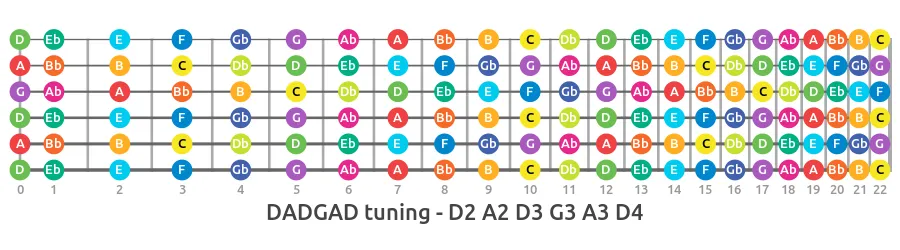
Three strings are D, two are A and one is G. In chord terms: three roots, two 5ths and one 4th, on the 3rd string. There is no 3rd anywhere, and the 3rd is the note that tells your ear major or minor. Keep the 3rd string in mind: it's the string you'll change most to get other chords.
The six open strings, low to high, then strummed together (Dsus4)
How to Tune Your Guitar to DADGAD
Starting from standard tuning, you change three strings, and all three go down a whole step. Play each reference tone and match your string to it, or use a tuner and check the note names in the table.
| String | Standard | DADGAD | What to do | Check without a tuner | Reference tone |
|---|---|---|---|---|---|
| 6th | E | D (D2, 73.42 Hz) | Down a whole step | One octave below the open 4th string. Its 7th fret matches the open 5th string | |
| 5th | A | A (A2, 110 Hz) | Leave it | ||
| 4th | D | D (D3, 146.83 Hz) | Leave it | ||
| 3rd | G | G (G3, 196 Hz) | Leave it | Same note as the 5th fret of the 4th string | |
| 2nd | B | A (A3, 220 Hz) | Down a whole step | Same note as the 2nd fret of the 3rd string, one octave above the open 5th string | |
| 1st | E | D (D4, 293.66 Hz) | Down a whole step | Same note as the 5th fret of the retuned 2nd string, one octave above the open 4th string |
A few practical tips:
- Half of the guitar doesn't move. The 5th, 4th and 3rd strings stay in standard tuning. Use them as anchors: every retuned string is an octave of one of them.
- Coming from drop D? You're already halfway there. Drop D is D A D G B E: lower the 2nd and 1st strings a whole step and you're in DADGAD.
- Go around twice. Lowering three strings takes tension off the neck, and the first strings drift a little. Check all six again at the end.
- Is it safe for the guitar? Yes. Every change goes down, so there is less tension than in standard tuning, not more. The low D may feel loose with a very light set of strings, that's all.
If you want the numbers behind those pitches, they're in our note frequencies chart.
The Open DADGAD Chord: Dsus4, Not Major, Not Minor
A sus4 chord replaces the 3rd with the 4th: D, G and A instead of D, F# and A. Since the 3rd is missing, your ear can't decide between major and minor, and the chord sounds suspended, as the name says. In DADGAD that suspended chord is the whole open guitar.
Dsus4 (open)

The classic DADGAD move is to rock between the open chord and D5: one finger on the 2nd fret of the 3rd string turns the G into A, and the suspension resolves. Strum it, or hammer the finger on and pull it off:
Dsus4 (open) - D5 - Dsus4 - D5
This ambiguity is the reason DADGAD is so popular. A chord without a 3rd sits happily under a major melody and under a minor one. The open strings become a drone you can leave ringing under almost anything in D, and you decide the color with the notes you fret.
D Major and D Minor in DADGAD
To get a real D major chord you need F#, the major 3rd. The obvious idea is to lower the G on the 3rd string by a half step, but you can't fret a string lower than its open note. There are two ways out:
- Take the F# from the 4th string (4th fret) and move the 3rd string up to A (2nd fret). That's the shape everybody uses.
- Go up the 3rd string to the 11th fret, the F# one octave higher. It works, but it's far away from everything else.
D

Dm

Dsus2

- D (0-0-4-2-0-0): F# on the 4th string, A on the 3rd string. The notes are D A F# A A D: a full D major chord with open strings above and below.
- Dm (0-0-3-2-0-0): same shape, the 4th string finger moves one fret down to F, the minor 3rd. One fret is all that separates major from minor here.
- Dsus2 (0-0-2-2-0-0): the 4th string on the 2nd fret is E, the 2nd. Another chord with no 3rd, a bit brighter than the open Dsus4.
D5

And D5 (0-0-0-2-0-0), only roots and 5ths: D A D A A D. It's the "power chord" of DADGAD, and the safest chord to strum when you're not sure whether the song is major or minor.
Dsus4 - D - Dm - Dsus2 - D5, one strum each
G and A Chord Shapes in DADGAD
D, G and A are the I, IV and V of the key of D, the three chords you need for most folk songs. In DADGAD the open D strings keep ringing inside the G and A shapes too.
G

Gsus2

A

Asus4

- G (5-5-0-0-2-0): G and D on the 5th fret of the two low strings, B on the 2nd fret of the 2nd string. The notes are G D D G B D, a full G major.
- Gsus2 (5-5-0-0-0-0): lift the finger from the 2nd string and the B becomes A. Fun fact: G, A and D are the same three notes as the open Dsus4, just with G in the bass.
- A (x-0-2-2-4-x): E and A on the 2nd fret of the 4th and 3rd strings, C# on the 4th fret of the 2nd string. Mute the 6th and 1st strings: both are D, which doesn't belong to the A major chord.
- Asus4 (x-0-2-2-0-0): let the 2nd and 1st strings ring open and the D on top turns A into Asus4. Going from Asus4 to A is the same suspension and release you played on D.
G - Gsus2 - A - Asus4, one strum each
A D-G-A progression in DADGAD
Put the major shapes together. This is the three-chord progression in D, with the open strings filling every chord:
| D (0-0-4-2-0-0) | G (5-5-0-0-2-0) | A (x-0-2-2-4-x) | D (0-0-4-2-0-0) |
D - G - A - D
Now the same idea, DADGAD style. The C chord (x-3-2-0-3-0) gets the open D on top for free, so it becomes Cadd9, and the progression ends on the open strings instead of D major. C natural is the b7 of D, the note of D Mixolydian, a mode you hear all over Celtic music:
Cadd9

D5 - Cadd9 - G - Dsus4 (open)
DADGAD chord chart
All the shapes of this lesson in one table. Frets are written from the 6th string to the 1st, x is a muted string.
| Chord | Frets (6th to 1st string) | Notes (low to high) | What it does |
|---|---|---|---|
| Dsus4 | 0-0-0-0-0-0 | D A D G A D | The open tuning: no 3rd |
| D5 | 0-0-0-2-0-0 | D A D A A D | Roots and 5ths only |
| D | 0-0-4-2-0-0 | D A F# A A D | D major |
| Dm | 0-0-3-2-0-0 | D A F A A D | D minor: 4th string one fret lower |
| Dsus2 | 0-0-2-2-0-0 | D A E A A D | No 3rd, 2nd instead of 4th |
| G | 5-5-0-0-2-0 | G D D G B D | G major |
| Gsus2 | 5-5-0-0-0-0 | G D D G A D | Same notes as Dsus4, G in the bass |
| A | x-0-2-2-4-x | A E A C# | A major |
| Asus4 | x-0-2-2-0-0 | A E A A D | Resolves to A |
| Cadd9 | x-3-2-0-3-0 | C E G C D | The bVII chord of D Mixolydian |
The full set of chords in the key of D works in DADGAD too: look for shapes that keep the open D and A strings ringing, and let them add their color.
A Celtic-Style Drone Melody on the Top Strings
The other DADGAD sound is a melody on the high strings over open bass strings that never stop. Here is a short air in D Mixolydian. Your thumb plays the open 6th and 4th strings, the melody moves on the 1st and 2nd strings:
D |--0---2-4---5-------7---|--5-------4-2-----------0---|------------0-------------------|--0-------0-------|
A |------------------------|----------------3-----------|--3---------5---3-2-0-----------|--5-------0-------|
G |------------------------|----------------------------|--------------------------------|----------0-------|
D |------------------------|--0-------------------------|--------------------------------|----------0-------|
A |------------------------|----------------------------|--------------------------------|------------------|
D |--0---------------------|----------------------------|--0-----------------------------|--0---------------|
Short air in D Mixolydian over the open D strings, ending on the open Dsus4
Two DADGAD tricks are hiding in there. In bar 3, the 5th fret of the 2nd string is a D, the same note as the open 1st string: play them together and they ring as one fat, shimmering note. And bar 2 uses C natural (3rd fret of the 2nd string), the flat 7th that makes the tune sound Irish rather than "major scale". Change the order of the notes, add hammer-ons and slides, and you're improvising in DADGAD.
Songs in DADGAD Tuning
The British folk guitarist Davy Graham (later spelled Davey) is the player usually credited with DADGAD. He popularised it in the early 1960s, and the story most sources tell is that he developed it while travelling in Morocco, to play along with the oud music he heard there. From the British folk scene it moved to Irish traditional music, to rock through Jimmy Page, and to modern fingerstyle players. The French guitarist Pierre Bensusan even published a whole book of his DADGAD compositions.
| Song | Artist | What to listen for |
|---|---|---|
| She Moved Through the Fair | Davy Graham | His arrangement of the traditional Irish air, the classic early DADGAD recording |
| White Summer | The Yardbirds (Jimmy Page) | Page's acoustic instrumental from Little Games (1967), with droning open strings |
| Black Mountain Side | Led Zeppelin | Folk-style fingerpicking over the open D strings, based on the traditional Blackwaterside |
| Kashmir | Led Zeppelin | The famous riff climbs over the open D drone |
| Out on the Western Plain | Rory Gallagher | His acoustic version of the Lead Belly song; Gallagher named DADGAD as one of his favorite tunings |
| Drifting | Andy McKee | Modern percussive fingerstyle on an acoustic, with ringing open strings |
DADGAD vs Open D, Drop D, Open G and Other Tunings
Is open D the same as DADGAD? No, and this is where they get mixed up most often. Here is how DADGAD relates to its neighbors:
| Tuning | Strings (6th to 1st) | Open strings sound | Compared with DADGAD |
|---|---|---|---|
| DADGAD | D A D G A D | Dsus4 | |
| Open D | D A D F# A D | D major | One string differs: the 3rd string is F# instead of G |
| Drop D | D A D G B E | Not a chord | The four low strings are the same. DADGAD also lowers the 2nd and 1st strings |
| D standard | D G C F A D | Not a chord | Every string a whole step below standard: the 6th, 2nd and 1st strings match DADGAD, the middle three are a whole step lower |
| Open G | D G D G B D | G major | Different layout, with the root on the 5th string |
Moving between open D and DADGAD takes a second: tune the 3rd string up a half step (F# to G) and you're in DADGAD, down a half step and you're back in open D. Want the sound in another key? A capo keeps all the shapes of this page: on the 2nd fret, DADGAD becomes Esus4 and the D shape becomes E. For more tunings, including open E, open C and half step down, see our list of alternate guitar tunings.
Conclusion
DADGAD is the tuning of open questions: the guitar plays a chord that is neither major nor minor, and every note you fret gives the answer. Here is the recap:
| Notes | D A D G A D (D2 A2 D3 G3 A3 D4) |
| From standard | 6th, 2nd and 1st strings down a whole step, the others unchanged |
| Open strings | Dsus4 (D, G, A): no 3rd |
| D and Dm | D = 0-0-4-2-0-0, Dm = 0-0-3-2-0-0, D5 = 0-0-0-2-0-0 |
| G and A | G = 5-5-0-0-2-0, A = x-0-2-2-4-x |
| Best for | Celtic and folk fingerstyle, drones, modal melodies, ringing acoustic accompaniment |
Your next step: tune down three strings, rock between Dsus4 and D5 for a minute, then play the drone melody slowly and let every note ring. You'll hear why so many players never tuned back.
That's all for today.
Remember that you can subscribe here to stay updated on new tutorials and gain access to the free download area, where you'll find some free chords and scales PDFs.

Created by
Giancarlo is a musician (teaching guitar since 2000), software engineer, AI consultant and published researcher
FAQ
What are the notes of DADGAD tuning?
DADGAD tuning is D A D G A D, from the 6th (lowest) string to the 1st. With octaves: D2, A2, D3, G3, A3, D4. The open strings contain only three notes, D, G and A, which form a Dsus4 chord: there is no 3rd, so the open guitar sounds neither major nor minor.
How do you tune a guitar to DADGAD from standard tuning?
Three strings go down a whole step and three stay where they are. Lower the 6th string from E to D, the 2nd string from B to A and the 1st string from E to D. The 5th (A), 4th (D) and 3rd (G) strings do not change. Every change lowers the pitch, so the tension on the neck goes down.
Is open D DADGAD?
No. Open D is D A D F# A D and DADGAD is D A D G A D: they differ by one string, the 3rd, which is F# in open D and G in DADGAD. That half step turns the open chord from D major (open D) into Dsus4 (DADGAD). Five strings are the same, so going from one to the other takes a few seconds.
How do you play a D major chord in DADGAD?
The open 3rd string is G, and you cannot fret a string lower than its open note, so the F# must come from another string. The most common shape is 0-0-4-2-0-0: the 4th fret of the 4th string gives F#, and the 2nd fret of the 3rd string turns the G into A. For D minor, move the 4th string finger down to the 3rd fret: 0-0-3-2-0-0.
What popular songs are in DADGAD?
Well-known examples are Kashmir and Black Mountain Side by Led Zeppelin, White Summer by Jimmy Page with the Yardbirds, She Moved Through the Fair as arranged by Davy Graham, Out on the Western Plain by Rory Gallagher and Drifting by Andy McKee.
Who invented DADGAD tuning?
The British folk guitarist Davy (later Davey) Graham is the player usually credited with it: he popularised the tuning in the early 1960s, and the usual story is that he developed it while travelling in Morocco, to play along with the oud music he heard there. His arrangement of She Moved Through the Fair is the classic early example.
Why is DADGAD so popular?
Because the open strings have no 3rd. A Dsus4 chord works under both major and minor melodies, so the same open strings can drone under almost anything in D. Three strings are D and two are A, so the guitar rings like a harp, which is why Celtic and folk guitarists adopted it, and fingerstyle players after them.