A11 Guitar Chord | Play, Hear and Practice Interactively
Want a structured chord roadmap instead of jumping between pages?
Go to the full guitar chords tutorial.
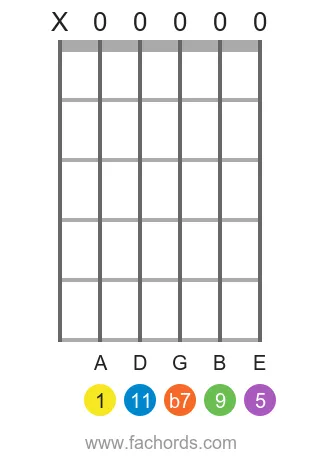
The A11 chord, a complex chord belonging to the Dominant Chords family, is composed of the notes A, C#, E, G, B, and D, representing the intervals Root (1), Major Third (3), Perfect Fifth (5), Minor Seventh (b7), Major Ninth (9), and Perfect Eleventh (11). Use the interactive fretboard tool at the top of this page to visualize every fingering, listen to the chord played as a strum or arpeggio, and check your own playing with the real-time microphone feedback to ensure perfect execution.
This advanced dominant chord adds harmonic richness, often found in jazz, blues, and funk. Understanding its extensive construction is key to mastering its sound; our Chord Construction guide can provide a deeper dive. As an extension of the dominant 7th and 9th chords, exploring its roots in the Dominant Chord family and Ninth Chords will clarify its unique qualities. Once you grasp its theory, practice smooth transitions using our tips to improve chord changes.
Scrolling further down, you'll discover multiple A11 chord diagrams, presented from the simplest open positions to more advanced movable shapes, alongside detailed music theory explanations, popular songs featuring this chord, and the key contexts where it naturally appears. Before exploring these static resources, take a moment to engage with the interactive tool above. Use the drum and BPM tool to set your tempo, play the chord, and let the mic feedback guide your technique. This direct, hands-on approach is the most effective way to internalize new chords like the A11.
Notes of the A 11 chord:
Chord structure of the Dominant Eleventh chord:
Guitar Patterns for the A Dominant Eleventh chord
Position 1
Open
Position 2
Barre
Open
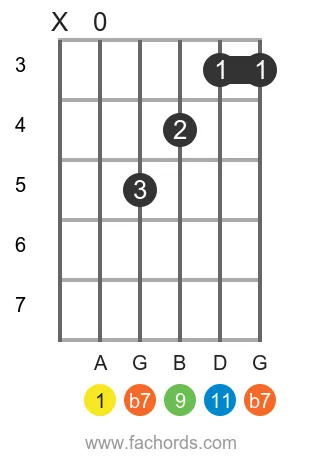
Position 3
Barre
Open
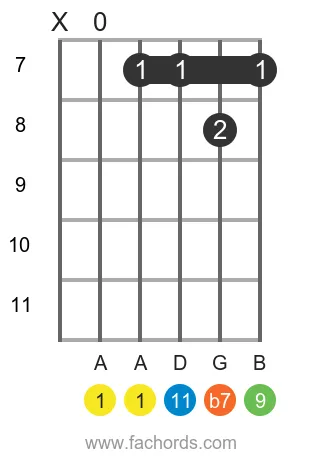
 Find more shapes in our all guitar chords online library. If you
prefer a printable pdf, download
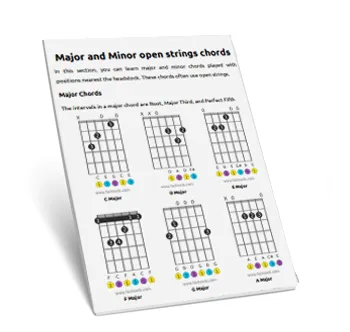
the Free Guitar Chords Chart Pdf
Find more shapes in our all guitar chords online library. If you
prefer a printable pdf, download
the Free Guitar Chords Chart Pdf
You can also use this accessible A11 chord page, with written diagram instructions and screen-reader support for blind users.
FAQ
What specific notes are included in the A11 guitar chord?
The A11 chord is built from six distinct notes: A, C#, E, G, B, and D. These notes are derived by extending the basic A major triad with additional intervals.
What do the intervals 1, 3, 5, b7, 9, and 11 represent for the A11 chord?
These numbers describe the harmonic structure of the A11 chord relative to its root note (A). They represent the root (A), major third (C#), perfect fifth (E), minor seventh (G), major ninth (B), and perfect eleventh (D), respectively.
Why is the A11 chord categorized as a 'dominant chord'?
The A11 chord belongs to the dominant chord family because it contains a minor seventh interval (G, relative to the root A). This characteristic minor seventh gives dominant chords their unique, often tension-creating sound, commonly utilized in jazz and blues.
What contributes to the unique and complex sound of the A11 chord?
The A11 chord's distinct and complex sound arises from the combination of its specific intervals, particularly the inclusion of the minor seventh (b7), major ninth (9), and perfect eleventh (11). These extensions add richness and harmonic depth beyond a basic triad.
Is the A11 chord generally difficult for guitarists to play?
Learning to play the A11 chord can present a challenge due to the requirement of accurately fretting six different notes. However, with dedicated practice and the aid of chord diagrams and fretboard patterns, guitarists can successfully master it.