Master the C# aug Guitar Chord with Interactive Practice
Looking for C augmented, one fret lower? Visit Caug.
Spelled C#, E# and G##, C#aug is the C# augmented chord, with the root, major third and raised fifth above its root. All 3 voicings are fretted and none rings an open string; one is a barre shape.
Every interval between neighbouring notes is a major third, which is why the chord sounds symmetrical. For lead lines, reach for the C# whole-tone scale: it holds each note of the chord, so every chord tone is available. E# and G## are unusual spellings, which is why the same sound is also written Dbaug.
The player at the top adds a drum loop with a tempo you set, which is a simple way to play along and rehearse chord changes.
C# augmented guitar chord is also written as C#aug, C#+, C#(#5) or C#maj(#5).
C#aug Chord Notes and Formula
Notes of the C# aug chord:
Chord Structure:
Formula: 1 3 #5
Same chord, different name: C#aug is also written as Dbaug (Db augmented).
C#aug Chord Interactive Fretboard
Want a structured chord roadmap instead of jumping between pages?
Go to the full guitar chords tutorial.
C#aug Guitar Chord Diagrams
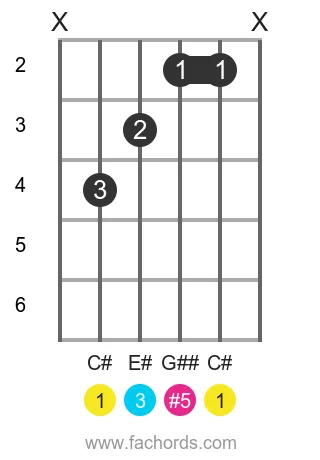
Position 1 Barre Movable
C# Augmented Finger Positions
- Mute the low E string
- Mute the high E string
- Place your index finger (1) on the fret 2 of the G and B strings at the same time
- Place your middle finger (2) on the fret 3 of the D string
- Place your ring finger (3) on the fret 4 of the A string
Position 2 Movable
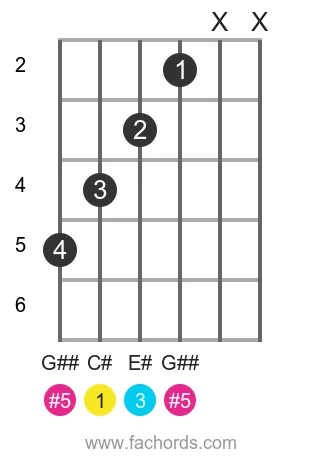
C# Augmented Finger Positions
- Mute the B string
- Mute the high E string
- Place your index finger (1) on the fret 2 of the G string
- Place your middle finger (2) on the fret 3 of the D string
- Place your ring finger (3) on the fret 4 of the A string
- Place your pinky finger (4) on the fret 5 of the low E string
Position 3 Movable
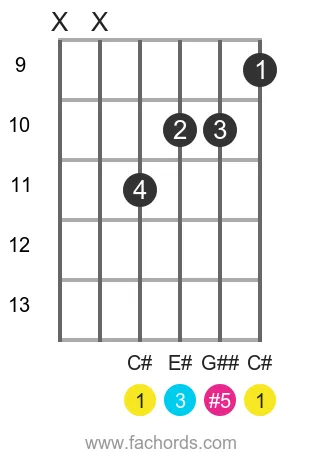
C# Augmented Finger Positions
- Mute the low E string
- Mute the A string
- Place your index finger (1) on the fret 9 of the high E string
- Place your middle finger (2) on the fret 10 of the G string
- Place your ring finger (3) on the fret 10 of the B string
- Place your pinky finger (4) on the fret 11 of the D string
 Find more shapes in our all guitar chords online library. If you
prefer a printable pdf, download
the Free Guitar Chords Chart Pdf
More C# Chords
Want to know how this chord is built? Read chord symbols and intervals, or browse all C# guitar chords.

Created by
Giancarlo is a musician (teaching guitar since 2000), software engineer, AI consultant and published researcher
FAQ
What notes make up C#aug?
C#aug contains C#, E# and G##. These are the root, a major third and a raised fifth. E# sounds like F and G## sounds like A.
Why does the C# augmented chord include E# and G##?
The notes follow the letters C, E, G. A major third from C# lands on E#, and the raised fifth lands on G##. They are the same pitches as F and A.
How is C#aug different from a C# major triad?
A C# major triad has G#. C#aug raises that note by a semitone, so the fifth becomes G##. The major third E# is shared, and the stack becomes two equal major thirds.
Which scale fits C# augmented?
The C# whole-tone scale, C#, D#, E#, F##, G##, B, includes every chord tone. It is a quick source of notes that agree with C#aug.
How many C#aug voicings are there?
There are 3 voicings, 1 of them with a barre and none with an open string. The lowest is at fret 2 and the highest at fret 11.