Practice the D 13 Guitar Chord: Real-Time Feedback and Tools
Want a structured chord roadmap instead of jumping between pages?
Go to the full guitar chords tutorial.
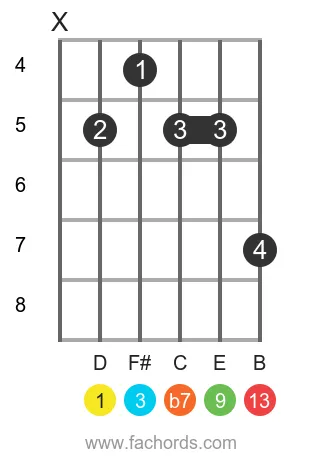
Struggling to nail advanced chords like the D 13 guitar chord? Our interactive fretboard tool provides instant gratification: play the chord and get immediate feedback on your accuracy via your microphone. This complex Dominant Chord, built from the notes D, F#, A, C, E, G, and B, utilizes the intervals 1, 3, 5, b7, 9, 11, and 13. Test your playing and explore its unique sound with real-time feedback and adjustable playback.
As an extended Dominant Chord, the D 13 brings a rich, tension-filled sound, often heard in genres like jazz and blues, driving harmonic movement towards resolution. Its construction involves adding specific intervals beyond a standard dominant seventh, such as the major thirteenth. If you're keen to understand how notes and intervals stack up to build complex harmonies, our Chord Construction guide provides a solid foundation. Expanding your chord vocabulary with the D 13 chord is a significant step; you might also explore related harmonies like Ninth Chords or 6th Chords to further enrich your musical palette.
Dive deeper into the D 13 chord by exploring our comprehensive diagrams, arranged from easiest to hardest, which visually represent the notes across the fretboard. Learn the underlying theory and discover how this chord fits into various songs and musical keys. Before diving into static charts, we encourage you to use the interactive tool above to test your playing skills and truly internalize the chord's feel and sound. Challenge yourself, practice diligently, and listen to the distinct character this chord adds to your playing!
D dominant 13th guitar chord is also written as D13, Ddom13 or D7(13).
Notes that compose the D 13 chord:
Tones of the Dominant Thirteen chord:
D 13 Guitar Chord Diagrams
Position 1 Movable
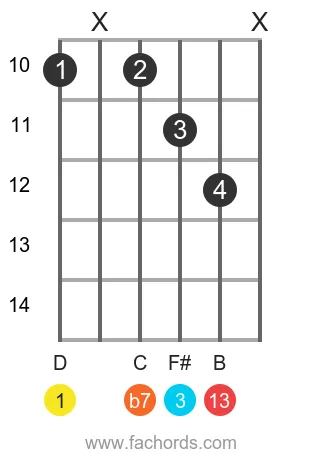
Finger Positions
- Mute the A string
- Mute the high E string
- Place your index finger (1) on the fret 10 of the low E string
- Place your middle finger (2) on the fret 10 of the D string
- Place your ring finger (3) on the fret 11 of the G string
- Place your pinky finger (4) on the fret 12 of the B string
Position 2 Movable
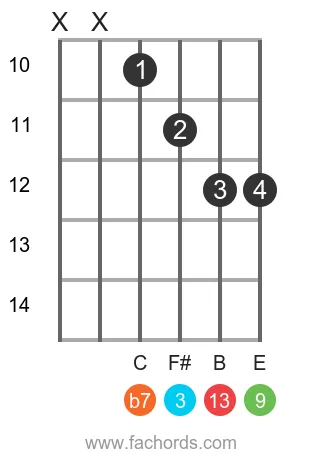
Finger Positions
- Mute the low E string
- Mute the A string
- Place your index finger (1) on the fret 10 of the D string
- Place your middle finger (2) on the fret 11 of the G string
- Place your ring finger (3) on the fret 12 of the B string
- Place your pinky finger (4) on the fret 12 of the high E string
Position 3 Open
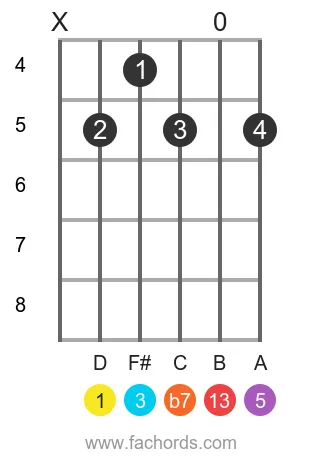
Finger Positions
- Mute the low E string
- Let the B string play without pressing any fret
- Place your index finger (1) on the fret 4 of the D string
- Place your middle finger (2) on the fret 5 of the A string
- Place your ring finger (3) on the fret 5 of the G string
- Place your pinky finger (4) on the fret 5 of the high E string
Position 4 Barre Movable
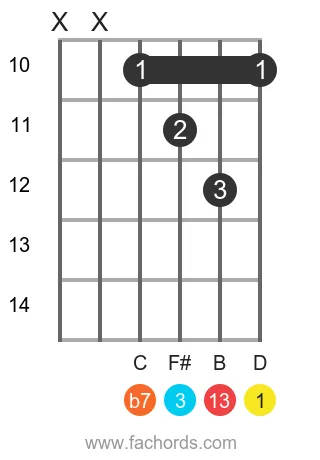
Finger Positions
- Mute the low E string
- Mute the A string
- Place your index finger (1) on the fret 10 of the D and high E strings at the same time
- Place your middle finger (2) on the fret 11 of the G string
- Place your ring finger (3) on the fret 12 of the B string
Position 5 Barre Movable
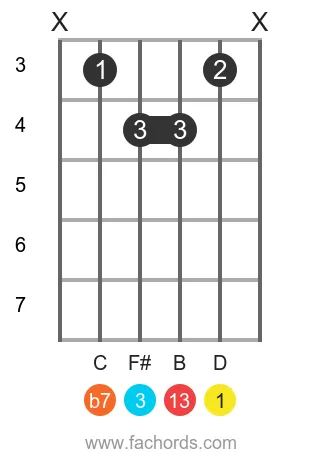
Finger Positions
- Mute the low E string
- Mute the high E string
- Place your index finger (1) on the fret 3 of the A string
- Place your middle finger (2) on the fret 3 of the B string
- Place your ring finger (3) on the fret 4 of the D and G strings at the same time
Position 6 Barre Movable
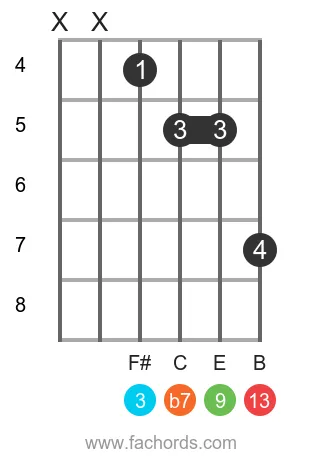
Finger Positions
- Mute the low E string
- Mute the A string
- Place your index finger (1) on the fret 4 of the D string
- Place your ring finger (3) on the fret 5 of the G and B strings at the same time
- Place your pinky finger (4) on the fret 7 of the high E string
Position 7 Barre Movable
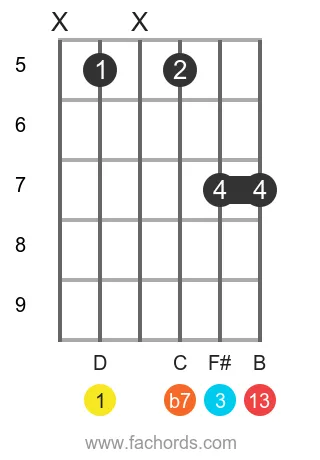
Finger Positions
- Mute the low E string
- Mute the D string
- Place your index finger (1) on the fret 5 of the A string
- Place your middle finger (2) on the fret 5 of the G string
- Place your pinky finger (4) on the fret 7 of the B and high E strings at the same time
Position 8 Barre Open
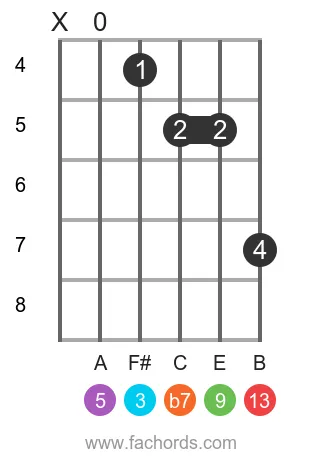
Finger Positions
- Mute the low E string
- Let the A string play without pressing any fret
- Place your index finger (1) on the fret 4 of the D string
- Place your middle finger (2) on the fret 5 of the G and B strings at the same time
- Place your pinky finger (4) on the fret 7 of the high E string
Position 9 Barre Movable
Finger Positions
- Mute the low E string
- Place your index finger (1) on the fret 4 of the D string
- Place your middle finger (2) on the fret 5 of the A string
- Place your ring finger (3) on the fret 5 of the G and B strings at the same time
- Place your pinky finger (4) on the fret 7 of the high E string
Position 10 Barre Movable
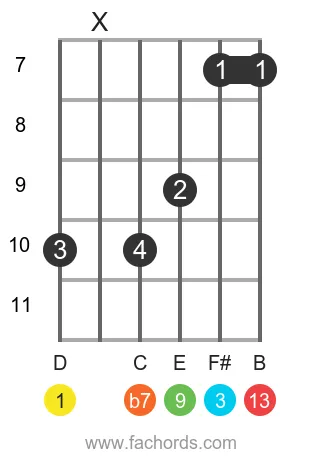
Finger Positions
- Mute the A string
- Place your index finger (1) on the fret 7 of the B and high E strings at the same time
- Place your middle finger (2) on the fret 9 of the G string
- Place your ring finger (3) on the fret 10 of the low E string
- Place your pinky finger (4) on the fret 10 of the D string
Position 11 Barre Movable
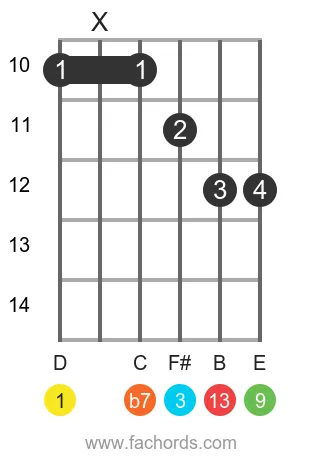
Finger Positions
- Mute the A string
- Place your index finger (1) on the fret 10 of the low E and D strings at the same time
- Place your middle finger (2) on the fret 11 of the G string
- Place your ring finger (3) on the fret 12 of the B string
- Place your pinky finger (4) on the fret 12 of the high E string
Position 12 Barre Movable
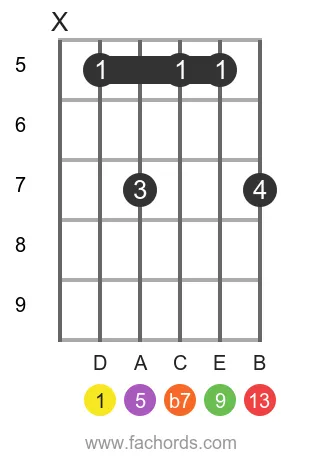
Finger Positions
- Mute the low E string
- Place your index finger (1) on the fret 5 of the A, G and B strings at the same time
- Place your ring finger (3) on the fret 7 of the D string
- Place your pinky finger (4) on the fret 7 of the high E string
Position 13 Barre Movable
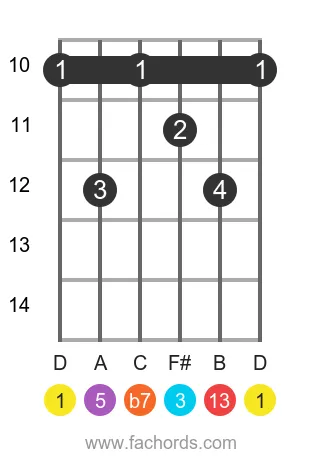
Finger Positions
- Place your index finger (1) on the fret 10 of the low E, D and high E strings at the same time
- Place your middle finger (2) on the fret 11 of the G string
- Place your ring finger (3) on the fret 12 of the A string
- Place your pinky finger (4) on the fret 12 of the B string
 Find more shapes in our all guitar chords online library. If you
prefer a printable pdf, download
the Free Guitar Chords Chart Pdf
Find more shapes in our all guitar chords online library. If you
prefer a printable pdf, download
the Free Guitar Chords Chart Pdf

Created by
Giancarlo is a musician (teaching guitar since 2000), software engineer, AI consultant and published researcher
FAQ
What are the specific notes and intervals that make up a D 13 guitar chord?
The D 13 chord is built on the root note D and includes seven distinct notes: D, F#, A, C, E, G, and B. These correspond to the intervals of Root (1), Major Third (3), Perfect Fifth (5), Minor Seventh (b7), Major Ninth (9), Perfect Eleventh (11), and Major Thirteenth (13) respectively.
Why is the D 13 chord considered a 'dominant chord' and what does '13' signify?
The D 13 chord is part of the Dominant Chord family primarily because it includes a minor seventh (b7) interval (C in the key of D), which creates a characteristic tension. The '13' signifies that the chord includes extensions up to the Major Thirteenth interval (B), along with the Major Ninth (E) and Perfect Eleventh (G), making it a rich and complex voicing beyond a standard dominant seventh.
How does the D 13 chord achieve its 'tension-filled sound'?
The tension in a D 13 chord comes from the combination of its specific intervals, particularly the minor seventh (b7) and the extended tones like the ninth, eleventh, and thirteenth. These intervals, especially when voiced together, create harmonic clashes or 'dissonances' that contribute to its characteristic tension and desire to resolve.
Does a D 13 chord always require playing all seven of its notes on the guitar?
While the D 13 chord is theoretically composed of seven distinct notes, it is often impractical or impossible to play all of them simultaneously on the guitar. Guitarists frequently omit certain notes (like the 5th or 11th) while ensuring the crucial defining intervals (Root, 3rd, b7th, 13th, and often the 9th) are present to retain the chord's essential quality and sound.
In what musical genres or contexts is the D 13 chord typically used?
The D 13 chord is a sophisticated voicing often found in genres that utilize advanced harmonies, such as jazz and blues. Its rich and tension-filled sound makes it suitable for creating complex harmonic progressions, particularly as a dominant chord leading to a resolution, or for adding color and depth to a chord progression.
What is the key difference between a D 13 chord and simpler dominant chords like a D7?
The primary difference lies in the added extended intervals. A D7 chord includes the Root, Major Third, Perfect Fifth, and Minor Seventh (D, F#, A, C). A D 13 chord builds upon this by adding the Major Ninth (E), Perfect Eleventh (G), and Major Thirteenth (B). These additional notes significantly enhance the chord's richness, complexity, and harmonic tension, offering a much fuller sound than a D7.