E13(#9) Guitar Chord | How To Create and Play the E Dominant Thirteen Sharp Ninth chord
Built on E, the E13(#9) chord (E thirteenth sharp nine) combines a root, a major third, a perfect fifth, a minor seventh, a sharp ninth, an eleventh and a thirteenth, which gives E, G#, B, D, F##, A and C#.
The F## is the raised ninth and sounds like G, a minor third above the root. Try the E Half-Whole scale next: it alternates half and whole steps and contains every chord tone except the eleventh A.
As a dominant chord it usually resolves to the chord a fourth above E, which is A. The minor seventh D and the major third G# form its tritone.
E 13th with sharp 9th guitar chord is also written as E13(#9), E13#9 or E13+9.
E13(#9) Chord Notes and Formula
E 13(#9) chord Notes:
Tones of the Dominant Thirteen Sharp Ninth chord:
Formula: 1 3 5 b7 #9 11 13
E13(#9) Chord Interactive Fretboard
Want a structured chord roadmap instead of jumping between pages?
Go to the full guitar chords tutorial.
E13(#9) Guitar Chord Diagrams
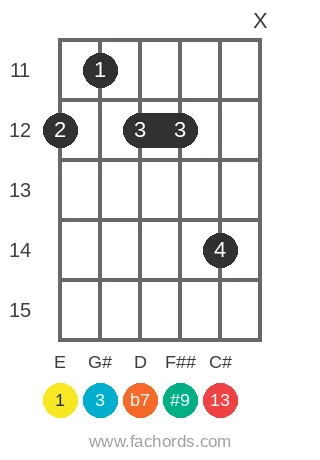
Position 1 Barre Movable
E Thirteenth Sharp Nine Finger Positions
- Mute the high E string
- Place your index finger (1) on the fret 11 of the A string
- Place your middle finger (2) on the fret 12 of the low E string
- Place your ring finger (3) on the fret 12 of the D and G strings at the same time
- Place your pinky finger (4) on the fret 14 of the B string
Position 2 Movable Slash Chord
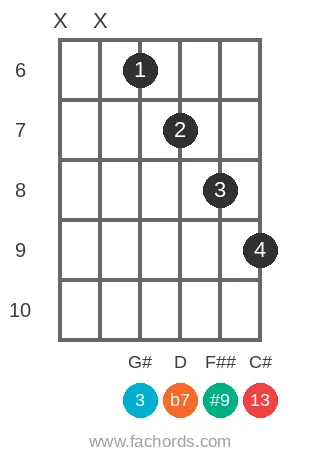
E/G# Thirteenth Sharp Nine Finger Positions
- Mute the low E string
- Mute the A string
- Place your index finger (1) on the fret 6 of the D string
- Place your middle finger (2) on the fret 7 of the G string
- Place your ring finger (3) on the fret 8 of the B string
- Place your pinky finger (4) on the fret 9 of the high E string
The lowest note is G#, not the root, so this voicing is the slash chord E13(#9)/G#.
 Find more shapes in our all guitar chords online library. If you
prefer a printable pdf, download
the Free Guitar Chords Chart Pdf
Chords That Go With E13(#9)
One key where E13(#9) fits is A major, where it works as the V chord, an altered chord whose F## is borrowed from outside the key. These are the main chords of that key, the ones you will often hear around it:
See every key in the guitar keys chart, or build a progression with these chords in the chord progression generator.
More E Chords
Want to know how this chord is built? Read dominant chords explained, or browse all E guitar chords.

Created by
Giancarlo is a musician (teaching guitar since 2000), software engineer, AI consultant and published researcher
FAQ
What notes are in E13(#9)?
E13(#9) is spelled E, G#, B, D, F##, A and C#. It stacks a major third, perfect fifth, minor seventh, sharp ninth, eleventh and thirteenth on E.
Which scale fits E13(#9)?
The E half-whole scale covers every chord tone except the eleventh, A. It includes the sharp ninth, F##, and the thirteenth, C#.
Why does E13(#9) use F## rather than G?
Counting letters up from E, the ninth falls on F. The major ninth is F#, so the sharp ninth is F##, which sounds like G.
What kind of chord is E13(#9)?
It is a dominant chord, with a major third, G#, and a minor seventh, D. The sharp ninth and the thirteenth extend it, and it is often heard in jazz.