G#13(#9) Guitar Chord Chart and Fingering
What does the (#9) in G#13(#9) (G# thirteenth sharp nine) change? It raises the ninth to A##, so the notes are G#, B#, D#, F#, A##, C# and E#.
A chart may print the chord as Ab13(#9), with the same pitches and different note names. For melodies, reach for the G# Half-Whole scale, an eight-note scale of alternating half and whole steps: it holds every chord tone except the eleventh.
Counted from the root G#, the formula is 1, 3, 5, b7, #9, 11, 13, and the thirteenth is the E# at the top of the stack.
G# 13th with sharp 9th guitar chord is also written as G#13(#9), G#13#9 or G#13+9.
G# 13(#9) chord Notes:
Tones in the Dominant Thirteen Sharp Ninth chord:
Formula: 1 3 5 b7 #9 11 13
G# 13(#9) Chord Interactive Fretboard
Want a structured chord roadmap instead of jumping between pages?
Go to the full guitar chords tutorial.
 Download
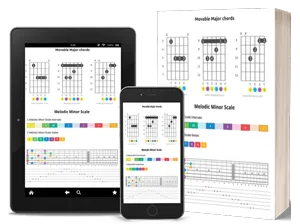
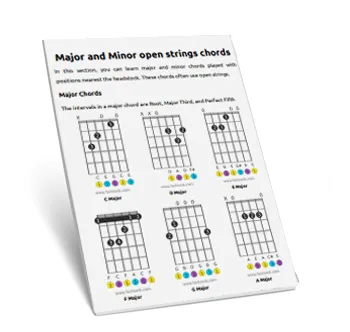
the Free Guitar Chords Chart Pdf

Created by
Giancarlo is a musician (teaching guitar since 2000), software engineer, AI consultant and published researcher
FAQ
What are the notes of G#13(#9)?
G#13(#9) is spelled G#, B#, D#, F#, A##, C# and E#. It stacks a major third, perfect fifth, minor seventh, sharp ninth, eleventh and thirteenth on G#.
Can G#13(#9) also be called Ab13(#9)?
Yes, they are enharmonic. Ab13(#9) is spelled Ab, C, Eb, Gb, B, Db and F, which reads more simply than the A## in G#13(#9).
What is the difference between G#13(#9) and G#13?
G#13 has the natural ninth, A#. In G#13(#9) that note is raised to A##, which adds bite and gives the chord a bluesy tension.
Which scale matches G#13(#9)?
The G# half-whole scale has every chord tone except the eleventh, C#. It includes the sharp ninth, A##, and the thirteenth, E#.