Practice the E9b5 Chord for Guitar with Our Interactive Fretboard
Want a structured chord roadmap instead of jumping between pages?
Go to the full guitar chords tutorial.
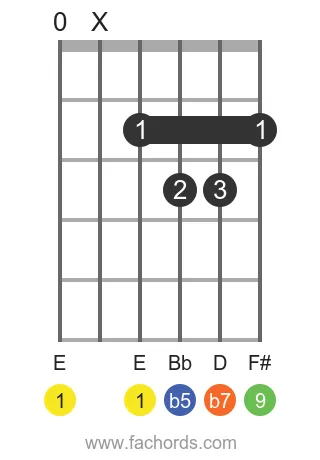
Ready to tackle the complex E9b5 chord on your guitar? This advanced chord, belonging to the Dominant Chords family, is made up of the notes E, G#, Bb, D, and F#. Its intervals are 1, 3, b5, b7, and 9. Jump straight into our interactive fretboard tool to visualize and play this chord, getting immediate feedback from your microphone to check your accuracy in real-time. Hear its distinct sound with chord playback before diving into the theory.
The E9b5 chord is an intriguing member of the Dominant Chords family, showcasing extended harmony and unique color tones. Its distinct sound comes from the inclusion of the diminished fifth interval. For a deeper dive into such intricate structures, our guide on Diminished Guitar Chords can be very insightful. Understanding how chords are built by stacking intervals is fundamental to mastering this chord; explore this further in our Chord Construction tutorial. As a Ninth Chord, the E9b5 adds a rich, complex texture often found in jazz and blues, extending beyond basic triad harmonies.
Once you've tested your playing with our interactive tool, scroll down to explore various E9b5 chord diagrams, arranged from the easiest to the most challenging shapes. Delve into the underlying theory to fully grasp its musical context and discover how this chord is used in actual songs and different keys. Our goal is to equip you with the knowledge and practice to truly own this chord.
E 9th with flat 5th guitar chord is also written as E9b5, E9(b5) or E9-5.
Notes that compose the E 9b5 chord:
Chord structure of the Dominant Ninth Flat five chord:
E 9b5 Guitar Chord Diagrams
Position 1
Barre
Open
Position 2
Barre
Open
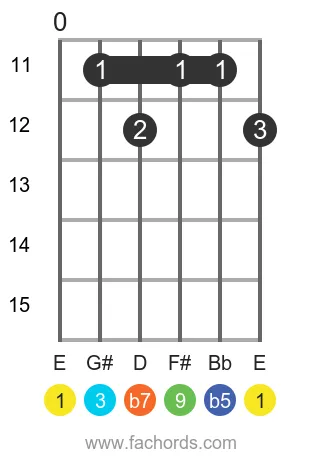
Position 3
Barre
Movable
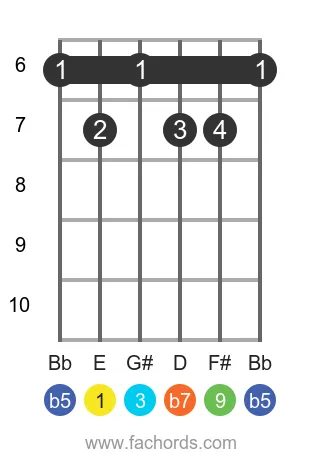
 Find more shapes in our all guitar chords online library. If you
prefer a printable pdf, download
the Free Guitar Chords Chart Pdf
Find more shapes in our all guitar chords online library. If you
prefer a printable pdf, download
the Free Guitar Chords Chart Pdf
You can also use this accessible E9b5 chord page, with written diagram instructions and screen-reader support for blind users.

Created by
Giancarlo is a musician (teaching guitar since 2000), software engineer, AI consultant and published researcher
FAQ
What is the E9b5 chord and how is it constructed?
The E9b5 chord is a unique dominant chord built from the notes E, G#, Bb, D, and F#. Its construction involves stacking specific intervals: the Root (1), Major Third (3), Diminished Fifth (b5), Minor Seventh (b7), and Major Ninth (9).
Why is the E9b5 chord classified as a dominant chord?
The E9b5 chord is part of the dominant chord family because its core structure contains a root, a major third, and a minor seventh (E, G#, D). These three intervals define a dominant seventh chord, with the added 'b5' and '9' intervals acting as extensions that modify its sound within this family.
What gives the E9b5 chord its distinctive sound?
The 'b5' interval, which stands for Diminished Fifth, is the primary element that gives the E9b5 chord its unique and often tense sound. This specific interval creates a harmonic tension and color that sets it apart from other dominant ninth chords.
What specific notes make up an E9b5 chord?
The E9b5 chord is composed of the following notes: E (the Root), G# (the Major Third), Bb (the Diminished Fifth), D (the Minor Seventh), and F# (the Major Ninth).
In which musical genres is the E9b5 chord typically used?
The E9b5 chord is not a basic chord and is typically found in more advanced musical contexts. It is particularly prominent in genres such as jazz and blues, where its unique harmonic tension and color are frequently employed for expressive purposes.